
What drives the cost of hospital communication systems?
Understanding hospital communication cost is essential when evaluating investments in nurse call systems, clinical messaging, and other connected infrastructure. The purchase price is only one part of the decision: installation, integration with existing systems, software licensing, staff training, maintenance, and future expansion can all affect the total budget. The challenge for an approver is to distinguish necessary investment from features, interfaces, and service commitments that add cost without addressing a defined clinical need.
There is no dependable price per bed that fits every hospital. A straightforward replacement in a ward with usable cabling is a different project from a facility-wide deployment that connects patient calls, staff smartphones, monitoring systems, and an electronic health record. Before comparing prices, agree on what each proposal actually includes.
Start with the workflow, not the equipment list
Hospital communication systems cover several related but distinct functions. A nurse call system lets a patient request assistance and routes that request to staff. Clinical messaging supports communication between care teams. Other components may include wireless handsets, corridor displays, staff location tools, alarm notification software, or integration with bedside devices.
These functions are often sold together, but they do not have to be purchased at the same time. A medical-surgical ward may need dependable bedside calls, bathroom emergency pulls, and escalation when a call is unanswered. An intensive care unit may also want information from patient monitors sent to designated staff. That second requirement introduces a different level of integration, testing, and operational risk.
Ask clinical leaders to describe a few routine and exceptional journeys: who receives a call, what happens when that person is unavailable, and how the request is closed. If a proposed feature cannot be tied to an agreed workflow, it is a candidate for a later phase rather than an automatic part of the initial budget.
Physical infrastructure can change the economics
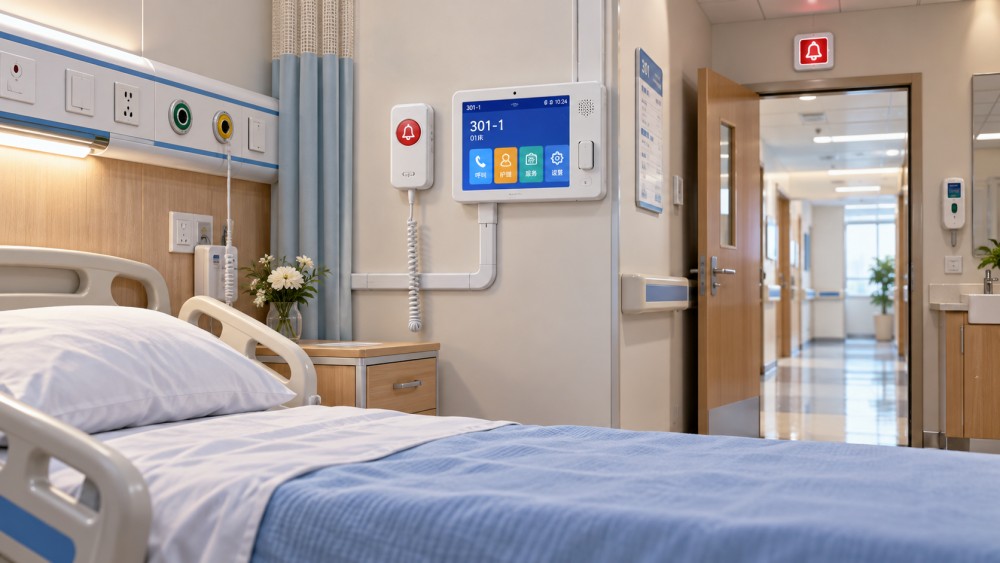
The visible devices are only part of the installation. A proposal may require bedside terminals, call buttons, room controllers, corridor lights, servers, network switches, cabling, power supplies, and wireless coverage improvements. The mix depends on the architecture and the condition of the existing building.
Retaining existing cabling can be attractive, but compatibility should be established through a site survey and documented testing, not assumed from the age of the system or the appearance of a connector. In older facilities, concealed cable routes, limited ceiling access, or insufficient network capacity can turn a seemingly simple replacement into a construction project.
Work in occupied clinical areas carries its own cost. Installation may need to be staged around patient moves, restricted working hours, infection prevention precautions, and temporary arrangements for receiving calls. Ask whether the quotation includes these activities, who provides temporary coverage, and what happens if access to a ward is delayed.
A new-build project has different trade-offs. Cabling can be coordinated with other infrastructure work, but design changes made after construction is underway can be expensive. Finance should check whether communication requirements have been incorporated into room layouts, power planning, network design, and the construction schedule.
Integration is a project, not a checkbox
A vendor may say its platform can integrate with an electronic health record, patient monitoring system, telephone system, or staff scheduling application. That statement is a starting point, not a complete scope of work. An interface may still require licenses from both suppliers, technical configuration, mapping of data, validation, and ongoing support after either system is upgraded.
For example, routing an alert from a patient monitor to a mobile device involves more than making a connection. The hospital must decide which alerts are sent, which staff receive them, how escalation works, and what staff should do if a message is delayed or a device is unavailable. These decisions need clinical review as well as engineering and IT input.
Ask vendors to price each interface separately and identify the other parties involved. The contract should also make clear who investigates a failure that crosses system boundaries. Without that allocation, the hospital can end up paying for additional troubleshooting while suppliers debate responsibility.
Importantly, a notification on a phone should not be assumed to replace the original alarm or an established response process. Whether a proposed configuration is suitable depends on the equipment, intended use, local requirements, and the hospital’s risk assessment.
Separate the capital request from recurring commitments
A low initial quotation can mask a substantial operating commitment. Cloud-hosted messaging, user accounts, mobile device management, interface subscriptions, cybersecurity services, and software support may all be billed separately. Even an on-premises system can carry recurring costs for server maintenance, software updates, database support, and replacement hardware.
Build a cost model over the hospital’s chosen planning horizon rather than relying on the first-year invoice. Include one-time implementation and acceptance costs, annual fees, expected hardware replacement, training for new staff, and the cost of adding wards or users. Where estimates are uncertain, show them as assumptions and test a higher-cost scenario.
Licensing terms deserve particular attention. A charge may be based on named users, concurrent users, beds, devices, sites, or interfaces. Shift patterns and shared devices can make one model much more expensive than another. Check whether inactive accounts can be removed, whether license counts can be reduced, and how renewal prices may change under the contract.
Also clarify the accounting treatment with the hospital’s finance team. Equipment, implementation, subscriptions, and support may be treated differently depending on applicable accounting rules and the organization’s policies. The procurement comparison should show cash commitments even when their accounting treatment differs.
Reliability and support are budget decisions
Communication failures can affect care workflows, so the cheapest support package is not necessarily the least expensive choice. The useful question is not simply whether support is available around the clock, but what that promise covers.
A response time may mean that a technician acknowledges a ticket, not that the system is restored or a replacement part is on site. Review incident severity definitions, remote and on-site coverage, spare-parts availability, travel charges, and escalation routes. Check whether the service provider has the access and authority to investigate connected third-party systems.
Resilience also has a price. Depending on the design, backup power, redundant servers, network resilience, or alternative communication procedures may be appropriate. These measures should follow a documented assessment of the clinical consequences of failure, rather than being added uniformly to every part of the system.
Cybersecurity belongs in the same discussion. Budget for access controls, updates, vulnerability management, and the internal effort needed to review vendor advisories. Confirm who applies patches, whether updates require downtime or retesting, and how long the supplier intends to support the proposed hardware and software. A system that becomes difficult to patch can create costs well before its physical equipment wears out.
Implementation and training are easy to underestimate
A functioning installation is not the same as a completed project. Staff assignments, escalation rules, device configuration, user permissions, and reporting settings all have to reflect actual practice. Clinical engineering, nursing, IT, facilities, and procurement may each have work to do before the system is ready for acceptance.
Training costs extend beyond an initial demonstration. Shift workers need access to instruction, supervisors need to understand configuration and reporting, and new employees will need onboarding after the supplier leaves. Ask whether training materials can be reused, who can administer the system, and what additional sessions cost.
Acceptance criteria should be agreed before installation begins. They might cover verified call routing, escalation, interface behavior, failover procedures, and documentation. Payment milestones tied to clear deliverables give both parties a practical way to identify unfinished work without treating a system power-up as proof that every workflow is ready.
How to compare supplier proposals fairly
Request a common scope and a separate list of assumptions from each bidder. One supplier may include cabling, project management, and staff training in its base price; another may list them as optional. Neither quotation can be judged properly until those differences are reconciled.
A useful review should resolve these questions before approval:
- Which rooms, devices, users, interfaces, and workflows are included, and what is explicitly excluded?
- What site conditions must be confirmed, and how will unforeseen installation work be priced and authorized?
- Which fees recur, what drives their growth, and what renewal terms apply?
- Who owns integration testing, cybersecurity updates, incident resolution, and acceptance documentation?
- What are the costs and technical conditions for adding a ward, replacing devices, or moving to another supplier?
Exit costs are particularly easy to miss. Ask what data and configuration information can be exported, in what format, and whether assistance with migration is chargeable. Also check whether proprietary components limit future purchasing choices. An apparently inexpensive expansion path is less attractive if every additional endpoint must be bought under terms that have not yet been agreed.
Make the approval conditional on the unresolved risks
The strongest business case does not need to promise a precise return from shorter response times or reduced staff workload unless the hospital has credible baseline data and a method for measuring the change. It can instead set out the problem, the required clinical functions, the full financial commitment, and the risks the investment is intended to address.
For complex projects, a phased approval can be sensible: fund a site survey and detailed design before committing to full deployment, then revisit the budget once cabling, interfaces, and operational dependencies are better understood. A contingency should reflect identified uncertainties, not serve as a substitute for a defined scope.
Resources such as Global MedTech & Healthcare Intelligence Hub can help procurement and clinical engineering teams frame the technical questions. The final decision, however, should rest on the hospital’s own workflows, infrastructure assessment, supplier terms, and service capabilities. Before signing, make sure the approval covers not just what will be installed, but what the organization will need to operate, support, and eventually replace.
Have questions about the global trade trends discussed here, or planning your expansion and supply chain strategy? Leave a message below and let the trade experts at MTHH guide you.
We respect your privacy. Your information is strictly confidential.
Related News
- What Trendelenburg angle should an operating table provide?Nov 05, 2026Compare operating tables Trendelenburg angles, load limits and accessories. Discover what to check before choosing the right table for your procedures.
- How to estimate the total cost of hospital imaging equipmentNov 04, 2026Plan hospital capital equipment imaging investments with confidence. Learn to estimate installation, service and operating costs and compare bids fairly.
- How to prioritize repairs in a clinical engineering management workflowNov 02, 2026Improve your clinical engineering management workflow with practical repair triage, risk-based priorities, and smarter resource allocation. Learn how.
- What drives the cost of hospital communication systems?Nov 01, 2026Explore the key drivers of hospital communication cost, from installation and integration to licensing and support, and compare supplier proposals with confidence.