
How to estimate the total cost of hospital imaging equipment
The purchase price is only one part of a hospital imaging investment. A useful estimate adds the cost of making the room ready, installing and connecting the equipment, operating and maintaining it, and eventually replacing or removing it. It also identifies which costs are already covered by the hospital’s budget and which require new funding.
For hospital capital equipment imaging decisions, compare proposals over the same operating period and under the same assumptions about patient volume, service coverage and upgrades. A lower equipment quote may still be the better choice, but only after the costs outside that quote are visible.
Start with a complete cost model
Choose an evaluation period that reflects the hospital’s expected use of the system and the available service support. For a replacement project, distinguish the spending needed to open the room from costs that recur throughout operation.
Total cost of ownership = acquisition and implementation costs + operating and support costs over the evaluation period + end-of-use costs − any credible residual value.
The formula is straightforward; defining its inputs takes more work. A practical model should include the following cost groups:
- Equipment and acquisition: the imaging system, required accessories, freight, insurance, applicable taxes and duties, and financing costs where relevant.
- Site preparation and implementation: design, construction, utilities, shielding where required, installation, testing, IT integration and initial training.
- Recurring operation: service contracts, parts not included in the contract, consumables, software subscriptions, staffing and utilities.
- Future changes: planned upgrades, replacement components, additional training and changes in support after the warranty expires.
- End of use: removal, disposal, site reinstatement and any expected resale or trade-in proceeds supported by a specific offer.
Assign an owner and timing to each item. A hospital facilities team may pay for electrical work while the imaging department pays for training, but both belong in the project estimate. Record each supplier’s inclusions and exclusions so that a cost is not counted twice or omitted because each party assumed the other would cover it.
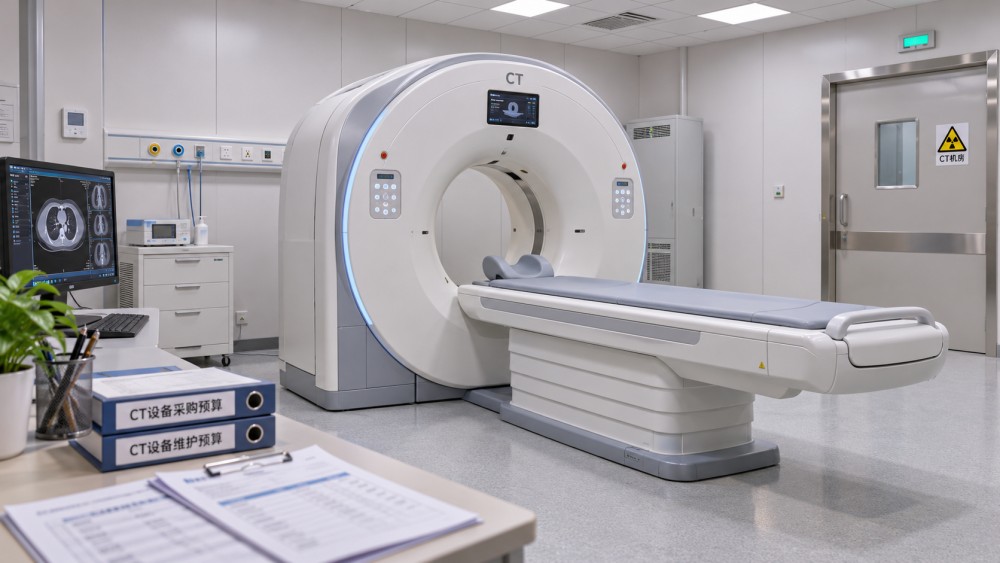
Separate the equipment quote from the cost of opening the room
A scanner cannot generate clinical value until it is installed, tested, connected and ready for use. The work between delivery and the first patient can materially change the funding request.
Ask for a detailed equipment configuration rather than a single package price. For CT, MRI or X-ray, this may include workstations, image reconstruction options, patient positioning accessories, contrast injection equipment or other items needed for the intended examinations. For ultrasound, the number and type of probes can affect both the initial purchase and future replacement costs.
Then map the supplier’s installation requirements against the actual room. Depending on modality and site conditions, the project may require electrical upgrades, cooling or ventilation changes, structural assessment, radiation shielding, magnetic shielding or controlled-access arrangements. MRI planning may also involve a quench vent where applicable to the system design. The relevant scope should come from the equipment specifications and a site assessment, with costs assigned to the responsible contractor or hospital department.
Include delivery access, rigging and removal of the existing system. A quote that includes installation does not necessarily include building alterations, disposal of old equipment or delays caused by restricted access. If the project replaces an active unit, estimate the cost of maintaining imaging services during construction, such as temporary capacity, outsourced examinations or rescheduled work. Keep this operational disruption separate from construction spending so its assumptions remain visible.
Model the costs that continue after installation
Service, parts and uptime
Request a service proposal for the full evaluation period, not just the warranty year. Compare coverage for preventive maintenance, corrective repairs, labor, travel, remote support and replacement parts. Check whether major components, such as an X-ray tube or detector, are included, subject to limits, or billed separately.
A comprehensive contract has a higher known fee but can reduce exposure to individual repair bills. A narrower agreement may suit a hospital with qualified in-house support and dependable parts access, although it leaves more cost and coordination risk with the hospital. Neither is automatically cheaper: use the proposed coverage and the hospital’s actual capabilities to build each scenario.
Response time is also different from repair time. A contract may promise that an engineer will respond within a stated period without promising when the system will return to service. Review escalation procedures, parts availability and any remedies for extended outages. Where downtime has a meaningful financial effect, show that exposure as a separate scenario rather than treating an uncertain loss as a guaranteed annual cost.
Software, connectivity and staff
Imaging equipment may need connections to the hospital’s picture archiving and communication system, radiology information system, electronic records or reporting workstations. Include interface development, licenses, cybersecurity work, testing and any charges from existing IT vendors. A system can be technically compatible yet still require paid configuration and ongoing support.
Identify which software functions are perpetual licenses and which require subscriptions or support renewals. Include planned updates, storage requirements and any charges for additional workstations or users. Confirm whether the quoted service period includes software updates and security support, since hardware maintenance alone may not cover them.
Training costs extend beyond the supplier’s initial sessions. Budget for the time clinical users and technical staff spend away from normal duties, additional training for new personnel, and specialist instruction if the hospital intends to perform some maintenance itself. For a new service, assess whether staffing hours, reporting capacity and administrative support must increase; for a replacement, include only the incremental change.
Consumables and utilities
Use expected activity to estimate examination-dependent costs. These may include contrast media, disposables, protective supplies and cleaning materials, depending on the service. Apply the same clinical assumptions to competing proposals, and avoid attributing shared costs to one vendor unless its configuration changes them.
Electricity, cooling and other facility costs can also differ by system and room. Use site-specific utility rates and equipment requirements where they are material. For MRI, ask how the proposed magnet’s cooling and helium requirements affect routine operation and exceptional events; requirements vary by design and service arrangement.
Compare proposals on a like-for-like basis
Before ranking bids, create a common specification covering the intended clinical applications, required throughput, room conditions, integration needs and service expectations. A low quote that excludes an essential workstation or offers limited service is not equivalent to a proposal that includes both.
A comparison sheet can make these differences visible:
Use supplier quotations, facility estimates and internal labor assumptions as separate inputs. Label an allowance as an allowance, not a contracted price. Include a contingency for unresolved scope, explain what it covers, and reduce it when firmer estimates are available. Applying a single arbitrary contingency to every bid can conceal the fact that one room requires substantially more work than another.
For costs incurred in different years, finance can calculate a present value using the organization’s approved discount rate. Show the undiscounted cash-flow schedule alongside it: present value helps compare long-term commitments, while the schedule shows when funding is needed. Apply the same rate and evaluation period to every option.
Test whether the investment works at different volumes
Divide annual operating costs by expected annual examinations to understand the cost per study. If the goal is a full economic cost per study, also allocate acquisition and implementation costs consistently over the evaluation period. State whether financing, depreciation or discounted capital costs are included, and avoid counting more than one representation of the same capital expense.
This calculation is sensitive to utilization. A higher-capacity system may have a reasonable cost per study when demand is sufficient, but the same fixed service and facility costs must be spread over fewer examinations if referrals fall short. Model a base case and lower- and higher-volume cases. Adjust variable costs with volume; do not assume that all staffing, service or facility expenses fall proportionally.
For a replacement project, compare the proposed system with a realistic alternative, such as continuing to operate the existing unit for a defined period. That alternative should include its expected maintenance, parts availability, potential downtime and any limitations on clinical use. Comparing a new purchase against a zero-cost baseline can overstate the incremental burden of the investment.
Revenue estimates need the same discipline. Use expected collections rather than list charges, account for the payer mix and capacity to report examinations, and distinguish new activity from studies transferred from another hospital unit. Present clinical access, quality or resilience benefits separately when they cannot be credibly converted into cash.
What should be included in the approval request?
A decision-ready request should show the recommended configuration, total funding needed to make it operational, annual commitments and the assumptions that could change the result. It should also identify the departments responsible for the room, IT interfaces, training and ongoing service.
Before approval, ask the project team for an exclusions list and a cash-flow schedule. Pay particular attention to contract renewal terms, major parts, integration work, construction allowances and the plan for maintaining service during installation. These items often determine whether an apparently affordable purchase remains affordable once it becomes an operating department asset.
The strongest proposal is not necessarily the one with the lowest initial price or the most features. It is the option that meets the clinical requirement, fits the facility and makes its long-term financial commitments clear enough to fund and manage.
Have questions about the global trade trends discussed here, or planning your expansion and supply chain strategy? Leave a message below and let the trade experts at MTHH guide you.
We respect your privacy. Your information is strictly confidential.
Related News
- What Trendelenburg angle should an operating table provide?Nov 05, 2026Compare operating tables Trendelenburg angles, load limits and accessories. Discover what to check before choosing the right table for your procedures.
- How to estimate the total cost of hospital imaging equipmentNov 04, 2026Plan hospital capital equipment imaging investments with confidence. Learn to estimate installation, service and operating costs and compare bids fairly.
- How to prioritize repairs in a clinical engineering management workflowNov 02, 2026Improve your clinical engineering management workflow with practical repair triage, risk-based priorities, and smarter resource allocation. Learn how.
- What drives the cost of hospital communication systems?Nov 01, 2026Explore the key drivers of hospital communication cost, from installation and integration to licensing and support, and compare supplier proposals with confidence.