
What Trendelenburg angle should an operating table provide?
What Trendelenburg Angle Should an Operating Table Provide?
When evaluating operating tables, Trendelenburg angle is a key specification because it affects surgical access, patient positioning and equipment suitability. Many general-purpose tables offer approximately 25° to 30° of head-down tilt, although the appropriate range depends on the procedures performed and the table’s rated load and configuration. For technical evaluators, comparing operating tables trendelenburg capabilities also means checking reverse Trendelenburg range, movement controls, positioning accessories and manufacturer documentation—not just the maximum angle listed in a brochure.
For a general-purpose operating room, a table offering around 25° to 30° is a reasonable starting point for evaluation, not a universal purchasing threshold. Where pelvic surgery or robot-assisted procedures are a significant part of the workload, the clinical team may need a greater range or more specific positioning capabilities. The decisive question is whether the stated angle remains available and safe with the intended patient load, tabletop arrangement and accessories.
Start with the procedure mix, not the largest number
Trendelenburg positioning tilts the patient head-down relative to the feet. It can help provide access during some lower abdominal and pelvic procedures. Reverse Trendelenburg tilts the patient head-up and may be useful for procedures requiring a different relationship between the patient, surgical field and equipment.
Those descriptions do not prescribe a clinical angle. Positioning is chosen by the surgical and anesthesia teams for the individual patient and procedure. From a purchasing perspective, however, the difference between occasional use and routine steep positioning matters. A mixed-use theater may value a practical tilt range alongside imaging access, height adjustment and quick changeovers. A room dedicated to complex pelvic procedures may place more weight on controlled positioning, compatible supports and clearance around a surgical robot.
Before writing a minimum specification, ask clinicians which procedures are expected, which positions they use and whether their requirements are likely to change during the table’s service life. An unusually steep advertised angle has little value if the hospital cannot use it with its required leg supports, patient weight range or imaging setup.
What does the advertised angle actually describe?
Angle figures are easy to compare and surprisingly easy to misunderstand. One supplier may describe tilt with the tabletop level and centered; another may present a maximum for a particular configuration. A removable or modular tabletop can add further conditions. Ask for the measurement reference, the tabletop position and any restrictions that apply when sections are articulated.
Also distinguish whole-table longitudinal tilt from adjustment of the back, seat or leg sections. Raising a back section does not provide the same patient position as tilting the complete tabletop. If a proposal combines movement ranges in one illustration, request separate values for Trendelenburg, reverse Trendelenburg and relevant section articulation.
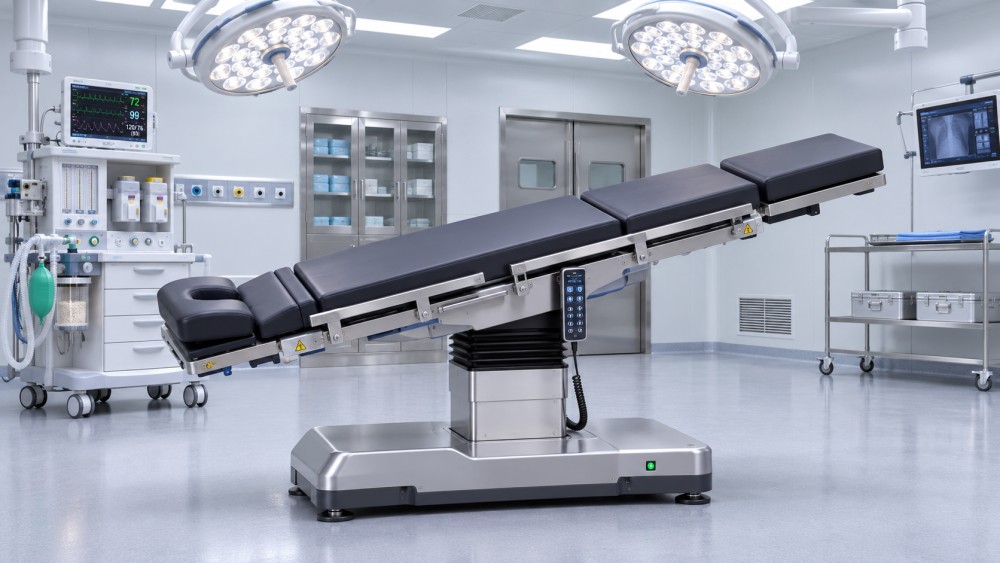
The same caution applies to reverse orientation. If the patient can be positioned with the head at the opposite end of the table, verify whether the controls, displayed direction and permitted angles change. A clear explanation during training matters more than an attractive diagram when staff are working across several table models.
Load capacity and tilt must be evaluated together
A common comparison error is to take the highest advertised patient weight and the maximum tilt angle as capabilities that necessarily apply at the same time. They may not. Tables can have different limits for lifting, positioning, longitudinal slide or specific tabletop configurations. The rated load may also be defined to include accessories as well as the patient.
Request the manufacturer’s load and positioning information for the complete proposed setup. That includes the tabletop, mattress, leg supports, head section and other accessories. Where load distribution or patient orientation affects the limit, the supplier should identify the applicable conditions rather than rely on a single headline capacity.
For a hospital treating heavier patients, this is not a minor detail. A table that reaches the desired angle under a favorable test configuration may have a reduced operating envelope when the tabletop is shifted or heavily loaded. If the documentation does not make that relationship clear, treat it as an unresolved technical question, not as an assumed pass.
Ask suppliers to document these conditions
- The maximum Trendelenburg and reverse Trendelenburg angles, and how each is measured.
- The permitted load during movement and while positioned, including whether accessories count toward that load.
- Any reduction in angle or load with longitudinal slide, reverse orientation or specific tabletop sections.
- The approved supports and attachment points for the intended patient position.
- Operating restrictions, warnings and recovery procedures relevant to a power or control failure.
These answers should come from the applicable instructions for use, technical documentation or written supplier clarification for the exact model and configuration being offered.
A usable angle depends on the rest of the room
A tilt range that looks adequate on paper can become difficult to use once the table is surrounded by anesthesia equipment, a C-arm, a robot or ceiling-mounted devices. At a steep head-down angle, staff still need access to the patient’s airway, lines and monitoring connections. The tabletop, supports and attached equipment must also clear the floor, table base and surrounding devices throughout the movement.
For imaging-intensive work, check how longitudinal slide and radiolucent sections interact with tilt and load limits. A table may provide useful C-arm access in one position but less working room in another. Similarly, a robot-compatible workflow is not established simply because a table reaches a steep angle: docking clearance, support placement and the manufacturer’s instructions for repositioning must be reviewed together.
This is where a demonstration earns its place in the evaluation. Use the intended accessories and walk through representative configurations with surgical, anesthesia and clinical engineering staff. Confirm clearance and access without a patient, following the supplier’s instructions and the hospital’s evaluation procedures. A demonstration is not a substitute for documented load limits, but it can reveal awkward control placement or collisions that a specification sheet will not.
Patient support is part of the specification
Increasing head-down tilt changes how the patient is supported and secured. It can also affect ventilation, circulation, pressure exposure and access for the anesthesia team. The acceptable position and duration depend on clinical judgment, the procedure and the patient; the table’s mechanical maximum is not a recommendation to use that angle.
Evaluate the proposed positioning system as a complete assembly. Check compatibility between the mattress, support surfaces, straps, lateral supports and accessory rails, as well as the supplier’s instructions on permitted combinations. Pay attention to how staff can inspect pressure areas and maintain access to lines after positioning. Accessories sourced separately should not be assumed compatible merely because they fit a rail.
Ask who supplies replacement pads and whether consumable or reusable positioning components have defined cleaning and inspection requirements. A low initial table price can become less attractive if essential supports are optional, difficult to replace or unavailable through the local service channel.
Controls, service and documentation affect long-term value
During evaluation, operate the proposed hand control and any backup controls. Look for clear direction labels, predictable movement and a practical way to stop motion. Confirm how the table behaves when a control is released and how staff are expected to return it toward a safe position if normal power or the primary controller fails. Specific capabilities vary by model, so they should be demonstrated and documented rather than assumed.
Clinical engineering should also review preventive maintenance requirements, battery arrangements where applicable, fault reporting, spare-parts access and service response. Ask whether technical training and service documentation are available locally, and establish which work can be performed by the hospital versus an authorized service provider. These details affect downtime and ownership cost throughout the table’s life.
For compliance review, obtain the documentation required for the destination market and confirm that it covers the exact model and accessories being purchased. Applicable regulatory requirements and recognized standards depend on the jurisdiction and product configuration; a generic statement in a brochure is not enough to complete that review.
Make the final comparison on the intended configuration
A useful procurement comparison records more than each table’s maximum angle. Put the intended clinical configuration beside it: patient load, orientation, tabletop position, required supports, imaging needs and any movement restrictions. Separate mandatory requirements from desirable features, then ask suppliers to identify exceptions in writing.
If two tables both offer approximately 25° to 30° of Trendelenburg, the better choice may be the one with clearer load documentation, more suitable accessories and dependable local support—not the one with the larger figure on the cover. Where a greater angle is genuinely required, verify that it can be reached and controlled within the complete working setup before accepting it as a compliant offer.
Have questions about the global trade trends discussed here, or planning your expansion and supply chain strategy? Leave a message below and let the trade experts at MTHH guide you.
We respect your privacy. Your information is strictly confidential.
Related News
- What Trendelenburg angle should an operating table provide?Nov 05, 2026Compare operating tables Trendelenburg angles, load limits and accessories. Discover what to check before choosing the right table for your procedures.
- How to estimate the total cost of hospital imaging equipmentNov 04, 2026Plan hospital capital equipment imaging investments with confidence. Learn to estimate installation, service and operating costs and compare bids fairly.
- How to prioritize repairs in a clinical engineering management workflowNov 02, 2026Improve your clinical engineering management workflow with practical repair triage, risk-based priorities, and smarter resource allocation. Learn how.
- What drives the cost of hospital communication systems?Nov 01, 2026Explore the key drivers of hospital communication cost, from installation and integration to licensing and support, and compare supplier proposals with confidence.