
How to verify a surgical gown manufacturer’s barrier level claims
A surgical gown’s barrier level is a performance claim that needs a traceable evidence trail. Before approving a surgical gowns manufacturer, connect the claimed standard to the exact gown model, its protective zones, and the test results supporting those zones. A certificate for an unnamed fabric or a report for a different gown does not establish that the product being offered meets your requirements.
The most useful review follows a simple sequence: define the claim, identify what was tested, examine how it performed, and establish whether the supplied gown matches the tested construction. This also helps separate liquid resistance, viral penetration resistance, and sterility—properties that require different evidence.
Start by making the barrier claim specific
“High protection,” “medical grade,” and “impervious” are not substitutes for a named performance classification. Ask the supplier to identify the standard, its edition, the claimed level, and the product codes covered. For an ANSI/AAMI PB70 claim, the documentation should explicitly connect the classification to the gown you intend to purchase.
PB70 classifies liquid barrier performance in protective apparel and drapes used in healthcare facilities. It does not, by itself, establish every aspect of a surgical gown’s suitability. Sterility, material strength, fit, packaging integrity, and other product requirements remain separate parts of the assessment.
Confirm the intended product category as well. Surgical gowns and isolation gowns have different protective-zone requirements. A report supporting an isolation gown cannot automatically support a surgical gown, even when both use similar fabric and display the same barrier level.
The purchase specification should therefore describe more than “Level 3 gown.” It should identify the product category, applicable standard and edition, required barrier classification, sterile or nonsterile presentation, and intended use conditions. This gives both parties a defined basis for acceptance.
Understand what each PB70 level actually demonstrates
The distinction between water-based testing and viral penetration testing is central to verification. Higher resistance in a water test does not establish performance in a viral penetration test.
Use the acceptance criteria in the applicable PB70 edition when reviewing results. A report saying only “hydrostatic test passed” leaves an important gap: it does not identify the classification requirement against which the result was assessed.
ASTM F1670/F1670M, which evaluates penetration by synthetic blood, is also easy to misinterpret. It provides useful barrier information, but a synthetic blood penetration result alone does not establish a PB70 Level 4 surgical gown claim. That claim requires the relevant viral penetration evidence.
Likewise, Level 4 does not mean protection against every pathogen, exposure duration, pressure, or route of contamination. Laboratory testing addresses defined conditions. Clinical suitability still depends on anticipated exposure, garment coverage, fit, and how the gown is used.
Check where the claimed protection applies
A gown can contain several materials with different barrier properties. Reinforced front panels, sleeves, breathable back panels, and joining seams may perform differently. A strong result for one fabric cannot establish the performance of every protective area.
For surgical gowns, PB70 identifies critical zones in the front and sleeves. Those zones, including relevant seams, must support the claimed classification. The back is outside the surgical gown’s critical zones, so a classification should not be interpreted as identical protection across the entire garment.
Request a construction drawing showing the critical-zone boundaries, material changes, reinforcement panels, and seam locations. Match that drawing against the test sample descriptions. If the report identifies specimens only as “blue nonwoven fabric,” there is no reliable way to determine whether they represent the front, sleeve, reinforcement, or another component.
Seams deserve particular attention because joining can create a weaker barrier than the surrounding material. Needle holes, incomplete seals, and inconsistent bonding can affect performance. Evidence should cover applicable seam constructions within the critical zones, rather than relying solely on uninterrupted fabric specimens.
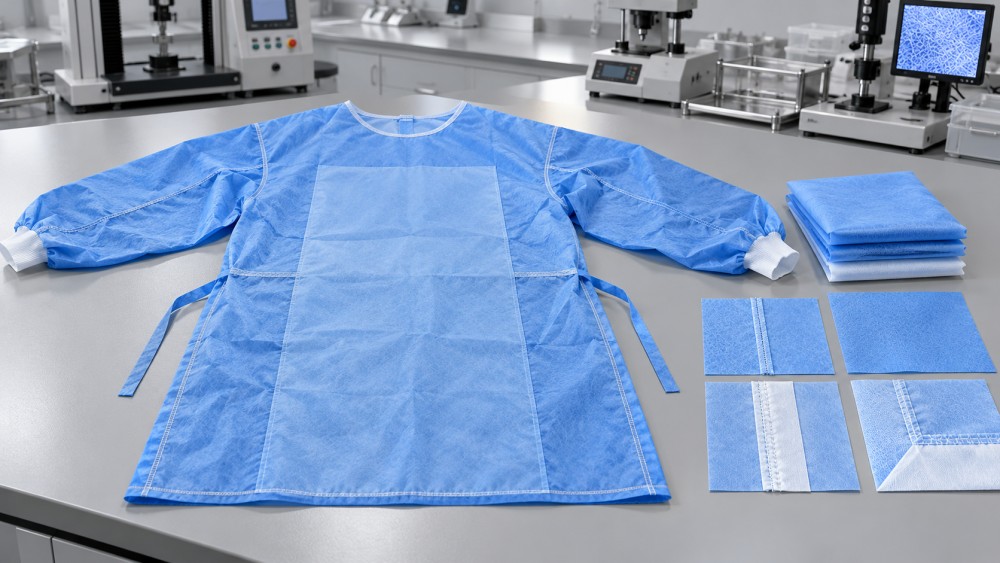
A useful visual record pairs the gown’s critical-zone diagram with a specimen-location map. Each tested material and seam can then be traced to its position on the finished garment. This is especially helpful when different sizes or models use different panel arrangements.
Read the test report beyond its “pass” statement
A credible report should allow a reviewer to reconstruct what was tested and why the result supports the claim. A certificate summary can help organize records, but it should not replace the underlying evidence.
Review these elements together:
- Product identity: Manufacturer, model or catalogue number, material description, and sample identifiers that connect to controlled product records.
- Test method: The named method and edition, with any deviations or modified procedures clearly identified.
- Specimen coverage: The materials, layers, locations, and seam constructions represented by the samples.
- Preparation: Conditioning, sterilization status, and any laundering or other processing relevant to the intended product.
- Results and assessment: Reported measurements or observations, specimen quantities, acceptance criteria, and the basis for the conclusion.
- Report control: Laboratory identity, report number, issue date, authorization, and any amendments.
Do not assess only a reported average. Review specimen-level results where provided and how the classification rules handle variation and failures. An attractive average can obscure an individual result that matters to acceptance.
A fabric report is not automatically unsuitable evidence. Material specimens are part of barrier testing, and laboratory samples do not always arrive as complete gowns. The issue is whether the specimens represent the finished product’s relevant construction and condition. A raw-material report with no connection to gown design, seams, or processing leaves that connection unproven.
If one report supports several models, ask for the documented grouping rationale. Shared fabric may support part of that rationale, but differences in reinforcement, seam design, or processing can change the conclusion. Family coverage needs a technical explanation tied to the characteristics affecting barrier performance.
Check laboratory competence and document authenticity
ISO/IEC 17025 accreditation is useful evidence of laboratory competence when the relevant testing falls within the laboratory’s accredited scope. The accreditation logo alone is insufficient: a laboratory may be accredited for some activities while offering other tests outside that scope.
Match the laboratory’s legal name and testing location to the report, then review the scope for the relevant methods. Where subcontracted testing appears, identify which laboratory performed it and how the results are incorporated.
For unfamiliar suppliers or inconsistent documents, validate the report through the laboratory’s published verification channel. Obtain the complete report, including annexes and amendments. Cropped pages can remove sample descriptions, limitations, or qualifications that materially change the meaning of a pass statement.
Keep different forms of evidence in their proper roles. ISO 13485 certification concerns a quality management system; it does not establish a particular gown’s barrier level. Market authorization and regulatory documentation address other requirements. Neither replaces model-specific performance evidence.
Connect the tested construction to the gown being supplied
Even an authentic, technically sound report can be irrelevant if production has changed. Compare the tested sample with the current controlled specification, including fabric or laminate construction, reinforcement, seam method, manufacturing site, and relevant processing.
For sterile gowns, establish how the evidence represents the sterilized product. Sterilization can affect materials and bonds, so testing unprocessed material without an appropriate supporting rationale may leave a gap. Shelf-life support should also address whether relevant performance is maintained over the claimed storage period.
Reusable surgical gowns require evidence tied to their processing instructions and claimed service life. A new gown’s result does not establish its performance after repeated laundering, sterilization, inspection, and repair. The supporting program should address the conditions and processing cycles under which the barrier claim remains valid.
Report age alone is a poor acceptance rule. An older report may remain relevant when the construction, processing, and applicable requirements remain unchanged. A recent report may be unsuitable if it covers a different material or seam. Evaluate continued applicability through change records and product traceability.
Ask how the manufacturer evaluates changes to fabric suppliers, coatings, laminate layers, sealing settings, and sterilization processes. The answer should describe when technical review or repeat testing is triggered. A promise that the gown “always meets the same level” provides little control over changes that could affect performance.
Use a practical approval decision and receiving plan
Supplier approval should distinguish a complete evidence package from one containing unresolved gaps. If critical-zone coverage, product identity, or test-method suitability is missing, pause approval of the barrier claim until the relevant evidence is supplied. A commercial assurance cannot close a technical gap.
Independent testing is particularly useful when qualifying an unfamiliar manufacturer, investigating conflicting results, or evaluating a significant construction change. Define the sampling and test plan before sending samples. The plan should identify the product, protective locations, seams, processing condition, applicable methods, and acceptance rules.
Initial qualification does not mean every delivered gown requires destructive laboratory testing. Routine receiving controls should instead connect shipments to the approved product and identify visible or documentary changes. Useful checks include:
- Matching model numbers, barrier claims, and lot identifiers against purchasing and approval records.
- Checking packaging condition, labeling, and the supplied sterile presentation where applicable.
- Comparing sampled gowns with approved construction details, including reinforcement placement and seams.
- Reviewing lot documentation, deviations, and notified manufacturing changes.
Visual checks cannot prove a barrier classification, but they can reveal reasons to quarantine a shipment or investigate further. A missing reinforcement panel or changed seam may break the connection between the approved evidence and the delivered product.
The final approval record should identify the exact gown, the claim accepted, the supporting reports, and the conditions requiring reassessment. That record makes future decisions clearer: when a supplier changes a material or sends a substitute model, the team can determine which evidence still applies and what must be demonstrated before use.
Have questions about the global trade trends discussed here, or planning your expansion and supply chain strategy? Leave a message below and let the trade experts at MTHH guide you.
We respect your privacy. Your information is strictly confidential.
Related News
- How does order volume affect disposable medical supplies cost?Nov 07, 2026Discover how order volume affects disposable medical supplies cost and learn to balance bulk discounts, storage, expiry risk, and reliable supply.
- How to choose suction consumables in South Africa that fit your pumpOct 29, 2026Buying suction consumables South Africa suppliers offer? Learn how to verify pump compatibility, compare system costs and choose the right fit before ordering.
- How to assess a bandage manufacturer's batch-to-batch consistencyOct 25, 2026Choosing a bandages manufacturer? Learn how to compare production lots, verify test data, and check traceability to reduce sourcing risks and buy with confidence.
- How to verify a surgical gown manufacturer’s barrier level claimsOct 24, 2026Evaluating a surgical gowns manufacturer? Learn how to verify barrier level claims, review test reports, and confirm critical-zone protection before approving your next supplier.