
How to choose suction consumables in South Africa that fit your pump
Choose suction consumables by matching the complete collection system to your pump’s documented requirements. A tubing connector that fits is only the first check: the canister, liner, lid, filter and overflow protection must also work together at the intended vacuum and flow. A low purchase price offers little value if the assembly leaks, restricts suction or allows fluid to reach the pump.
For procurement teams buying suction consumables in South Africa, a reliable starting point is the pump’s exact model and its instructions for use. Compare proposed consumables against that configuration, then assess replacement availability and running costs. Compatible alternatives can be worth evaluating, provided the supplier supports the claim with model-specific documentation and the assembled system passes an appropriate technical assessment before clinical use.
Start with the equipment you have, including the collection system
A request for “suction tubing and liners” leaves too much room for substitution. The same hospital may operate portable aspirators, theatre suction units and collection systems connected to regulated wall suction. Their consumables can look similar while differing in connection geometry, vacuum resistance, filtration and overflow arrangements.
Record the pump manufacturer, model and relevant configuration. Photograph the equipment label, collection assembly and port markings, and record the part numbers of consumables already approved for use. Where suction comes from a wall outlet, identify the regulator and collection equipment as well; there may be no standalone pump beside the patient.
The reusable components deserve particular attention. A liner may depend on a specific outer canister, lid or support arrangement. Two liners with the same nominal capacity can have different sealing surfaces and port positions. Replacing the liner without identifying its supporting hardware creates a compatibility gap that a catalogue photograph cannot resolve.
Before requesting quotations, assemble a short equipment record containing:
- The pump or regulator model and the relevant manufacturer instructions.
- The reusable canister, holder and lid models, where fitted.
- Existing liner, tubing, filter and connector part numbers.
- The intended clinical application and required collection capacity.
- The approved vacuum settings or operating range for that application.
This record gives suppliers a defined system to match. If the installed equipment cannot be identified, involve clinical engineering before ordering a large quantity. An old consumable found in a storeroom is useful evidence, but it does not establish that the previous configuration was correct.
Check the whole suction pathway, not just the connector
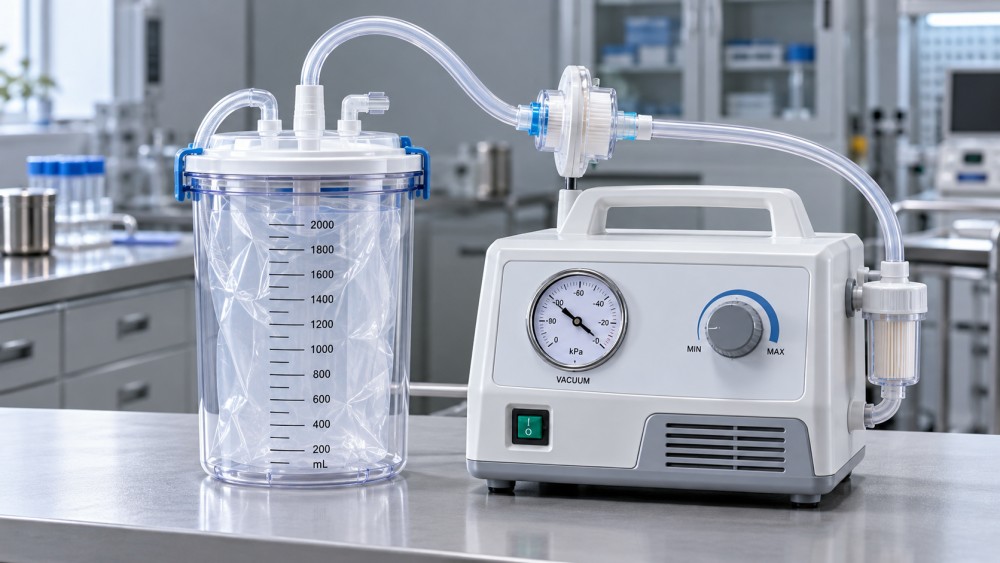
Follow the system from the patient-side tubing through the collection container and protective components to the vacuum source, using the manufacturer’s connection diagram. Each component can affect performance or protection. A successful fit at one port says little about the rest of the assembly.
Tubing needs both a secure connection and suitable performance
Check the specified internal diameter, length, material and resistance to collapse under the intended vacuum. Soft tubing may fit a connector yet flatten during use. Tubing that is unnecessarily long, narrow or easily kinked can increase resistance and reduce available flow, particularly when collecting viscous material.
Connector dimensions and geometry also matter. A connection should remain secure during normal handling without improvised tape, excessive stretching or unsupported adapters. Where an adapter is proposed, ask whether it is approved for the intended assembly and whether it changes the bore or creates an additional leak point.
A supplier’s statement that tubing is “medical grade” does not establish these characteristics. Request the product specification and its intended use. Sterility requirements should follow the clinical application and facility policy; sterile packaging alone does not demonstrate mechanical compatibility.
Canisters, liners and lids need a documented match
Confirm the exact liner-to-canister and lid-to-container combinations. Look at the seal, usable capacity, port identification and installation method. Some systems require a particular vacuum connection or assembly sequence to position the liner correctly. Mixing components can prevent proper sealing even when the lid appears to close.
Ask for the manufacturer’s stated maximum operating vacuum for the relevant collection components and compare it with the intended system configuration. A volume marking describes capacity; it does not establish vacuum resistance. Likewise, a pump’s free-air flow specification cannot show how much suction will remain available through a particular tubing, filter and collection assembly.
Capacity should reflect the procedure and changeover workflow. A larger container may reduce replacement frequency, but it also needs adequate support, space and a safe handling arrangement when filled. Check that the holder accommodates the proposed container and that staff can see the fill level and access the connections.
Overflow protection and filtration perform different jobs
Identify how the proposed system prevents collected liquid from reaching the vacuum source. Depending on the design, this may involve a float shut-off, a protective filter, an integrated liner feature or a combination. Ask which component provides each function and what replacement is required after activation, wetting or contamination.
A filter’s appearance does not establish its purpose. A component described as hydrophobic, bacterial or protective should have documentation supporting the claimed function and intended location. Filters also introduce resistance, so an alternative must suit the system’s flow requirements as well as its connection size.
Do not assume that a liner’s integrated protection makes an external pump filter unnecessary. Follow the equipment instructions for the complete arrangement. Removing a specified protective component to improve suction can expose the vacuum source to contamination or damage.
Match the consumables to the clinical task and changeover process
A technically compatible assembly can still be a poor purchase if it creates difficulties during use. Procurement should establish what is being collected, how the equipment is positioned and how often staff need to replace the collection container.
For intermittent airway suction, manageable tubing and an accessible collection assembly may be priorities. Procedures involving larger fluid volumes place more emphasis on capacity, secure mounting and the approved changeover arrangement. Collection of thicker material also makes tubing bore, kinking and restrictions particularly relevant. Clinical users should define these needs before buyers compare product codes.
Avoid selecting higher vacuum as a general solution to disappointing suction. The clinical setting must remain appropriate to the procedure, while technical staff investigate leaks, obstruction, filter condition and assembly errors. Consumables should support the required operation without prompting staff to compensate for an unsuitable setup.
Replacement procedures affect both safety and consumption. Establish whether the liner is single use, whether the lid is discarded with it, and which components can be reused under their manufacturer’s instructions. A liner price is difficult to compare if one offer includes an integrated lid and filter while another requires separate purchases.
Also examine the filled container’s removal process. Port closures, disconnection steps and disposal arrangements influence handling and spill risk. If a supplier proposes solidifying agents or pretreated liners, assess them against the intended fluids, product instructions and the facility’s waste procedures. They should not be treated as interchangeable additions to every suction system.
Ask South African suppliers for evidence tied to the offered product
The useful question is whether the exact catalogue item being quoted is suitable for your installed configuration. Terms such as “universal,” “standard fit” and “compatible with most pumps” are too broad to support a purchasing decision by themselves.
Request a written compatibility statement identifying the proposed consumable, the relevant equipment models and any conditions on use. Establish whether that statement comes from the equipment manufacturer, the consumable manufacturer or the distributor. A documented manufacturer-supported combination gives a different level of assurance from a supplier’s visual comparison.
The quotation should make the following information easy to establish:
- Product identity: manufacturer, catalogue code, size, pack quantity and included components.
- Technical suitability: intended use, relevant vacuum limits, connection details and installation instructions.
- Traceability: lot identification, shelf life where applicable, storage conditions and complaint or recall contact.
- South African supply documentation: the supplier’s role and the applicable SAHPRA licensing or other regulatory documentation for that role and product.
- Continuity of supply: stock location, replenishment lead time, minimum order quantity and proposed substitution controls.
Regulatory documentation and quality certificates support supplier assessment, but they do not demonstrate compatibility with a particular pump. Check that documents apply to the offered manufacturer and product range rather than accepting an unrelated certificate as sufficient evidence.
Local availability also needs a precise meaning. Stock held in South Africa, stock available from an overseas manufacturer and stock available only against an import order have different implications for replenishment. Ask how the supplier handles shortages and whether an alternative catalogue code requires your approval before dispatch.
For facilities using several suction systems, standardisation can simplify stockholding. It should follow a model-by-model compatibility review. Forcing one liner or tubing set across equipment with different requirements can transfer inventory savings into operational problems.
Approve a sample assembly before committing to routine supply
Documentation should narrow the options; a controlled assessment should establish whether the proposed assembly is acceptable for local use. Ask clinical engineering and relevant clinical users to assess samples against the equipment instructions and the facility’s acceptance procedures, before use on patients.
The assessment should cover correct assembly, secure mounting, seal integrity, tubing behaviour and the system’s specified performance checks. Assess protective functions only through the manufacturer’s prescribed procedure. Deliberately drawing liquid towards the pump to demonstrate an overflow device can contaminate or damage equipment.
Include the people who change liners and reconnect tubing. They can assess whether port markings are clear, connections are accessible and replacement can be completed according to instructions. A technically sound product may still require revised training if its installation differs from the existing system.
Record the approved catalogue codes and configuration, including required filters, lids and adapters. Attach those details to the purchasing specification. Otherwise, a later order may arrive with a similar-looking substitute that has never been assessed.
Compare costs only after the acceptable configurations are established. Use cost per usable collection setup or per defined procedure, accounting for the liner, lid, tubing, filters and other components consumed under the approved replacement policy. Add freight, minimum-order effects and expiry-related waste where relevant. Avoid assigning unsupported savings to fewer changeovers or lower failure rates.
The final purchase order should identify the accepted products, supporting documentation and substitution conditions. If a supplier cannot establish compatibility with your existing collection hardware, treat the offer as a proposed system change. That may still be a reasonable purchase, but its assessment must include the new hardware, training and ongoing consumable commitment before an attractive liner price becomes a long-term dependency.
Have questions about the global trade trends discussed here, or planning your expansion and supply chain strategy? Leave a message below and let the trade experts at MTHH guide you.
We respect your privacy. Your information is strictly confidential.
Related News
- How to verify CE marking on rehabilitation consumables in GermanyNov 13, 2026Buying rehabilitation consumables in Germany? Learn how to verify CE marking, check MDR documents and spot supplier red flags before ordering.
- How to assess a medical consumables management supplier's ability to prevent stockoutsNov 11, 2026Evaluate a medical consumables management supplier with practical checks for forecasting, inventory visibility and contingency plans to reduce stockout risk.
- FDA Alert: Arrow Removes Guidewire Products Over Coating Shedding RiskNov 11, 2026FDA alert: Arrow guidewire products face voluntary removal over potential coating shedding. Explore the risks and key checks for buyers and healthcare providers.
- How does order volume affect disposable medical supplies cost?Nov 07, 2026Discover how order volume affects disposable medical supplies cost and learn to balance bulk discounts, storage, expiry risk, and reliable supply.