
How to assess a bandage manufacturer's batch-to-batch consistency
A bandage manufacturer demonstrates batch-to-batch consistency through comparable results from separate production lots, supported by traceable records and stable production controls. A successful sample establishes a starting point; approval requires evidence that routine deliveries repeatedly meet the same agreed specifications.
The assessment must connect measured variation to clinical function. An adhesive bandage that becomes harder to remove, a compression bandage that delivers uneven tension, and a gauze bandage that sheds more fibers present different problems. Begin with the exact product and intended use, then examine whether its important characteristics remain predictable across production runs.
Define what must remain consistent
A specification described only as “medical grade” or “standard quality” provides little basis for comparison. Establish a controlled product specification that identifies construction, dimensions, materials, packaging, performance requirements, and the methods used to assess them. Each requirement needs an acceptance limit or a clearly defined visual criterion.
Keep product families separate. Results for one adhesive formulation, fabric construction, or manufacturing site do not automatically support another. Even products with the same trade description can differ in backing material, absorbent pad structure, elastic yarn content, or sterilization status.
Acceptance limits should reflect intended performance. Adopting the widest range a factory already achieves makes approval easier but says little about suitability. Conversely, an unnecessarily tight tolerance creates rejection costs without improving function. The basis for each important limit should be documented before samples are tested.
Make sure the samples represent separate production
Several cartons carrying different shipment references may originate from one manufacturing lot. Ask how the lot is defined and where its boundaries fall: a material batch, a coating run, a conversion run, or another controlled production interval. Where packaging and sterilization use separate batch identifiers, the records must connect them to the finished product lot.
Initial comparison should include multiple independently produced lots of the same specification. Select lots spanning different production dates and, where relevant, different raw material batches or production lines. The number of lots and samples should reflect product risk, production volume, and available history; a small initial study cannot establish long-term capability.
Samples drawn from normal finished inventory provide stronger evidence of routine output than specially prepared approval samples. Record who selected them, how they were selected, and whether they represent different positions within a run. Samples from the beginning, middle, and end of production help expose drift that a single carton could conceal.
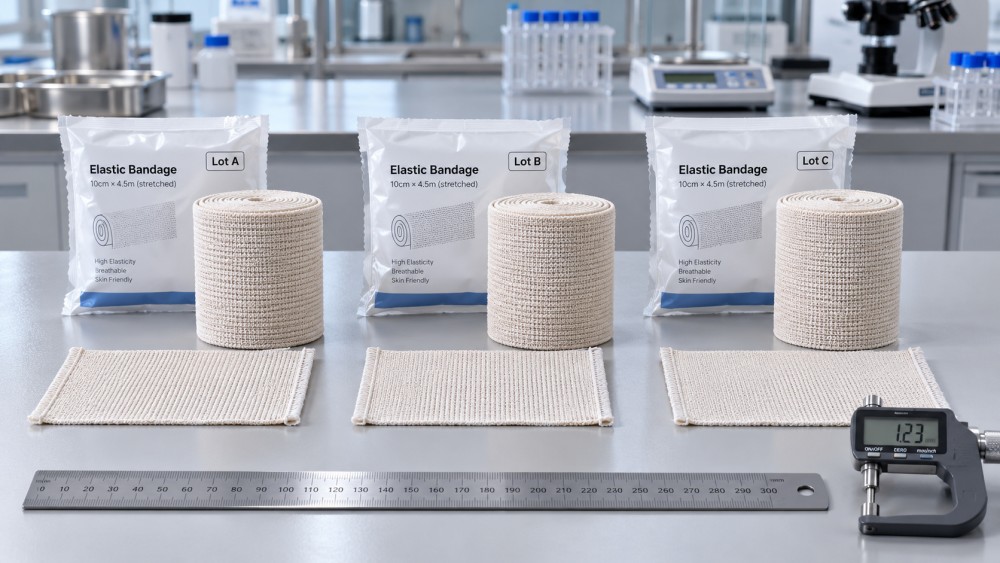
Preserve the identity of every sample through testing. Pooling units from several lots into one result destroys the comparison. Retain unopened reference samples under documented storage conditions so that a later complaint can be compared with material from the same lot.
Compare the measurements behind the certificate
A certificate of analysis is useful when it identifies the product revision, lot, test method, acceptance criteria, and actual results. A document containing only “pass” or “conforms” leaves the amount of variation invisible. Request underlying measurements for characteristics that directly affect performance, including the number of units tested and the sampling locations.
Examine both variation within each lot and differences between lots. Similar averages can conceal a lot containing unusually weak and unusually strong units. Conversely, tightly grouped measurements that shift steadily toward a specification limit suggest a changing process even while every reported lot passes.
A simple plot of individual values by lot often reveals more than a summary table. Look for widening spread, abrupt shifts after material changes, repeated results near a limit, and trends over production time. Formal control charts require an appropriate baseline and subgroup structure; specification limits describe acceptable product, while control limits describe observed process behavior.
Capability indices deserve scrutiny when presented as proof of consistency. Their interpretation requires a stable process, suitable data, and an appropriate statistical model. An impressive index calculated from selected approval samples does not establish performance across routine production.
Also establish how measurement variation is controlled. Instrument calibration alone does not show that a soft, stretchable product is positioned consistently during testing. Fixtures, conditioning, sample preparation, and repeatability between laboratories matter. If results sit close to an acceptance limit, measurement uncertainty becomes relevant to the release decision.
Use test conditions that explain real differences
Comparisons are valid only when methods remain aligned. A bandage tested immediately after unpacking in a cool room cannot be directly compared with one conditioned in warm, humid conditions if those conditions affect its materials. Document conditioning time, temperature, humidity, and the interval between manufacturing and testing.
Adhesive bandages
Adhesive behavior needs several complementary observations. Peel testing addresses removal force; holding tests address movement under sustained load; liner release affects application. Strong peel adhesion alone does not establish appropriate skin performance. Excessive removal force, adhesive transfer, or backing damage deserves investigation even when the average adhesion result meets its limit.
Use a defined test substrate for repeatable laboratory comparisons. Skin behavior varies with moisture, hair, movement, and application site, so laboratory adhesion results cannot independently establish wear performance or skin compatibility. Any use evaluation should follow an appropriate, controlled protocol with acceptance criteria established beforehand.
Elastic and absorbent bandages
For elastic products, compare force at specified extensions and recovery after repeated stretching. A bandage can match its stated length yet require a different application force because yarn properties or knitting tension changed. Where compression performance is claimed, relate testing to defined application conditions: delivered pressure depends on tension, overlap, layers, and limb geometry.
For absorbent constructions, distinguish total uptake from absorption speed and fluid retention under pressure. A pad that absorbs freely during immersion may release fluid when compressed. Examine linting, wet integrity, and separation between layers when these characteristics affect the intended use. Appearance alone will not reveal these differences.
Trace an unexpected result back to production
Records should connect finished lots to relevant incoming materials, production equipment, process settings, inspection results, and release authorization. For an adhesive bandage, useful links include the backing, adhesive, absorbent pad, release liner, and packaging material. Traceability becomes meaningful when a suspect component can be linked to every affected finished lot.
Ask for a demonstration using an actual historical lot. The record should explain which materials entered production, which inspections occurred, whether deviations were recorded, and how the release decision was reached. A procedure document establishes the intended process; a completed record shows its execution.
Concentrate on controls capable of explaining the measured variation. Coating weight and drying conditions affect adhesive behavior. Fabric tension and cutting settings influence dimensions. Pad placement affects the usable wound-contact area. Packaging seal performance depends on the interaction of material properties and sealing conditions.
Rework also needs visibility. Rewinding, repacking, or other permitted reprocessing can change the handling history of a lot. Records should identify what occurred, its approved basis, and any additional inspection required before release. Unexplained rework makes otherwise acceptable test results harder to interpret.
Change control is equally important. Agree which changes require notification and which require renewed evaluation. Changes to adhesive formulation, fabric source, manufacturing location, packaging structure, or sterilization processing deserve review according to their effect on the approved product.
Separate release quality from shelf-life evidence
Freshly manufactured bandages can perform consistently while aging differently between lots. Adhesive performance, elastic recovery, packaging integrity, and component bonding may change during storage. Compare lots at similar ages, and review stability evidence relevant to the supplied construction and claimed shelf life.
Transport exposure also complicates interpretation. A damaged delivery does not automatically prove unstable manufacturing. Compare warehouse retention samples with delivered samples and review available storage and transport records. Differences confined to the shipment direct attention toward distribution conditions; similar changes in retained units point toward the product or its storage history.
For sterile bandages, finished-product sterility testing alone cannot establish reliable sterilization. Evidence should connect the lot to the validated sterilization process, applicable routine processing records, and release criteria. Packaging integrity and its maintenance through storage require separate support. Nonsterile products require the cleanliness controls and specifications appropriate to their intended use, without implying sterility.
Set approval conditions around the remaining uncertainty
A useful assessment ends with a documented disposition tied to the evidence. Full approval requires acceptable lot comparisons, reliable traceability, and resolved questions about methods and production controls. Limited evidence supports a narrower decision, such as restricted initial orders with additional incoming testing, rather than an unsupported claim of established consistency.
Record the agreed product revision, test methods, sampling approach, defect classifications, acceptance rules, and handling of disputed results. Sampling plans need to distinguish serious defects from minor appearance issues. A sampled acceptance decision provides defined assurance about a lot; it does not certify every unit as defect-free.
When a lot fails, require containment before routine deliveries resume. The investigation should identify affected material, examine related lots, explain the cause, and document corrective action. Effectiveness requires evidence from subsequent production. Replacing rejected goods addresses the immediate delivery problem but leaves recurrence unresolved.
Continue reviewing results after approval, especially following material changes, complaints, or production transfers. The practical purchasing criterion is sustained performance within agreed limits, supported by records that explain variation and show effective action when it occurs.
Have questions about the global trade trends discussed here, or planning your expansion and supply chain strategy? Leave a message below and let the trade experts at MTHH guide you.
We respect your privacy. Your information is strictly confidential.
Related News
- How does order volume affect disposable medical supplies cost?Nov 07, 2026Discover how order volume affects disposable medical supplies cost and learn to balance bulk discounts, storage, expiry risk, and reliable supply.
- How to choose suction consumables in South Africa that fit your pumpOct 29, 2026Buying suction consumables South Africa suppliers offer? Learn how to verify pump compatibility, compare system costs and choose the right fit before ordering.
- How to assess a bandage manufacturer's batch-to-batch consistencyOct 25, 2026Choosing a bandages manufacturer? Learn how to compare production lots, verify test data, and check traceability to reduce sourcing risks and buy with confidence.
- How to verify a surgical gown manufacturer’s barrier level claimsOct 24, 2026Evaluating a surgical gowns manufacturer? Learn how to verify barrier level claims, review test reports, and confirm critical-zone protection before approving your next supplier.