
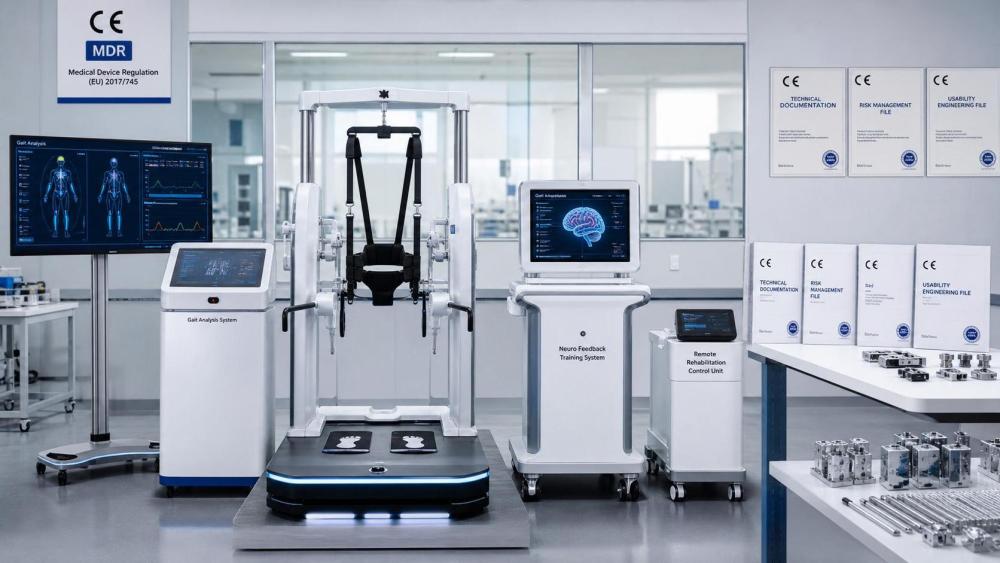
On July 2, 2026, the European Commission issued Regulation (EU) 2026/1189 to revise MDR Annex XVI, changing how certain rehabilitation devices with AI-assisted functions are treated in the EU market. Devices that include AI-driven gait analysis, neurofeedback training, or remote rehabilitation guidance are no longer covered by the relevant exemption list and now face a separate clinical assessment requirement for the AI module itself. For rehabilitation equipment manufacturers, exporters, certification teams, and EU-facing distribution channels, this deserves close attention because it directly affects certification pathways for complete devices, including products exported from China to the EU.
What the amendment changes in practical terms
According to the provided information, the European Commission released Regulation (EU) 2026/1189 on July 2, 2026 as an amendment related to MDR Annex XVI. The amendment removes rehabilitation devices with AI-driven gait analysis, neurofeedback training, or remote rehabilitation guidance functions from the Annex XVI exemption list.
The same information states that the AI module in those products must now be treated as an independent medical device subsystem. As a result, that module must be supported by a complete Clinical Evaluation Report (CER) and obtain a CE certificate issued by a notified body.
The rule took effect immediately on the date of publication. The provided summary also makes clear that this change affects the certification route for complete rehabilitation devices exported from China to the EU.
Where the disruption may appear across the chain
Manufacturers exporting complete rehab systems
From an industry perspective, manufacturers are likely to feel the impact first because the regulatory treatment of AI-assisted functions is now more explicit. The potential effect is concentrated in product classification, technical documentation preparation, clinical evaluation planning, and overall certification sequencing for complete systems intended for the EU market.
What deserves closer attention is whether existing or planned product configurations include AI-driven gait analysis, neurofeedback training, or remote rehabilitation guidance, because those functions are specifically named in the provided information.
Certification and regulatory affairs teams
For internal regulatory teams and external compliance service providers, the main pressure point is procedural rather than commercial. Analysis shows that the AI module can no longer be treated as a minor embedded feature within the broader device dossier if it falls within the functions described in the amendment summary. That means document structure, evidence preparation, and notified body engagement may need to be reorganized around a subsystem-level review.
The key business link here is timing. Because the amendment took effect immediately, teams handling active EU market access work may need to reassess current submission assumptions without waiting for a later transition date stated in the provided information.
Distributors, importers, and EU market channel partners
For downstream market participants, the impact may show up in delivery planning, listing readiness, and customer communication. Observably, any change in the certification path for the complete device can affect when products are ready for placement in the EU market, even though the provided information does not specify individual transaction outcomes.
These parties should pay attention to whether supplier documentation clearly addresses the AI subsystem requirement and whether CE certification status remains aligned with the revised rule.
Supply chain and project delivery coordination
For companies managing cross-border supply and project execution, the issue is less about components in isolation and more about documentation flow and milestone control. Analysis shows that where AI functions are part of the delivered rehabilitation solution, contract timing, handover materials, and regulatory dependencies may need closer alignment with certification progress.
What companies should review now
Check whether product functions fall within the named AI scope
The first practical priority is product screening. Companies should distinguish between general rehabilitation hardware and products that specifically include AI-driven gait analysis, neurofeedback training, or remote rehabilitation guidance, because the provided amendment summary identifies those functions directly.
Separate the AI module in compliance planning
What deserves closer attention is the regulatory treatment of the AI module as an independent medical device subsystem. In practice, this means compliance teams should review whether internal documentation, evidence mapping, and submission logic are still built around a single complete-device pathway that may no longer match the amended requirement.
Reassess submission schedules and customer commitments
Because the rule is stated to take effect immediately, companies with products already being prepared for EU entry should closely review delivery schedules, certification assumptions, and external communications. The distinction between a policy signal and an operational requirement matters here: based on the provided information, this is already an operative change rather than a future proposal.
Track further official clarification
Observably, the amendment establishes the immediate rule change, but companies should continue monitoring how the requirement is expressed in subsequent official interpretations, notified body communication, and supporting compliance practice. This is especially important for businesses trying to determine how subsystem-level clinical assessment will be reflected in real project execution.
Why this looks like more than a short-term procedural update
Analysis shows that this development should not be read merely as a technical wording adjustment inside MDR Annex XVI. The core message in the provided information is that certain AI-assisted rehabilitation functions are being separated out for their own clinical evaluation and CE certification route. That shifts attention from the device as a single integrated product toward the regulatory status of the AI capability within it.
It is more appropriate to understand this as both an immediate compliance change and a longer-term regulatory signal. The immediate part is clear from the stated effective date. The longer-term signal, based only on the provided facts, is that AI functionality in rehabilitation equipment is receiving more distinct regulatory scrutiny when it affects assessment, training, or guidance functions.
At the same time, this remains a dynamic area that still requires observation. The provided information confirms the rule change, but businesses will still need to follow how it is applied in practice across certification workflows.
How the market may need to read this development
For the industry, the main significance of this amendment is not simply that another compliance step has appeared, but that the certification path for AI-enabled rehabilitation equipment entering the EU has become more segmented and function-specific. For Chinese exporters in particular, the provided information directly points to an effect on the approval route for complete devices shipped to the EU.
A neutral reading is the most appropriate one here. This is not enough on its own to support broad conclusions about market outcomes, but it is sufficient to treat as a concrete regulatory change with immediate operational relevance. At present, it is more appropriate to understand the development as a confirmed rule change with broader implications that still need continued monitoring in implementation.
Basis of this article and points requiring continued verification
This article is based on the user-provided news title, event date, and event summary concerning the European Commission's July 2, 2026 amendment to MDR Annex XVI. Typical source categories for developments of this kind may include official regulatory notices, company disclosures, industry association updates, authoritative media reporting, and standards-related documentation.
No specific official source link was provided in the input, so the exact underlying publication record and any later interpretive materials still require ongoing verification. What should be followed next includes any additional official wording, notified body implementation practice, and further clarification affecting certification routes for rehabilitation devices with AI-assisted functions.