
FDA Sets New IVD Traceability Rule for China Exports
On July 2, 2026, the FDA updated its IVD Exporter Compliance Bulletin, introducing a new compliance requirement tied to July 1, 2026 for Chinese manufacturers exporting in vitro diagnostic reagents to the U.S. The measure covers reagent-based IVD products including antigen, antibody, and molecular testing kits, and requires a verifiable electronic batch traceability system within the FDA registration framework. For manufacturers, exporters, distributors, and supply chain teams, the immediate concern is practical: the new rule is directly linked to customs clearance efficiency and continued market access.
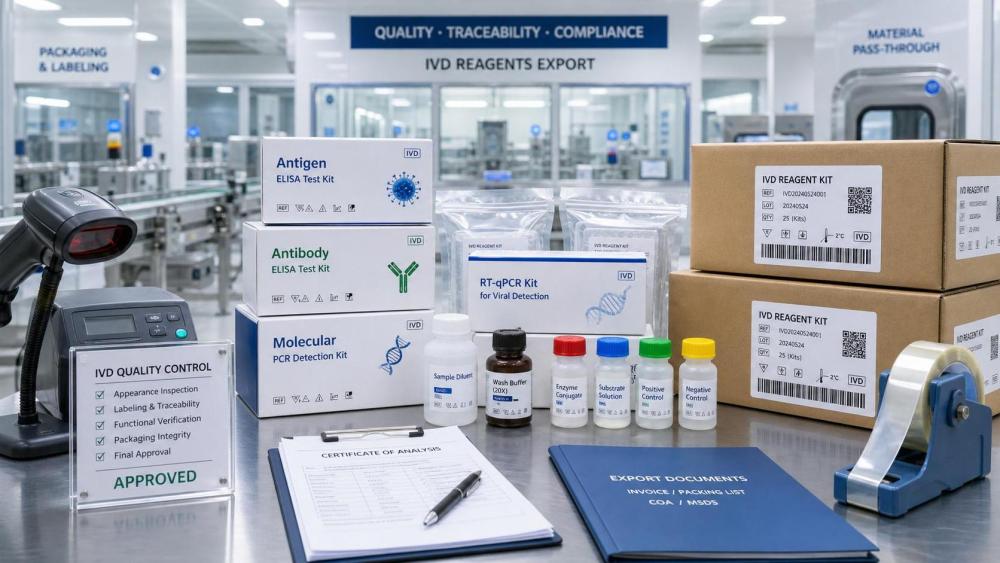
What the FDA update now requires
Based on the information provided, the FDA updated its IVD Exporter Compliance Bulletin on July 2, 2026. The update states that, effective July 1, 2026, all Chinese manufacturers exporting IVD reagents to the United States must connect a verifiable electronic batch traceability module, or EBTS, to the FDA registration system.
The requirement applies to reagent-based IVD products, including antigen and antibody tests as well as molecular diagnostic kits. The EBTS must support real-time access to batch-related records, specifically production batch numbers, raw material sources, sterilization records, and stability data.
The information provided also makes clear that this requirement has a direct effect on customs clearance efficiency and on market access eligibility for reagent-based IVD products.
Where the pressure is likely to appear first
Export-facing manufacturers will be affected at the compliance interface
From an industry perspective, Chinese manufacturers shipping IVD reagents to the U.S. are the first group exposed to the rule because the requirement is tied to FDA system connectivity and verifiable batch information. The operational impact is likely to center on registration readiness, batch data availability, and the ability to respond quickly when shipment or product records are checked.
Raw material and production documentation may become a practical bottleneck
Analysis shows that the rule reaches beyond finished-goods shipment because the required traceability fields include raw material sources, sterilization records, and stability data. That means upstream procurement, production, and quality documentation functions may all come under closer operational scrutiny when export batches are prepared for the U.S. market.
Distributors and trade operators may see an effect in delivery timing
For trading companies, channel partners, and circulation businesses involved in U.S.-bound IVD products, the issue is less about manufacturing itself and more about whether documentation and traceability records are complete and retrievable in real time. Observably, any gap between product shipment and traceability verification could affect customs handling and delivery schedules.
Supply chain service providers may need tighter coordination
Logistics, compliance support, and regulatory service teams may also feel the impact because the rule directly connects traceability readiness with clearance efficiency. What deserves closer attention is whether all parties in the export chain can align product records, shipment documents, and registration-linked traceability information without delay.
What companies should watch now
Whether internal systems can support real-time record retrieval
The core practical issue is not only whether records exist, but whether they can be verified through the required module in real time. Companies involved in U.S. exports should closely review whether production batch data, source records, sterilization records, and stability information are organized in a way that matches the new compliance requirement.
Which product lines are most exposed to immediate implementation risk
Because the stated scope includes antigen, antibody, and molecular testing kits, businesses should identify which export product lines fall directly within the rule and whether those products already have complete batch-level traceability prepared for FDA-linked review.
The gap between regulatory wording and business execution
Analysis shows that one of the most important distinctions is between the formal rule text and day-to-day export execution. A company may understand the requirement in principle, but still face delays if batch records, supplier information, or stability files are stored across disconnected systems or teams.
Customer communication and shipment planning
What deserves closer attention is how exporters communicate with U.S. customers, partners, and service providers during implementation. Where traceability readiness is still being aligned, shipment timing, documentation preparation, and contingency planning may require more active coordination than before.
Why this matters beyond a single filing update
Observably, this is more than a routine wording change in an export bulletin because the requirement is tied to verifiable and real-time batch traceability within the FDA registration context. Analysis shows that the policy signal points toward tighter linkage between product registration data and shipment-level compliance evidence for IVD reagents exported from China to the U.S.
At the same time, it is more appropriate to understand this as a regulatory development that already has defined compliance implications, while still requiring continued observation in terms of implementation detail. The confirmed facts establish the requirement and its direct relevance to customs clearance and market access, but day-to-day enforcement patterns and operational interpretation still need ongoing attention.
How this update is best understood at this stage
At this stage, the FDA update should be read as a concrete compliance requirement with immediate operational relevance for Chinese IVD reagent exporters, rather than as a distant policy signal. Its significance lies in how traceability capability may now affect both border movement and access to the U.S. market for covered products.
That said, a neutral reading remains necessary. The confirmed information supports attention to compliance readiness, documentation integrity, and cross-functional coordination, but it does not by itself establish broader market outcomes beyond the stated effect on clearance efficiency and market entry eligibility.
Basis of this article and points for further verification
This article is based on the user-provided news title, event date, and event summary concerning the FDA update on IVD reagent exports. For this type of industry development, commonly relevant source categories may include official regulatory notices, company disclosures, industry association updates, authoritative media coverage, and standard-setting documents.
No specific official source link was provided in the input, so the exact official link remains to be verified on an ongoing basis. Further follow-up should focus on any additional FDA wording, implementation clarifications, and practical compliance expectations related to EBTS connectivity and batch-level record verification.
Have questions about the global trade trends discussed here, or planning your expansion and supply chain strategy? Leave a message below and let the trade experts at MTHH guide you.
We respect your privacy. Your information is strictly confidential.
Related News
- Abbott Launches Next-Generation Whole-Genome Sequencing Oncodetect MRD TestOct 27, 2026Explore Abbott’s Oncodetect MRD test, using whole-genome sequencing to track up to 5,000 ctDNA variants. Discover key clinical evidence and procurement considerations.
- SCIEX Starts Beijing Plant Project, Danaher's Tenth Manufacturing Site in ChinaOct 24, 2026SCIEX's Beijing plant project marks Danaher's tenth manufacturing site in China. Explore how its RMB 100 million-plus investment could strengthen local mass spectrometer supply.
- How laboratory workflow solutions reduce sample processing delaysOct 23, 2026Discover how laboratory workflow solutions reduce sample processing delays, improve tracking, and streamline reporting. Explore practical steps to cut waiting times without compromising quality.
- How to evaluate a web-based LIMS for lab instrument integrationOct 22, 2026Evaluate a web based LIMS for reliable lab instrument integration. Learn how to verify connectors, test failure recovery, and compare costs before choosing your system.