
From October 1, 2026, a targeted compliance change under EU MDR Annex XVI becomes directly relevant to rehabilitation equipment with AI-assisted decision functions. The revision, issued by the European Commission through Regulation (EU) 2026/1189 on July 3, 2026, signals that manufacturers, certification-facing teams, procurement functions, and market operators can no longer treat AI-enabled rehabilitation systems as a documentation extension of the full device alone. What deserves closer attention is that the rule change affects how clinical evidence is prepared, reviewed, and presented for market access and delivery planning.
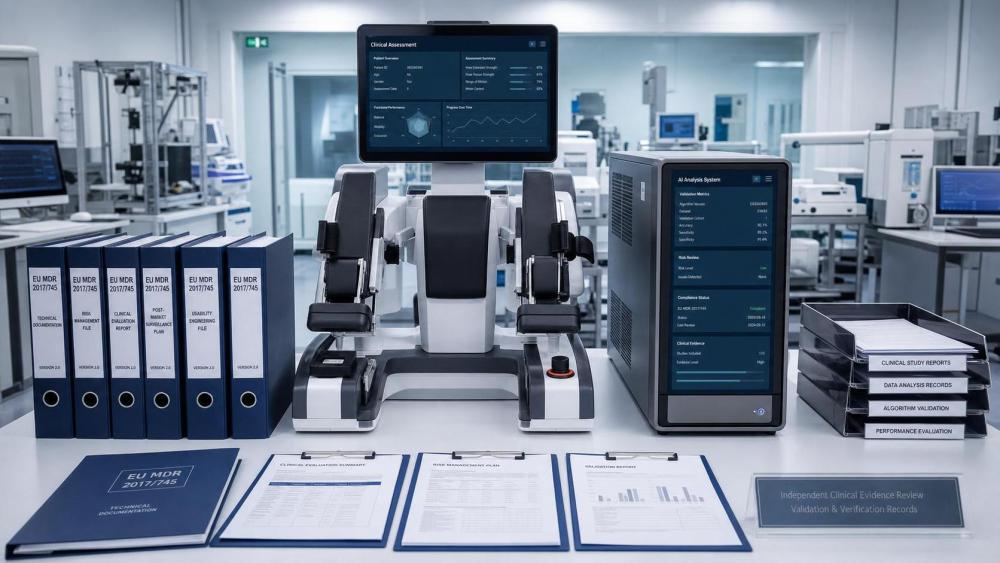
What the revision specifically changes
According to the provided information, the European Commission issued Regulation (EU) 2026/1189 on July 3, 2026, as an urgent revision to the scope of MDR Annex XVI.
The revision clarifies that rehabilitation devices containing AI-assisted decision functions, including examples such as intelligent gait training systems and neurofeedback rehabilitation platforms, are to be treated as high-risk AI medical products.
Under the same change, the AI module of those products must complete an independent clinical evaluation. The required evidence includes real-world performance validation.
The provided information also states that manufacturers may not reuse the complete device's existing CE clinical data as a substitute for the AI module's separate clinical evaluation.
The new requirement becomes mandatory on October 1, 2026.
Where the pressure is likely to appear first
Manufacturers of AI-enabled rehabilitation systems
From an industry perspective, these companies are the most directly affected because the rule change focuses on products that combine rehabilitation hardware or platforms with AI-assisted decision functions. The immediate impact is likely to fall on regulatory planning, technical documentation, and clinical evidence preparation. What deserves closer attention is whether current product files distinguish the AI module clearly enough for a separate evaluation path, especially where prior CE documentation was built around the device as an integrated whole.
Certification and compliance-facing service providers
Testing, regulatory, and certification-related service providers may see the impact in dossier structure, evidence expectations, and review workflows. Analysis shows that the key change is not simply an added document, but a different evidentiary boundary: the AI function must stand on its own clinical basis, including real-world performance validation. Service providers involved in technical file support or conformity preparation should therefore watch for changes in submission logic, report structure, and supporting records requested during review.
Procurement and delivery coordination teams
For procurement teams, distributors, and delivery coordinators handling rehabilitation technology, the issue is less about product design and more about documentation readiness at the point of purchase, market placement, or project delivery. Observably, buyers and channel partners may need to pay closer attention to whether an AI-enabled rehabilitation system has separate clinical materials for the AI module, rather than relying only on the device-level CE evidence package. This can affect document checks, supplier qualification reviews, and delivery timing where compliance files are part of acceptance conditions.
Export and after-sales market participants
Export-facing businesses and after-sales operators may also be affected because compliance expectations do not stop at initial shipment. Analysis shows that where product claims, software updates, service support, or traceability records touch the AI-assisted decision function, the separation between the full device and the AI module may become more important in customer communication and post-delivery support. Companies involved in export execution or installed-base service should therefore monitor how compliance records, technical explanations, and quality follow-up are presented.
What companies should review now
Recheck whether the AI function is being documented as a separate compliance subject
Analysis shows that companies should first determine whether the rehabilitation product includes an AI-assisted decision function that falls within the clarified scope. If it does, the practical issue is not only product classification but also whether internal files, regulatory submissions, and external product documentation already isolate the AI module as a distinct subject for clinical evaluation.
Review the clinical evidence package for gaps
What deserves closer attention is the explicit requirement for an independent clinical evaluation of the AI module, including real-world performance validation. Based on the provided information, firms should not assume that existing full-device CE clinical materials are sufficient. A focused review of reports, validation records, and supporting technical evidence is therefore a reasonable compliance step, even where the overall device documentation appears complete.
Check procurement files, tender materials, and supplier qualification records
Observably, the rule change may move beyond regulatory teams and into commercial execution. Companies involved in bidding, procurement, or distribution should watch whether technical schedules, supplier declarations, and document lists begin to reflect separate AI-module evidence requirements. Because the input does not provide detailed enforcement mechanics, this should be treated as a monitoring priority rather than an established market outcome.
Prepare for possible effects on delivery scheduling and customer communication
From an industry perspective, a separate clinical evaluation requirement can influence delivery preparation where customers or channel partners require pre-shipment compliance review. Firms should therefore pay attention to how the AI module is described in technical documents, acceptance files, and post-sale support records. At this stage, it is more appropriate to understand this as a practical readiness issue tied to implementation, not as proof of uniform market behavior.
How this should be read at this stage
Analysis shows that this development is best understood as an already effective regulatory change rather than a distant policy signal, because the input states that the requirement becomes mandatory on October 1, 2026. At the same time, it also remains a rule change whose operational interpretation may continue to develop through certification practice, documentation review, and market-side responses.
Observably, the most important message is the separation of evidence boundaries: AI-assisted decision functions in certain rehabilitation devices are no longer addressed only through the broader device-level clinical file. That makes this a concrete compliance signal for manufacturers and related operators, while leaving room for continued observation on how review expectations and transaction documents evolve in practice.
Why the revision matters beyond the text itself
From an industry perspective, the significance of this revision lies in how it changes the compliance workload around AI-enabled rehabilitation products. It does not merely add a label; it changes what must be demonstrated independently and limits the reuse of existing CE clinical data for the AI module. That can influence certification preparation, supplier review, procurement checks, and delivery sequencing.
Current industry reading should therefore remain measured: this is a landed rule change with immediate compliance relevance, but its full market impact still needs to be assessed through implementation practice, certification interpretation, tender documentation changes, and feedback from companies operating in the affected product categories.
Basis of this article and points that still require verification
This article is generated based on the user-provided news title, event date, and event summary. The confirmed factual basis used here is limited to the stated revision to MDR Annex XVI, the identification of AI-assisted decision functions in rehabilitation devices as high-risk AI medical products, the requirement for a separate clinical evaluation including real-world performance validation, the prohibition on reusing full-device CE clinical data for that purpose, and the mandatory date of October 1, 2026.
For events of this type, commonly relevant source categories may include official regulatory notices, releases from supervisory authorities, standards or certification documents, industry association updates, trade or customs-related notices, and reporting by authoritative professional media. No specific official source link was provided in the input, so the exact official publication path still requires ongoing verification.
What still needs continued observation includes detailed implementation language, certification interpretation, changes in tender or procurement documentation, industry feedback, and how affected companies execute the separate clinical evaluation requirement in practice.