
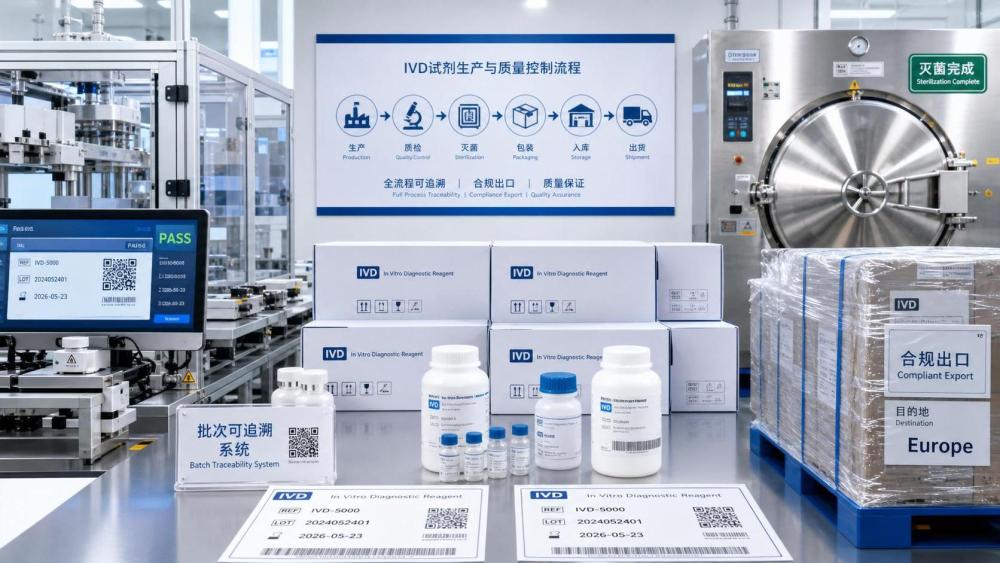
On July 15, 2026, a new FDA compliance requirement starts to affect Chinese manufacturers exporting in vitro diagnostic reagents to the United States. The change centers on real-time batch traceability: suppliers must connect directly to the FDA UDI-RTS system by API and be able to provide timestamped records covering production, quality inspection, sterilization, release, and logistics for each batch. For IVD exporters, this is worth close attention because it links traceability data readiness with registration status and customs efficiency rather than treating documentation as a later-stage administrative step.
What the FDA update specifically requires
The confirmed facts are limited but clear. The FDA issued the IVD Export Traceability Directive Update on July 3, 2026. Under that update, from July 15, 2026, all Chinese manufacturers exporting IVD reagents to the U.S. must complete direct API connectivity with FDA UDI-RTS, described as a real-time traceability system.
The same update requires batch-level timestamp data covering the full chain of production, quality inspection, sterilization, release, and logistics. According to the provided information, the requirement directly affects registration compliance and customs clearance efficiency for IVD export enterprises. Suppliers that do not meet the requirement will face suspension of EUA authorization and FDA listing.
Where the pressure will appear first in the export chain
Manufacturers will face a systems-and-records compliance test
From an industry perspective, the most immediate impact falls on Chinese IVD manufacturers that ship to the U.S. Their exposure is direct because the rule is tied to API connectivity and batch-level timestamp reporting. In practical terms, the affected business links are likely to include production record management, quality documentation, release workflows, and the handoff between factory data and export compliance files. What deserves closer attention is whether internal records can be structured in a way that supports real-time transmission rather than only retrospective document submission.
Export operations and customs-facing teams may see delivery friction
For export-facing teams, the stated effect on customs clearance efficiency suggests that traceability readiness may influence shipment timing and release predictability. Analysis shows that the operational risk is not only regulatory status but also whether each batch can be matched with complete chain-of-custody timestamps when goods are moving. That makes trade documentation, shipment coordination, and batch release alignment more sensitive than before.
Supply chain and service partners will need cleaner data handoffs
Supply chain service providers, including parties involved in logistics coordination or supporting documentation flows, may also be affected indirectly. The reason is straightforward: the required dataset includes logistics timestamps, so weak data handoffs between manufacturer, release function, and transport arrangement could create gaps in the traceability chain. Observably, this does not automatically create a new legal obligation for every partner based on the provided information, but it does raise the importance of timestamp consistency and document traceability across the export process.
Buyers and procurement functions may tighten supplier screening
Procurement teams and downstream buyers involved in U.S.-bound IVD sourcing may need to pay closer attention to supplier eligibility. Since non-compliance can lead to suspension of EUA authorization and FDA listing, supplier qualification review may increasingly focus on whether a manufacturer has completed the required FDA UDI-RTS API connection and can maintain batch-level traceability records in usable form. This matters not only for product acceptance but also for delivery reliability.
What companies should review now
Check whether API connectivity is treated as a registration prerequisite
Analysis shows that companies should not read this update as a purely IT task. Based on the provided information, API direct connection is linked to ongoing export compliance standing. That makes it necessary for affected suppliers to review whether their current registration, listing, or EUA-related workflows already depend on data interfaces that are complete, stable, and auditable.
Review whether batch records can produce the required timestamps
What deserves closer attention is the completeness of batch-level records. The requirement explicitly covers production, quality inspection, sterilization, release, and logistics. Companies should therefore review whether these records exist in a consistent timestamped format and whether they can be associated clearly with each exported batch. The available information does not provide detailed technical specifications, so this remains an area where execution details still need to be monitored.
Reassess shipment planning and document readiness
Because the update is described as directly affecting customs clearance efficiency, exporters should watch for practical changes in shipment preparation, release timing, and supporting trade documentation. It is more appropriate to understand this as a signal that traceability data readiness may become part of delivery execution discipline, especially where batches are moving on tight schedules.
Track later clarification on implementation language
The provided summary confirms the requirement and the consequence of non-compliance, but it does not include more granular implementation language. For that reason, companies should continue to monitor later official wording, certification-related interpretations, tender document changes, and market-side execution feedback before assuming a single uniform operating approach across all transactions.
Why this reads as an execution signal, not just a policy notice
Observably, this update is more than a general statement about traceability. It connects real-time system access, batch-level timestamp evidence, and regulatory consequences in one rule change. Analysis shows that the practical message to the industry is that export compliance for IVD reagents is moving closer to data-verifiable execution, especially for suppliers shipping from China to the U.S.
At the same time, it would be premature to claim a fully settled enforcement pattern from the current input alone. The confirmed facts establish the requirement and the stated consequences, but they do not yet answer every operational question about how the rule will be applied in day-to-day shipment, review, and documentation scenarios. That is why this should be read as a landed compliance change with continuing implementation details to watch.
How this update is best understood for now
At this stage, the FDA update is best understood as an already effective compliance threshold for Chinese manufacturers exporting IVD reagents to the U.S., with immediate relevance to registration continuity and shipment execution. From an industry perspective, the key issue is not only whether companies are aware of the rule, but whether their batch data, system interfaces, and export documentation processes can support it in practice.
A measured reading is appropriate. The rule change clearly raises the operating standard for traceability, but the full market impact will depend on how implementation details, review expectations, and industry response develop after the stated effective date.
Basis of this article and what still needs verification
This article is generated based on the user-provided news title, event date, and event summary. For events of this type, relevant source categories usually include official regulatory notices, announcements from supervisory authorities, customs or trade administration updates, industry association communications, standard-setting documents, and reporting from authoritative trade media.
No specific official source link was provided in the input, so the underlying document link and any subsequent official clarification still need to be verified on an ongoing basis. Areas that remain worth monitoring include detailed implementation language, certification and listing interpretation, tender document changes, industry feedback, and how affected companies execute the new traceability requirement in practice.