
What medical equipment servicing radiology plans need to solve in daily use
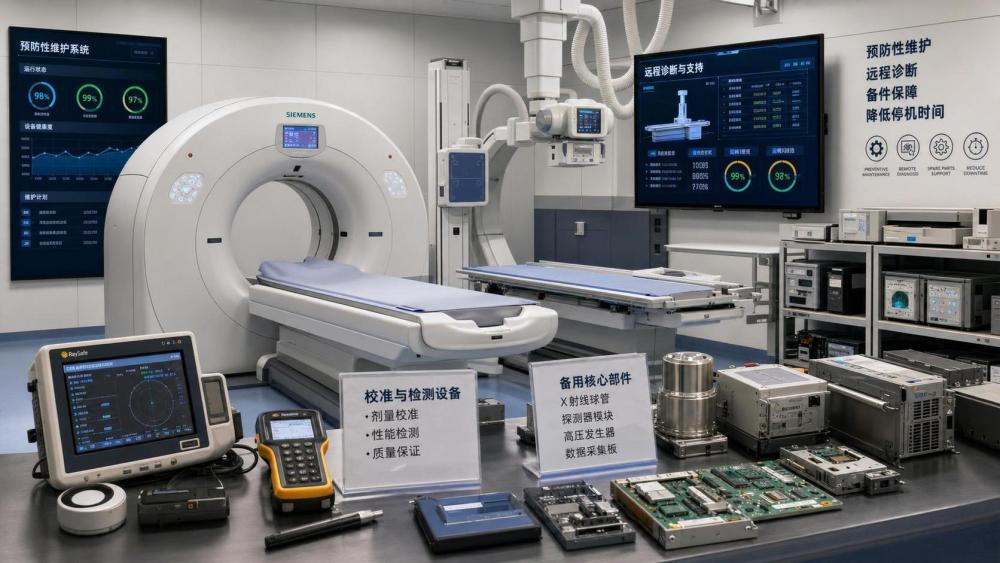
Radiology downtime rarely starts with a single dramatic failure. More often, it builds through missed calibration, delayed parts, outdated software, or weak service coordination.
That is why medical equipment servicing radiology cannot be judged only by break-fix coverage. The stronger question is whether the service plan protects imaging continuity under real operating pressure.
In practical healthcare operations, one hour of scanner downtime may affect emergency triage, inpatient flow, elective scheduling, and reporting backlog at the same time.
A useful agreement should therefore connect technical maintenance with workflow reality. It should preserve image quality, support compliance, and reduce avoidable service interruptions across the equipment lifecycle.
Within the broader MTHH view of healthcare procurement and clinical engineering, this matters because equipment value is shaped by long-term stability, not purchase price alone.
Different imaging environments create different service priorities
Not every radiology room experiences downtime in the same way. A high-volume CT unit has different risks from a mobile C-arm or a community ultrasound system.
The service plan should reflect workload, modality complexity, room infrastructure, and clinical urgency. Without that, medical equipment servicing radiology becomes generic on paper and weak in practice.
More demanding sites usually need faster response times, remote diagnostics, and tighter preventive maintenance intervals. Lower-volume sites may need stronger operator guidance and broader parts planning.
This is also where structured industry information becomes useful. MTHH often frames radiology evaluation through performance, serviceability, installation conditions, and long-term operating value rather than headline specifications.
Busy CT and MRI departments need service depth, not only speed
In advanced imaging departments, downtime carries a wider cost. Delays affect contrast scheduling, anesthesia coordination, referral commitments, and sometimes revenue-critical examination blocks.
Here, medical equipment servicing radiology plans should include preventive maintenance windows aligned to usage intensity, coil or detector checks, cooling verification, and software patch management.
Response time matters, but first-time fix capability matters just as much. If the engineer arrives without the right parts, downtime still extends into the next clinical session.
General X-ray, DR, and fluoroscopy often expose workflow gaps faster
These systems may appear simpler, yet they often face continuous daily use across emergency, outpatient, and ward-linked imaging activity.
In this setting, detector replacement arrangements, generator calibration, image workstation support, and interface checks with PACS or RIS deserve close attention.
A service plan that excludes software integration support may look cheaper initially, but it can leave unresolved workflow failures that feel like equipment faults to clinical teams.
Portable and distributed imaging benefit from stronger logistics control
Portable X-ray and ultrasound units move across wards, ICUs, and emergency care spaces. Their risk profile includes battery condition, connector wear, transport damage, and user variation.
Medical equipment servicing radiology in these environments should cover inspection frequency, spare battery planning, probe testing, and fast support for accidental damage assessment.
The practical issue is not just repair. It is maintaining reliable use in unstable, multi-location conditions where minor faults quickly disrupt patient flow.
What a workable radiology service plan should actually cover
A strong plan should be judged by coverage detail, not by the label of “full service” alone. Several elements are usually non-negotiable when uptime is the real goal.
- Preventive maintenance with defined intervals tied to modality usage and environmental conditions.
- Remote diagnostics for early fault identification and faster dispatch preparation.
- Software updates, cybersecurity patches, and version control for image workflow stability.
- Calibration, quality assurance, and documentation support for compliance review.
- Spare parts availability, including critical components with realistic lead times.
- Operator guidance after service events, especially when settings or workflows change.
- Clear service response targets, escalation rules, and reporting obligations.
Each item supports downtime reduction in a different way. Preventive maintenance avoids failures, software support reduces hidden instability, and operator guidance lowers repeat calls after technical resolution.
The right coverage changes when the site profile changes
The same medical equipment servicing radiology package will not fit every organization. The operational context changes the threshold for acceptable delay, backup capacity, and documentation depth.
This kind of comparison helps separate true needs from generic promises. It also aligns with how MTHH evaluates technology decisions across procurement, installation, and operating phases.
Common misjudgments that keep radiology downtime high
A frequent mistake is focusing on warranty length while ignoring scope. Two service plans may both say three years, yet one excludes calibration, software support, or detector loan options.
Another problem is treating all radiology modalities as if they fail in the same pattern. MRI service planning is not interchangeable with ultrasound or DR support.
Some reviews also underestimate infrastructure dependence. Power quality, cooling stability, shielding conditions, network performance, and room environment can trigger repeat service events.
There is also a softer issue. If operators do not receive post-service guidance, recurring user errors may be logged as equipment downtime, inflating both costs and frustration.
Medical equipment servicing radiology works best when technical support, usage discipline, and documentation control are treated as one operating system rather than separate tasks.
How to assess plan fit before service terms are finalized
Before accepting a service agreement, it helps to map failure impact first. The key question is not only how often a system may fail, but what happens operationally when it does.
- List the modalities with the highest interruption cost and the weakest backup coverage.
- Confirm whether preventive maintenance intervals match actual scan volume.
- Ask which parts are locally stocked and which depend on international lead time.
- Verify whether software, cybersecurity, and interface support are included.
- Check documentation support for inspections, quality control, and compliance review.
- Review escalation rules for repeat faults and unresolved intermittent issues.
These checks turn medical equipment servicing radiology from a contract formality into a risk control tool. That is especially relevant in cross-border projects and mixed-vendor environments.
A better service plan starts with the real operating picture
Radiology uptime improves when service coverage is built around actual use conditions, not generic promises. High-volume scanners, distributed devices, and infrastructure-sensitive rooms each need different protection.
The most reliable approach is to compare workload, room conditions, software dependency, backup capacity, and compliance demands before finalizing service scope.
In practice, the next step is straightforward: define the most disruption-sensitive imaging scenarios, identify likely failure points, and match them against preventive maintenance, parts access, response targets, and training support.
That is where medical equipment servicing radiology becomes operationally meaningful, and where structured healthcare intelligence can help turn service terms into measurable uptime protection.