
How to set maintenance intervals for biomedical equipment
How often should biomedical equipment be inspected, tested, and serviced? For an after-sales technician, the answer is rarely a single number. The interval depends on the manufacturer’s instructions, the device’s clinical role, how it is used, its service history, and applicable local requirements. A well-structured biomedical equipment maintenance checklist turns those inputs into a schedule that technicians can execute and customers can audit.
The aim is not simply to complete more preventive maintenance. It is to perform the right task, on the right device, at the right time—and to recognize when a proposed schedule change needs additional evidence or authorization.
Start with the device, not a generic calendar
Separate the maintenance tasks before assigning their intervals. A device may require an operator’s pre-use check, periodic cleaning, performance verification, calibration, and replacement of a time-limited component. These activities do not necessarily belong on the same schedule or to the same service provider.
For each asset, identify the manufacturer, model, serial number, software version where relevant, location, clinical function, installation date, warranty status, and service contract. Confirm the applicable instructions for use and service manual, including revisions and service bulletins. WHO’s medical equipment maintenance guidance emphasizes the importance of an equipment inventory and manufacturer documentation when organizing a maintenance program. [1]
Record the maintenance trigger as well as the interval. A calendar date may be appropriate for one task; another may depend on operating hours, cycles, test results, or an event such as relocation. If a device has several triggers, track each separately rather than allowing one annual work order to conceal an earlier requirement.
A practical method for setting maintenance intervals
- Extract the baseline requirements. List each manufacturer-specified task, its interval or trigger, required tools, acceptance limits, and technician qualifications. Note whether the instruction applies to the device, an accessory, or a replaceable component.
- Identify mandatory constraints. Check local law, regulator expectations, accreditation rules, contract terms, and facility policy. Do not assume that permission to use an alternative maintenance approach in one country applies elsewhere.
- Assess the consequences of failure. Consider the device’s clinical role, the likelihood that a fault will be detected before harm, and whether a safe substitute is available. A failure that can interrupt life support deserves a different escalation discussion from a fault that only affects a noncritical convenience function.
- Check real operating conditions. Compare actual workload with the assumptions behind the baseline schedule. High cycle counts, transport between departments, dust, humidity, frequent cleaning, and unreliable power can change the service burden.
- Review evidence by task and failure mode. Examine corrective work orders, inspection findings, parts replaced, failed performance checks, user reports, and repeat faults. Distinguish use-related damage from age-related deterioration before changing an interval.
- Approve, document, and monitor the schedule. Assign an owner, record the rationale, obtain the required approvals, and set a review date. Track results after implementation; a schedule is a controlled decision, not a permanent setting.
Where evidence is incomplete, use the manufacturer’s applicable instructions as the starting point and resolve gaps with the manufacturer, facility, or qualified clinical engineering authority. An unfamiliar model with no local service history is a poor candidate for an unsupported interval extension.
Use risk to prioritize work—not to invent a frequency
Risk ranking helps decide which devices require closer scrutiny and faster escalation. It does not, by itself, prove that a specific inspection interval is safe. A useful assessment combines clinical consequence with detectability, redundancy, operating environment, and observed reliability.
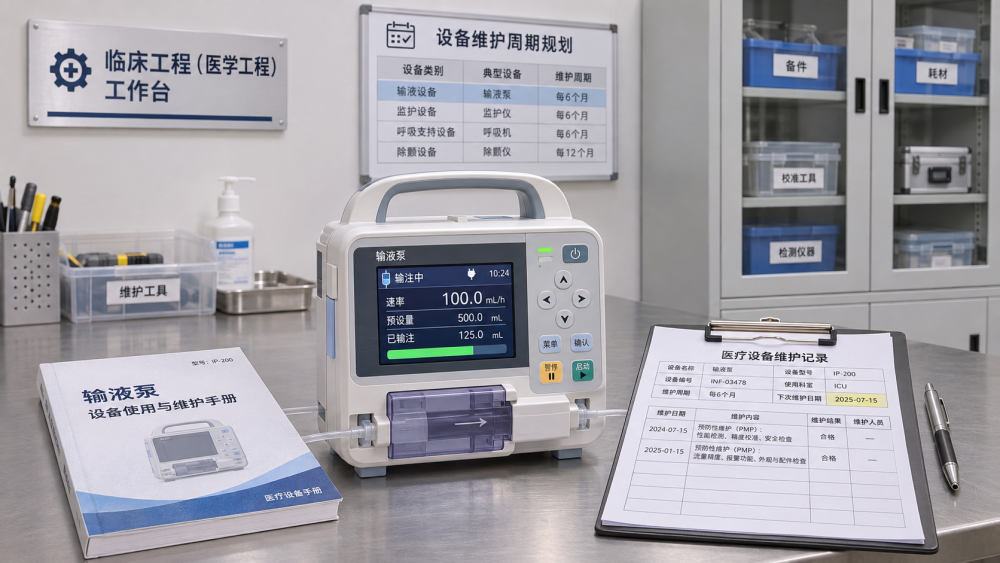
A ventilator, for example, may have user checks before operation alongside technician-performed preventive maintenance and component replacement. An infusion pump fleet may require attention to physical damage, battery performance, and delivery verification using the manufacturer’s procedure. For a laboratory analyzer, service intervals may interact with calibration, quality control, and reagent requirements. These are distinct controls: a satisfactory maintenance visit does not replace required clinical or laboratory quality checks.
Turn the schedule into a biomedical equipment maintenance checklist
A useful checklist tells a technician what to do, what constitutes an acceptable result, and what happens if the result is unacceptable. It should reference the controlled procedure rather than reproduce technical limits from memory.
Before the visit
- Confirm access and clinical availability. Agree on downtime with the department and identify any operational contingency.
- Verify the asset and scope. Match the serial number, configuration, accessories, and open work orders to the service record.
- Prepare controlled resources. Bring the current procedure, required parts, personal protective equipment, and suitable test equipment with traceable calibration where required.
- Review safety and decontamination status. Follow facility procedures before handling equipment exposed to infectious material, hazardous substances, or residual energy.
During and after service
- Perform the specified tasks. Inspect, clean, replace components, test, or calibrate only as applicable to the device and within your authorization and training.
- Record actual results. Capture measurements, units, acceptance criteria, test equipment identification, parts used, and relevant software changes—not only a “pass” checkbox.
- Control failures. If a device fails a safety or performance check, follow facility policy for removing it from service, labeling it, notifying the clinical owner, and arranging repair and retesting.
- Close the loop. Document the work performed, unresolved issues, release decision, technician identity, completion date, and next due date or usage trigger.
The checklist should also state what was not completed. If a required test cannot be performed because an accessory is unavailable, record the limitation and escalate it. Closing the work order as fully complete can hide a risk from both the customer and the next technician.
When should an interval change?
Shorten or supplement an interval when documented evidence indicates that a task may be needed earlier: repeated wear before the next visit, a change in operating conditions, a manufacturer bulletin, or a recurring failure discovered between scheduled checks. An additional inspection may also be appropriate after an event such as a drop, liquid ingress, repair, or relocation, depending on the device and its instructions.
Extending an interval requires a more demanding review. Define the exact task to be changed; an inspection interval is not automatically the same as a battery replacement interval. Compare results from sufficiently similar devices and operating conditions, examine failures as well as successful checks, and determine whether the data would have captured hidden faults. Document the proposed change, justification, approval authority, monitoring plan, and conditions for reverting to the previous schedule.
In the United States, CMS permits qualifying hospitals to adjust certain equipment maintenance, inspection, and testing activities or frequencies under an alternative equipment maintenance program, subject to specified conditions and exclusions. Some equipment must follow manufacturer recommendations, including certain imaging and radiologic equipment, lasers, and devices with insufficient maintenance history. Requirements vary by facility and jurisdiction; consult the current CMS guidance and applicable authorities before departing from manufacturer instructions. [2]
Control overdue work and make the next review meaningful
When a visit becomes overdue, do not simply move the date forward in the system. Identify the reason, notify the designated facility contact, assess the device’s clinical role and available alternatives, and record the interim decision under facility policy. The authorized clinical and technical teams should decide whether continued use, additional checks, or removal from service is appropriate.
At scheduled reviews, look beyond the percentage of work orders completed. Check whether failures occurred shortly after a visit, whether measurements are drifting toward limits, whether recurring faults are concentrated in one location, and whether tasks are repeatedly deferred. Compare like with like: a low-use backup unit should not automatically inherit the same evidence-based adjustment as a heavily used device of the same model.
Procurement and service teams can improve future schedules by asking suppliers for service manuals, task-level intervals, training requirements, test equipment specifications, spare-parts support, and software servicing arrangements before purchase. Those details make the eventual maintenance plan easier to resource and defend.
Frequently asked questions
Can all devices of the same model share one interval?
They can share a baseline when their configurations and applicable instructions match, but location, workload, accessories, and failure history may justify different task schedules. Document why an individual asset differs from the fleet plan.
Does passing preventive maintenance mean a device is safe until the next visit?
No. A completed check reflects the condition and tests performed at that time. User checks, incident reporting, corrective maintenance, and prompt response to abnormal operation remain necessary between visits.
Who can approve a schedule change?
Follow the facility’s governance process, applicable law, and service agreement. The decision may involve clinical engineering, the clinical owner, quality or safety personnel, and the manufacturer or authorized service provider. A field technician should not independently override a controlled requirement.
Sources
- [1] World Health Organization, Medical equipment maintenance programme overview, WHO Medical Device Technical Series, 2011: https://www.who.int/publications/i/item/9789241501538
- [2] Centers for Medicare & Medicaid Services, State Operations Manual, Appendix A: Survey Protocol, Regulations and Interpretive Guidelines for Hospitals, guidance on hospital equipment maintenance and alternative equipment maintenance programs: https://www.cms.gov/Regulations-and-Guidance/Guidance/Manuals/Downloads/som107ap_a_hospitals.pdf
- Last One:No more articles
- Next Article:FDA Updates Early Alert on Heraeus Guidewire Recall Over Coating DetachmentNov 26, 2026
Have questions about the global trade trends discussed here, or planning your expansion and supply chain strategy? Leave a message below and let the trade experts at MTHH guide you.
We respect your privacy. Your information is strictly confidential.
Related News
- How to set maintenance intervals for biomedical equipmentNov 26, 2026Use a biomedical equipment maintenance checklist to set risk-informed service intervals, document decisions, and keep your maintenance program on track.
- RSNA 2026 Announces Winners of Knee Abnormality Detection AI ChallengeNov 25, 2026RSNA 2026 knee abnormality detection AI challenge: Explore what the reported winners and focus on accuracy and generalization mean for clinical validation.
- How to assess a clinical engineering equipment supplier's maintenance supportNov 22, 2026Assess a clinical engineering equipment supplier with confidence. Compare response times, maintenance plans, spare parts, and contracts to reduce downtime.
- How does equipment condition affect medical imaging equipment prices?Nov 21, 2026Medical imaging price depends on equipment condition. Compare new, refurbished, and used systems, uncover hidden costs, and make a smarter buying decision.