
How does equipment condition affect medical imaging equipment prices?
Equipment condition affects the medical imaging price by changing the amount of wear, remaining support, verification work, and financial risk included in an offer. A new system generally carries the highest initial price, while a used system may cost less upfront but leave more maintenance, software, and performance risk with the buyer. A properly refurbished system can sit between those options, provided its restoration and acceptance criteria are clearly documented.
The lowest quotation is not necessarily the lowest-cost purchase. The meaningful comparison is the cost of obtaining and maintaining clinically acceptable imaging performance over the intended period of use, including installation, service, replacements, and potential downtime.
How condition changes the medical imaging price
Condition is more than an equipment label. Two systems of the same model can have different values because their components, operating histories, software versions, accessories, and service arrangements differ. The price should reflect both the current state of the equipment and the work required to make it ready for clinical use.
These categories are commercial descriptions, not interchangeable guarantees. “Refurbished” is meaningful only when the quotation explains what was inspected, repaired, replaced, tested, and warranted. Likewise, a used system with a documented service history can be a better-controlled purchase than a refurbished unit with an opaque restoration process.
Compare equivalent systems before comparing prices
A lower offer may reflect a smaller configuration rather than a better deal. Establish the required clinical applications and request an itemized equipment list for each quotation, including accessories, software, installation, and service.
- Core configuration: Confirm the model, generation, manufacture year, hardware configuration, and intended clinical applications.
- Imaging components: Identify included probes, detectors, coils, tubes, workstations, and other components relevant to the modality.
- Software and connectivity: List installed versions, enabled applications, transferable licenses, and required integration with existing imaging and information systems.
- Delivery scope: Separate equipment price from de-installation, packing, freight, insurance, installation, calibration, and acceptance testing.
- Support: Compare warranty duration, exclusions, labor, travel, replacement parts, response commitments, and the availability of a service contract.
Configuration differences can outweigh the headline discount. For example, an ultrasound system without the probes needed for the intended examinations requires additional spending before it can perform the planned workload. A CT quotation that excludes installation and tube coverage should not be compared directly with one that includes both.
Where equipment condition creates cost differences
Component wear and replacement exposure
Imaging systems contain components whose condition affects image quality, availability, or both. Their replacement costs and useful life depend on the model, workload, operating environment, and service history; age alone does not establish how much life remains.
- CT: Review tube history, available usage indicators, detector condition, cooling, and maintenance records. A replacement tube or detector repair can materially change the economics of a lower-priced system.
- MRI: Examine magnet service history, cooling arrangements, coils, gradient and radiofrequency subsystems, and any site-specific requirements. Relocation and recommissioning can add substantial complexity beyond the equipment purchase.
- Ultrasound: Inspect probes, cables, connectors, displays, and software options. Probe damage can degrade performance even when the console appears functional.
- X-ray and C-arm: Check the X-ray tube, generator, detector or image receptor, mechanical movement, and relevant safety functions. Detector condition and replacement availability deserve particular attention.
Usage counters are useful evidence, but they are not a stand-alone valuation. Ask how a counter is defined, whether it has been reset, which component it applies to, and whether service records support the reading. A component replaced recently should be identified by date, part, and supporting documentation rather than described only as “new.”
Image quality, safety, and functional performance
Cosmetic condition does not establish clinical readiness. A system can power on while still producing unacceptable images, displaying faults intermittently, or failing a required safety check.
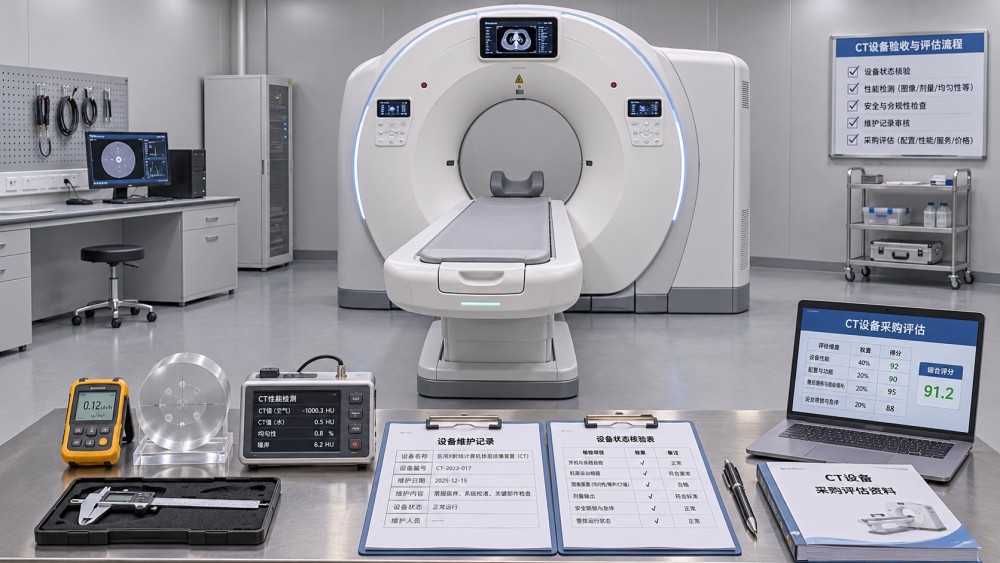
Define acceptance criteria around the intended use and applicable local requirements. Depending on the modality, these can include image-quality checks using suitable test objects, verification of safety functions and dose-related performance, examination of accessories, and confirmation that required clinical applications operate correctly. Testing should be performed by appropriately qualified personnel using documented procedures.
The timing and location of testing matter. A demonstration before shipment does not replace commissioning after installation: transport, reassembly, and site conditions can affect performance. The agreement should state who provides test equipment, pays for corrective work, and decides whether acceptance criteria have been met.
Software, licensing, and cybersecurity
Older equipment may have the hardware needed for an examination but lack a required software option or an active license. Licensing terms can restrict transfer between owners, and an included workstation may not have the interfaces or supported software needed for the destination facility.
Request written confirmation of software versions, license transfer rights, available updates, and the status of vendor support. Also assess whether the system can meet the facility’s network security requirements; if updates are unavailable, isolation or other controls may be needed and should be approved by the relevant technical teams. A low purchase price does not compensate for a system that cannot be connected or maintained as intended.
What a refurbishment premium should buy
A refurbishment premium is justified by verifiable work and a clear allocation of risk, not by cleaning and repainting alone. Ask for a report identifying the equipment by serial number and describing the scope of inspection, repairs, replacement parts, software configuration, and final performance checks.
The provider should explain whether replacement parts are new, reconditioned, or reused, and whether critical accessories were tested with the system. Documentation should distinguish work already completed from work promised before delivery. If a test result or repair is a condition of purchase, include it in the contract and acceptance process.
Warranty terms determine how much risk actually transfers to the seller. Check when coverage starts, whether it applies after relocation, which parts are excluded, who performs repairs, and whether loan equipment or downtime remedies are offered. A broad-sounding warranty with major exclusions may provide less value than a narrower but explicit service commitment.
Calculate the cost beyond the quotation
Use a common planning period for each offer and include costs that are necessary to achieve the same operating capability. A practical comparison is:
Planned ownership cost = purchase price + delivery and site preparation + installation and acceptance + service and expected replacements + software and connectivity costs + downtime allowance − estimated residual value.
This is a planning model, not a prediction of the final bill. Use documented contract prices where available, state assumptions for uncertain costs, and avoid counting the same repair both in a service contract and as a separate replacement expense. Residual value should be treated cautiously when future support or resale eligibility is uncertain.
In a hypothetical comparison, a refurbished system has a lower purchase price than a new alternative, but its offer excludes installation and a high-cost component from warranty. Add those items, the expected service arrangement, and any required software to the comparison. If the refurbished option remains less expensive, test the decision against a downside scenario in which the excluded component fails and the system is unavailable while a replacement is sourced.
Downtime has different consequences across facilities. Where another compatible system can absorb examinations, the operational effect may be manageable; where imaging capacity is limited, an extended outage can disrupt appointments and referrals. Estimate that exposure using the facility’s own workload and contingency plan rather than applying an unsupported industry-wide figure.
Match condition to operating constraints
A new system is easier to justify when uninterrupted support, a defined configuration, and a longer planning horizon are priorities, and the budget can accommodate the initial investment. Even then, verify what is included after the initial warranty and whether service and software support meet the intended operating period.
A refurbished system is a stronger candidate when capital is constrained but the required performance can be demonstrated, service is available locally, and the restoration record is credible. Its value depends on whether the remaining support period and replacement-part supply align with the planned use.
A used or as-is system requires a higher tolerance for uncertainty. It is most defensible when independent inspection is possible, repair expertise and parts are accessible, the intended use is compatible with the available configuration, and the price leaves room for commissioning and corrective work. A low offer is not a sound basis for proceeding if the system cannot be legally supplied or supported at the destination.
Documents and contract conditions to secure before award
- Equipment identity and history: Obtain serial numbers, configuration details, ownership or provenance information where available, maintenance records, fault history, and records of major component replacement.
- Performance evidence: Request recent functional checks and agree on post-installation acceptance tests, measurable criteria, responsible parties, and remedies for failure.
- Regulatory and import eligibility: Confirm that the specific device and its condition can be supplied, imported, installed, and used in the destination jurisdiction. Requirements can differ by country and device category.
- Service and parts: Verify the service provider, geographic coverage, parts sources, response terms, and support status for the exact model and software version.
- Site readiness: Assign responsibility for room preparation, power, cooling, shielding where required, network connections, access routes, and modality-specific installation conditions.
- Commercial protection: Specify what happens if the delivered configuration differs from the offer, licenses cannot transfer, hidden faults appear, or acceptance tests fail. Align payment milestones with delivery and acceptance where commercially agreed.
The strongest offer is the one whose price, documented condition, and contractual obligations fit the intended workload. Compare systems on equivalent scope, verify performance after installation, and retain enough budget for the risks that remain with the facility.
Have questions about the global trade trends discussed here, or planning your expansion and supply chain strategy? Leave a message below and let the trade experts at MTHH guide you.
We respect your privacy. Your information is strictly confidential.
Related News
- How to assess a clinical engineering equipment supplier's maintenance supportNov 22, 2026Assess a clinical engineering equipment supplier with confidence. Compare response times, maintenance plans, spare parts, and contracts to reduce downtime.
- How does equipment condition affect medical imaging equipment prices?Nov 21, 2026Medical imaging price depends on equipment condition. Compare new, refurbished, and used systems, uncover hidden costs, and make a smarter buying decision.
- How healthcare infrastructure in Saudi Arabia shapes demand for medical imaging equipmentNov 18, 2026Explore how healthcare infrastructure Saudi Arabia influences medical imaging demand, from hospital expansion to procurement and investment opportunities.
- How does image registration affect image-guided surgery accuracy?Nov 15, 2026Image-guided surgery accuracy depends on reliable registration. Explore error sources, verification methods and key questions to ask suppliers.