
How to choose diagnostic imaging equipment for small clinics
Choosing diagnostic imaging equipment for clinics involves more than comparing purchase prices. Procurement teams must balance clinical needs and patient volume with image quality, room requirements, staff training, service availability, and long-term operating costs. For small clinics, limited space and budgets make these decisions especially important. The best purchase is not necessarily the most capable machine; it is the one the clinic can use safely, support reliably, and justify with its expected workload.
Start with the examinations, not the equipment
Before requesting quotations, ask the clinicians who will use or interpret the images to define the examinations they need to perform. A general practice assessing abdominal complaints has different requirements from an orthopedic clinic imaging fractures or a women’s health practice performing obstetric examinations. One system may cover several needs, but that does not mean every configuration will be clinically adequate.
Build a shortlist of the most common indications, the patient groups involved, and the expected number of examinations. Separate work that must be available on site from work that can reasonably remain with a referral center. Include likely changes in clinical services, but be cautious about paying for advanced applications based on uncertain future demand.
Also establish who will acquire and interpret the images. An ultrasound system is only useful if qualified staff are available to perform the intended examinations; an X-ray room still needs an arrangement for image interpretation and follow-up. Local requirements for professional qualifications and supervision should be checked before the purchase is approved.
Choose the modality that fits the clinical pathway
For many small clinics, the practical choice starts with ultrasound or digital X-ray. They answer different clinical questions and should not be treated as interchangeable alternatives.
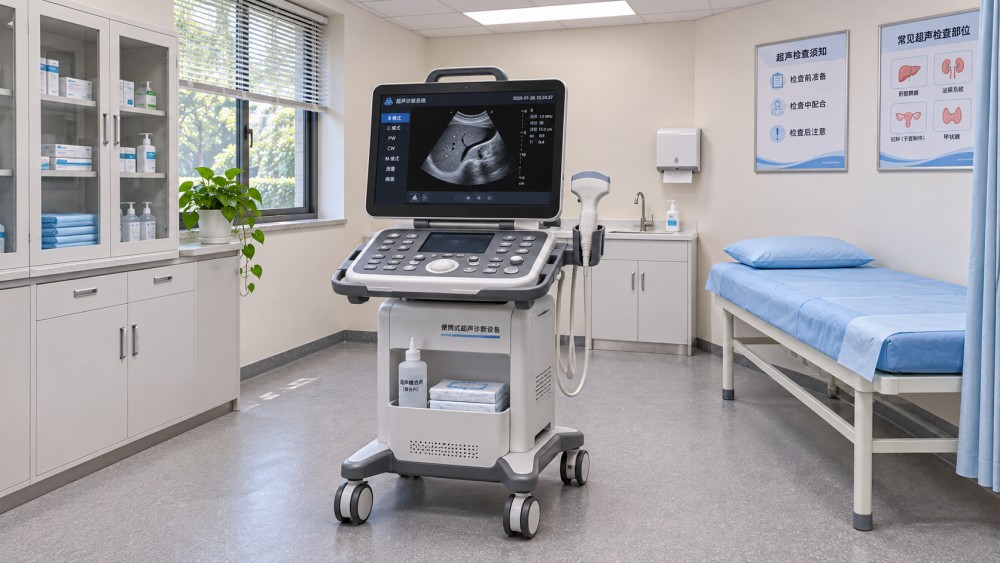
Ultrasound can support a range of examinations without ionizing radiation, and portable systems may fit rooms where a fixed imaging installation is impractical. Its usefulness depends heavily on operator skill, patient factors, the application, and the probes supplied. A low-priced console without the right transducers can be a poor fit for the intended work.
Digital X-ray may make sense for a clinic with a consistent need for skeletal or chest imaging and the staff and infrastructure to support it. Procurement should account for the generator, detector, positioning equipment, image workstation, shielding assessment, and applicable radiation controls—not just the price of the main unit. A mobile X-ray system does not eliminate the need to evaluate radiation protection.
CT and MRI can expand on-site diagnostic capability, but their installation, staffing, maintenance, and operating demands often make a referral arrangement worth examining for a small clinic. Compare the clinical and operational consequences of referral with the realistic cost of ownership. If advanced imaging is central to the clinic’s service model, involve facilities, radiology, clinical engineering, and finance teams early rather than treating it as a routine equipment purchase.
Specialized options such as mammography or dental imaging should be evaluated against their specific clinical applications, quality assurance obligations, and local requirements. A general-purpose imaging system is not automatically a substitute.
Compare performance under the clinic’s actual conditions
Specifications are useful for screening, but they rarely settle the decision. Ask suppliers to demonstrate the proposed configuration for the examinations on your shortlist. The clinical team should assess whether images provide the information needed for the intended use, while operators check how easily they can position patients, adjust settings, save images, and complete a study.
For ultrasound, examine the transducer selection, available presets, penetration and image detail for relevant applications, battery arrangements if portability matters, and the cleaning instructions for each probe. If guided procedures are planned, check that the required guidance features and compatible accessories are included. Image quality seen on a supplier’s ideal demonstration case may not reflect every patient or examination.
For digital radiography, review detector size and positioning options against the clinic’s expected studies. Ask about exposure controls, image processing, repeat-image workflow, and how dose information is recorded or displayed where applicable. A system that produces attractive images should not be evaluated separately from its exposure settings or the training needed to use them appropriately.
Be precise about what is included in the quoted configuration. Software packages, additional probes, grids, workstations, detector batteries, protective accessories, and future upgrades may be priced separately. Request a written list of included items and optional costs so that competing offers can be compared on the same basis.
Inspect the room before committing to a model
A machine’s footprint is not the same as the space required to use it. Allow for patient transfers, staff movement, equipment positioning, cable routes, cleaning, and access for maintenance. A compact ultrasound unit may still need storage for probes and supplies, while a fixed X-ray room may require changes that affect adjacent spaces.
Have the supplier review the site alongside the clinic’s facilities or clinical engineering team. Confirm electrical supply, grounding, network connections, environmental conditions, delivery access, and any structural requirements against the specific model. For radiation-emitting equipment, arrange the necessary shielding design and acceptance processes with appropriately qualified professionals under local rules. Do not assume an existing room is suitable because it previously housed another device.
For MRI, site planning also needs to address the device’s magnetic field and controlled access, along with the manufacturer’s installation requirements. CT and MRI projects can involve substantial building and utility work; obtain a site-specific assessment before approving the business case.
Calculate the cost of keeping images available
The purchase quote is only the starting point. Compare each option over the clinic’s planned ownership period, using supplier quotations and local operating assumptions rather than a generic cost estimate. Include:
- Delivery, installation, room modifications, acceptance testing, and any required inspection or licensing costs.
- Training for initial users and replacements, plus the cost of clinical coverage during training.
- Preventive maintenance, corrective repairs, service travel, and replacement parts such as ultrasound probes or X-ray detectors.
- Software licenses, cybersecurity updates, image storage, network integration, and recurring support fees.
- Consumables and accessories required for the planned examinations, including cleaning and infection-control supplies.
- The operational cost of downtime, including referrals or rescheduled appointments.
A service contract can make expenditure more predictable, but read its exclusions. Damage to a probe or detector, for example, may be handled differently from an internal component failure. Ask whether replacement equipment is available, who pays shipping, and what happens if a necessary part is no longer stocked.
Leasing or refurbished equipment may reduce the initial capital requirement. In either case, verify the exact configuration, condition, software support, remaining service life, and responsibility for repairs. For refurbished systems, ask what was inspected or replaced and whether the manufacturer or a qualified third party can provide ongoing support. A lower entry price is less attractive if the device cannot be maintained locally.
Test the workflow beyond the scanner
An examination is not complete when the image appears on the screen. The clinic must associate it with the right patient, store it, make it available for interpretation, and retrieve or share it when needed. Ask how the proposed system connects to the existing picture archiving and communication system, radiology information system, or electronic health record, where applicable.
DICOM support is a useful starting point for image exchange, but a supplier’s statement that a device is “compatible” is not proof that every desired workflow will work. Request the relevant DICOM conformance information and arrange an integration test with the other system provider. Check patient worklists, image transfer, reporting arrangements, and what users must do if the network is unavailable.
Clarify where images and backups reside, who can access them, how user accounts are managed, and how software vulnerabilities are addressed. If a cloud service or remote support connection is involved, review the applicable privacy and security obligations with the clinic’s IT and compliance teams.
Make supplier support part of the clinical decision
A reliable service arrangement matters particularly when a clinic owns only one imaging system. Ask who will install and maintain the device, whether engineers are locally available, and which work is performed by a distributor rather than the manufacturer. A promised response time should specify whether it means a phone call, remote diagnosis, or an engineer arriving on site.
Request the service schedule, warranty terms, spare-parts arrangements, software support policy, and escalation process in writing. Check that user manuals, cleaning instructions, maintenance guidance, and other required documentation will be supplied in a usable language. Confirm that the device and its proposed configuration can be legally supplied and used in the intended market; requirements vary by jurisdiction and application.
Training should cover more than switching the system on. Agree on application training for the intended examinations, routine checks, image handling, cleaning, basic troubleshooting, and when to contact service. Name the staff who need training and establish whether follow-up sessions are included after the clinic has gained some experience.
Use a practical acceptance test before final payment
Before signing, agree on what successful installation looks like. The acceptance plan should identify the delivered configuration, required accessories, functional checks, image-transfer tests, safety checks, documentation, and completed training. It should also identify who signs off and how unresolved faults will be corrected. Any testing required by local authorities or professional guidance should be incorporated into the project plan.
Global MedTech & Healthcare Intelligence Hub (MTHH) approaches equipment evaluation by connecting clinical requirements with installation, service, and procurement questions. That is a useful discipline for a small clinic: give clinicians and operators a meaningful role in the evaluation, but require suppliers to put their technical and commercial commitments in writing.
The next step is a short requirements document built around the clinic’s actual examinations, room, staff, and support arrangements. Send the same document to each shortlisted supplier. If a quotation cannot clearly show how the proposed system meets those requirements—and what it will cost to keep it working—it is not yet ready for comparison on price.
Have questions about the global trade trends discussed here, or planning your expansion and supply chain strategy? Leave a message below and let the trade experts at MTHH guide you.
We respect your privacy. Your information is strictly confidential.
Related News
- How to assess a clinical engineering equipment supplier's maintenance supportNov 22, 2026Assess a clinical engineering equipment supplier with confidence. Compare response times, maintenance plans, spare parts, and contracts to reduce downtime.
- How does equipment condition affect medical imaging equipment prices?Nov 21, 2026Medical imaging price depends on equipment condition. Compare new, refurbished, and used systems, uncover hidden costs, and make a smarter buying decision.
- How healthcare infrastructure in Saudi Arabia shapes demand for medical imaging equipmentNov 18, 2026Explore how healthcare infrastructure Saudi Arabia influences medical imaging demand, from hospital expansion to procurement and investment opportunities.
- How does image registration affect image-guided surgery accuracy?Nov 15, 2026Image-guided surgery accuracy depends on reliable registration. Explore error sources, verification methods and key questions to ask suppliers.