
How Hospital Equipment Lifecycle Management Reduces Unplanned Downtime
Unplanned equipment downtime can disrupt clinical workflows, increase service costs, and place added pressure on maintenance teams. A failed infusion pump, unavailable ultrasound unit, delayed sterilizer cycle, or analyzer placed out of service affects more than a maintenance schedule. It can change patient flow, delay testing or treatment, force staff to use backup equipment, and create difficult conversations between clinical departments, service providers, and hospital management.
Hospital equipment lifecycle management provides a more practical alternative to reactive repair. Rather than treating each service call as an isolated event, it connects procurement records, installation conditions, preventive maintenance, calibration, software status, spare-parts planning, user training, and replacement decisions over the usable life of an asset. The objective is not to eliminate every failure. That is unrealistic in a complex clinical environment. It is to identify avoidable risks earlier, shorten recovery when faults occur, and make equipment availability more predictable.
For maintenance teams and after-sales service organizations, this approach changes the quality of the conversation. Instead of asking only, “Can the device be repaired today?”, they can ask why the failure occurred, whether similar assets face the same exposure, whether the part is still supportable, and whether a recurring issue points to a training, environment, workflow, or supplier-management gap.
Downtime usually begins long before the fault alarm
Many equipment failures appear sudden at the point of use, but their underlying causes often develop gradually. A cooling problem in an imaging room, unstable power quality, missed cleaning routines, an overdue preventive-maintenance task, depleted backup batteries, aging seals, or an unavailable software patch may remain unnoticed until the device is required during a busy clinical period.
This is why an asset register alone is not lifecycle management. A serial number, purchase date, and department location are necessary, but they do not explain the operating condition of the device. A useful lifecycle record should also show service history, fault codes where available, installed software version, warranty or service-contract status, critical accessories, calibration requirements, known component risks, and dependency on consumables or external systems.
The detail required will vary by equipment category. A patient monitor may need particular attention to battery condition, accessory compatibility, alarm performance checks, and network configuration. An IVD analyzer may be highly dependent on scheduled maintenance, water quality, reagent logistics, quality-control processes, and laboratory workflow. For sterilization equipment, utility supply, chamber integrity, cycle documentation, and operator practice can matter as much as the mechanical condition of the unit.
When these dependencies are not visible in one working record, maintenance becomes reactive by default. Teams may complete repairs successfully yet continue to face the same preventable interruptions.
A lifecycle view links technical condition to clinical priority
Not every asset deserves the same maintenance interval, response plan, or spare-parts strategy. A portable device used occasionally in a non-critical setting should not be managed in the same way as a ventilator, anesthesia machine, defibrillator, CT scanner, central laboratory analyzer, or steam sterilizer supporting surgical turnover.
A practical hospital equipment lifecycle management program classifies assets by more than purchase value. It considers clinical criticality, utilization level, availability of backup equipment, failure history, repair complexity, service coverage, supplier lead times, and the likely effect of downtime on patients and operations. This makes it easier to decide where a preventive intervention has real operational value.
For example, a department may have several patient monitors but only one compatible module configuration for a specialist service. The monitor fleet may look adequately covered on paper, while the actual clinical risk sits with a single accessory or software-enabled capability. In the same way, an imaging system may be technically functional but vulnerable because its essential detector, workstation, injector interface, or cooling support arrangement has not been reviewed.
The most effective prioritization is therefore discussed with clinical users, not created only from a maintenance office. Nurses, laboratory managers, radiology staff, infection-control teams, and department heads often understand which disruption is manageable and which one immediately creates a bottleneck.
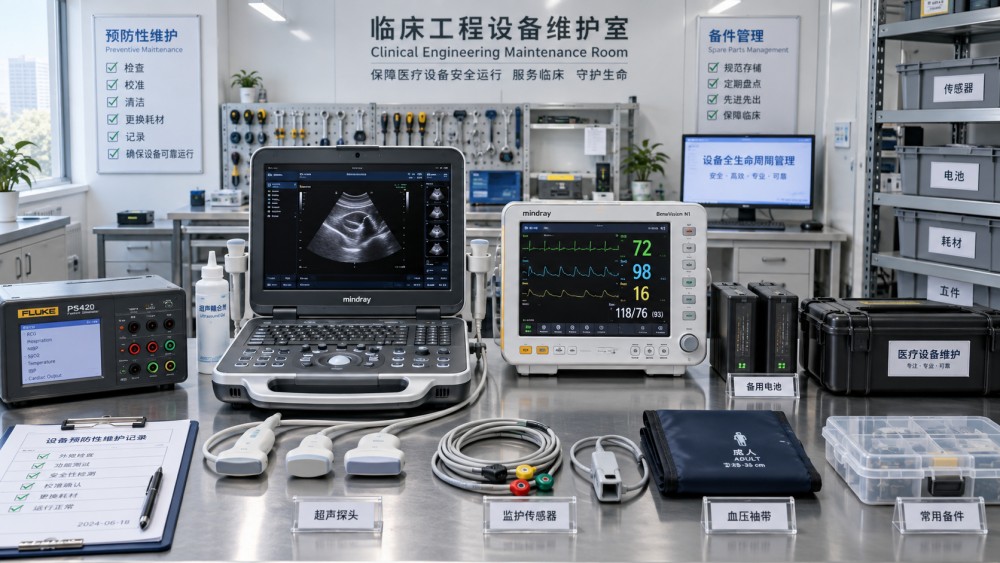
Preventive maintenance is more useful when it is risk-based
Preventive maintenance is sometimes reduced to a calendar exercise: a task is due, a technician visits, a checklist is signed, and the asset is marked complete. The documentation may be necessary, but it does not automatically prove that the most relevant failure risks have been addressed.
A risk-based plan starts with manufacturer instructions, applicable local requirements, and the actual use environment. It then considers what the service history is revealing. Repeated battery replacements, recurring sensor errors, frequent cleaning-related damage, unstable connectivity, or failures concentrated in one location should influence the maintenance plan. A fixed interval may remain appropriate, but the content of the inspection, the parts held in stock, and the training provided to users may need to change.
Condition monitoring can also improve decision-making where the technology supports it. Equipment logs, error histories, runtime information, environmental readings, and remote-service data may help identify deterioration before a complete shutdown. These signals should be interpreted carefully. A warning does not always mean immediate failure, and a device without a warning is not automatically low risk. The value lies in combining technical evidence with service experience and clinical context.
Spare parts are an availability decision, not simply an inventory cost
A common service challenge is the gap between diagnosing a fault and obtaining the part needed to repair it. In many cases, the technical diagnosis is straightforward; the downtime expands because a part must be sourced, a quotation approved, an import process completed, or a supplier confirms that the component is no longer available.
Holding every possible spare is neither economical nor sensible. The better question is which parts create disproportionate downtime if unavailable. The answer depends on the installed base, local logistics, service capability, component failure history, and whether a substitute device can safely support the clinical workload. Batteries, sensors, seals, filters, cables, pumps, boards, detectors, and specialized accessories each require different decisions depending on equipment type.
Spare-parts planning should also include lifecycle status. A device can remain in daily clinical use after its manufacturer support has narrowed. When that happens, teams need clarity on the remaining availability of parts, software support, technical documentation, and qualified service options. Waiting until a major failure occurs to discover that a critical component has become difficult to source creates avoidable pressure.
Service records should support decisions, not just prove work was completed
Good documentation is often discussed as a compliance requirement, but it is also one of the strongest tools for reducing unplanned downtime. A clear service history allows teams to compare failure patterns across units, identify equipment approaching a difficult maintenance phase, verify which modifications have been installed, and understand whether replacement may be more reasonable than repeated repair.
Useful records go beyond “repaired and tested.” They capture the reported symptom, confirmed cause where known, action taken, parts used, downtime period, functional checks performed, follow-up requirements, and any contributing environmental or user-related observations. If a cause cannot be confirmed, that should be recorded honestly rather than replaced with a vague closure note.
This discipline is particularly important when multiple organizations touch the same asset: an in-house biomedical engineering team, an authorized service provider, a distributor, an original manufacturer, and a facility-management contractor. Fragmented records make repeat failures harder to detect and can create uncertainty over responsibility, warranty coverage, or the device’s current technical configuration.
Installation, training, and infrastructure are part of reliability
Reliability does not begin after commissioning. Early installation decisions can shape the service burden for years. Equipment location, room access, ventilation, electrical protection, network readiness, water supply, drainage, medical gas quality, radiation shielding, and workload assumptions may all affect performance. The exact requirements must be confirmed against the manufacturer documentation and local project conditions, especially for complex imaging, laboratory, and critical-care systems.
Operator training also deserves more attention than a one-time handover session. Staff turnover, changes in clinical workflow, software updates, and expansion into new procedures can introduce usage patterns that were not present at installation. Some reported “equipment faults” are actually interface issues, accessory mismatches, incomplete cleaning routines, incorrect consumable handling, or uncertainty about alarm and error messages. These problems should not be dismissed as user error; they indicate that the support model needs to be strengthened.
For distributors and manufacturers, this is where after-sales support becomes a genuine operating capability. Responsive technical assistance, clear escalation routes, available documentation, training materials, and realistic service commitments are often more valuable to a hospital than a broad promise of support.
Replacement planning prevents end-of-life surprises
Every asset eventually reaches a point where repair becomes less predictable, support becomes limited, or the equipment no longer fits clinical and digital workflow requirements. End-of-life planning should not be triggered only by a catastrophic failure. It should begin when service evidence shows rising intervention needs, prolonged repair times, lack of parts, outdated software, changing safety expectations, or a growing mismatch between capacity and demand.
Replacement is not always the correct answer. A well-maintained system may remain suitable when supported by reliable parts, trained technicians, and a realistic contingency plan. But retaining older equipment without reviewing its supportability can move risk from a planned capital decision into an urgent clinical disruption.
A lifecycle review can therefore support better procurement timing. It gives purchasing teams a clearer basis for comparing not just acquisition price, but warranty scope, planned maintenance requirements, service response arrangements, software roadmap, consumable dependencies, installation conditions, and expected access to parts. These are operational questions, not administrative details.
Building a more workable lifecycle process
Hospitals do not need to redesign every maintenance process at once. A sensible starting point is to identify a small group of high-impact assets and review the information already available. Are records complete? Are service intervals aligned with actual use and manufacturer guidance? Which failures recur? Which parts cause long delays? Where is there no viable backup? The answers often reveal practical improvements faster than a large, abstract transformation project.
Global MedTech & Healthcare Intelligence Hub (MTHH) supports this kind of structured evaluation by organizing information across medical devices, diagnostic systems, hospital infrastructure, procurement considerations, clinical engineering, and service-related requirements. For teams assessing equipment categories or supplier support models, it can be useful to compare the technical characteristics of a device with its maintenance needs, installation conditions, consumable dependencies, documentation readiness, and long-term operating implications.
The practical test of hospital equipment lifecycle management is simple: when a fault occurs, does the organization already know the asset’s priority, service history, support path, likely parts requirement, and clinical contingency? If those answers are clear before the disruption, downtime becomes easier to control. If they are only discovered during the emergency, the hospital is already managing the consequences rather than the risk.