
What Warranty Terms Should Buyers Expect for High-Value Medical Equipment?
When asking, “what warranty terms should I expect for expensive medical equipment,” buyers should look beyond the headline coverage period. Hospitals, laboratories, and distributors need protection that supports clinical continuity, predictable costs, and reliable technical service.
A one-year warranty may be acceptable for some lower-risk accessories, but expensive systems demand more detailed commitments. Imaging platforms, laboratory analyzers, ventilators, anesthesia machines, and digital infrastructure can affect revenue, patient flow, and clinical safety.
The most valuable warranty is not simply the longest one. It is the agreement that clearly defines covered failures, service response, replacement parts, software support, exclusions, qualified personnel, and escalation procedures during operational downtime.
Buyers should also distinguish between a manufacturer warranty, a distributor service promise, and an optional service contract. These arrangements may overlap, but each can carry different responsibilities, limitations, and financial consequences after installation.
Before signing a purchase order, procurement teams should convert warranty language into measurable operational obligations. That means asking who responds, how quickly they respond, what they repair, what they replace, and what happens when equipment remains unavailable.
Start With Coverage Scope, Not the Warranty Headline
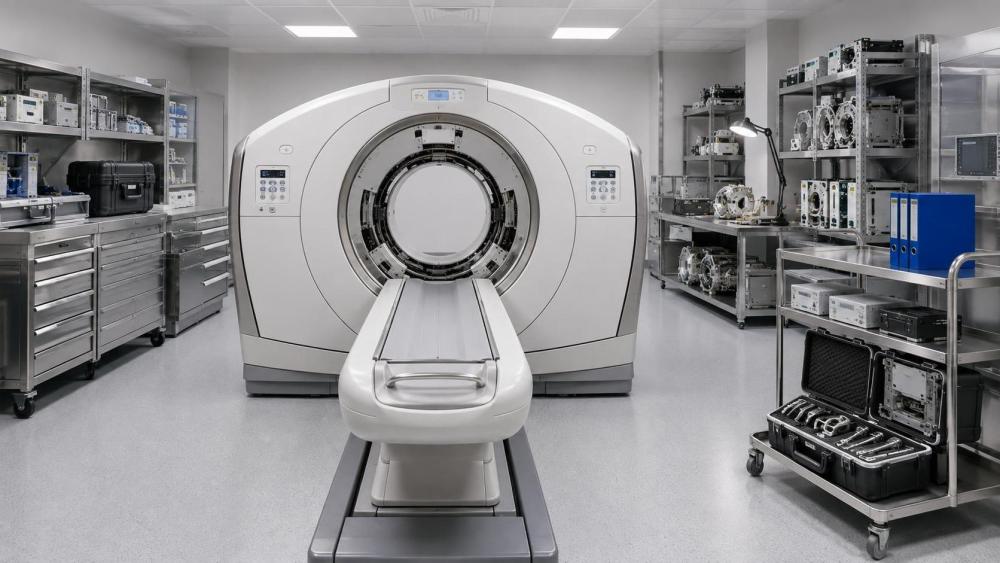
The first question is not how many years the warranty lasts. Buyers should ask exactly which equipment components, labor activities, software elements, accessories, and service visits are included during the stated coverage period.
For high-value medical equipment, comprehensive coverage normally includes defects in materials and workmanship, replacement parts, labor, travel time, technical diagnosis, and corrective repair. A warranty excluding labor or travel can create significant unplanned expense.
Complex systems contain components with different expected lifecycles. X-ray tubes, detectors, batteries, probes, pumps, sensors, computer workstations, printers, and monitors may have separate coverage rules that must be reviewed individually.
Buyers should request a component-level warranty schedule rather than accepting broad language such as “standard manufacturer warranty.” This schedule should identify included parts, limited-life items, consumables, and any components carrying shortened coverage periods.
Consumables are generally excluded, but the boundary is not always obvious. Reagents, tubing, electrodes, filters, seals, lamps, test cartridges, and calibration materials may be consumable items even when they directly affect system performance.
Wear-and-tear exclusions also deserve careful attention. A supplier may exclude failures caused by normal use, but the contract should not allow expected operational degradation to become a vague reason for denying legitimate repairs.
For refurbished equipment, warranty scope must be especially explicit. Buyers should know whether protection covers only newly installed replacement parts, the complete refurbished system, or selected assemblies tested during the refurbishment process.
A practical standard is to ensure that all essential functions required for the equipment's intended clinical use are covered. If a fault prevents safe operation, image acquisition, testing, monitoring, or reporting, responsibility should be clear.
Hospitals should also verify whether warranty coverage applies to remote sites, satellite clinics, mobile units, and temporary installations. Service eligibility can change when equipment is moved outside the originally contracted location.
How Long Should a Medical Equipment Warranty Last?
Warranty duration should reflect equipment value, technical complexity, expected usage intensity, and local service capability. There is no universal term, but buyers should avoid treating twelve months as automatically sufficient for every major purchase.
One-year coverage remains common for many medical devices, particularly where the manufacturer expects purchasers to transition quickly into paid maintenance contracts. However, standard practice does not necessarily represent an adequate risk allocation for the buyer.
For expensive imaging systems, laboratory automation, critical care platforms, and surgical equipment, buyers often seek at least one year of comprehensive warranty with opportunities to negotiate extended protection, especially for major components and software.
Two- or three-year coverage can be commercially reasonable when a system has substantial installation complexity, limited local service history, or a newly introduced technology platform. Longer coverage may also help distributors establish confidence in emerging markets.
The best term depends on the expected failure pattern. Early failures are more likely during installation and initial use, while some costly components may fail after the basic warranty period has expired.
Buyers should request reliability information where available, including expected service intervals, common replacement parts, recommended lifecycle schedules, and historical uptime data. Suppliers may not disclose every detail, but informed questions improve negotiations.
Extended warranty should be priced separately from full-service maintenance. An extended warranty often covers defects and repairs, while a maintenance agreement may add preventive visits, performance checks, applications support, uptime commitments, and priority dispatch.
A low-priced extended warranty can be misleading if it preserves extensive exclusions. Procurement teams should compare the proposed extension against the original warranty line by line rather than assuming the terms are equivalent.
When evaluating duration, consider the procurement timeline as well. Coverage should begin after successful installation and acceptance, not merely on shipment date or arrival at the hospital loading dock.
Response Time and Uptime Matter More Than Generic Service Promises
For equipment that supports emergency, diagnostic, surgical, or high-throughput laboratory workflows, service response terms are often more valuable than an additional month of coverage. Downtime can disrupt patient care and create substantial indirect costs.
Contracts should distinguish between acknowledgement time, remote diagnostic time, onsite arrival time, repair completion time, and escalation time. A promise to “respond promptly” is not sufficient for a system with critical operational importance.
For example, a supplier may acknowledge a fault within two hours, provide remote support within four hours, and dispatch an engineer within one business day. The appropriate target depends on equipment criticality and local support coverage.
Critical systems should have defined support channels outside normal office hours. Ventilators, anesthesia workstations, ICU monitoring systems, and emergency imaging equipment may require twenty-four-hour escalation arrangements, even where onsite service is not immediate.
Buyers should confirm whether response commitments apply on weekends, public holidays, and after-hours periods. A contract that measures service only during standard business hours can materially weaken the protection available to round-the-clock hospitals.
Ask whether remote troubleshooting is included without charge. Modern systems often require secure remote access, log review, configuration checks, software diagnostics, or application guidance before an engineer can determine whether onsite intervention is needed.
Where equipment is essential to daily operations, buyers should negotiate a loan unit, backup component, or alternative workflow plan. This is particularly relevant for portable ultrasound, patient monitoring modules, infusion pumps, and laboratory analyzers.
Service-level remedies should also be discussed. Credits, warranty extensions, substitute equipment, or priority escalation may be appropriate when a supplier repeatedly misses agreed response targets or cannot restore essential functionality within a reasonable period.
Do not rely solely on verbal assurances from a sales representative. Response and uptime expectations should appear in the signed quotation, service schedule, framework agreement, or warranty certificate that governs the transaction.
Software, Cybersecurity, and Digital Integration Need Separate Protection
Medical equipment increasingly depends on embedded software, operating systems, cloud services, workstations, network connectivity, and interfaces with hospital information systems. A hardware warranty without software commitments can leave significant operational risk unresolved.
Buyers should confirm whether warranty coverage includes corrective software patches, bug fixes, cybersecurity updates, firmware revisions, license maintenance, and technical support for software faults that affect normal equipment operation.
It is important to separate mandatory safety or corrective updates from optional feature upgrades. Suppliers may charge for new functionality, but critical patches should not be treated as discretionary commercial add-ons during the warranty period.
Integration responsibilities should be documented where systems connect with PACS, RIS, LIS, EMR, nurse call platforms, barcode systems, or hospital networks. A supplier should identify which interfaces it supports and what testing is included.
Many disputes arise when a device functions independently but fails after network changes, server upgrades, or third-party interface modifications. Warranty language should explain how such issues are investigated and where responsibility may end.
Cybersecurity support deserves particular scrutiny. Buyers should ask how vulnerabilities are reported, how long supported software versions remain protected, whether patches require onsite installation, and whether the supplier provides security notices to customers.
For cloud-connected systems, review data hosting, account access, subscription dependencies, backup responsibilities, and service availability. A device may remain physically functional while losing practical value if its hosted reporting or workflow platform becomes unavailable.
Distributors should ensure that they are authorized and trained to manage first-line software support. Otherwise, local customers may expect assistance that the distributor cannot legally or technically provide under the manufacturer agreement.
Acceptance testing should include digital functions, not only basic hardware operation. Confirm that worklists, image transfer, result reporting, alarm notifications, user accounts, and required integrations work correctly before warranty commencement is accepted.
Installation, Training, and Acceptance Testing Should Be Connected to Warranty Rights
Installation-related failures are common sources of disagreement because medical equipment depends on site readiness, electrical quality, environmental conditions, shielding, network configuration, plumbing, gases, ventilation, and operator setup.
A well-structured purchase agreement defines who verifies site readiness and who bears responsibility when installation cannot proceed. Suppliers should provide clear pre-installation requirements early enough for facilities teams to act before delivery.
Buyers should avoid accepting warranty start dates before installation and documented commissioning. Equipment stored in a warehouse, delayed by construction, or awaiting regulatory clearance should not consume valuable warranty time without clinical use.
Formal acceptance testing is essential for high-value systems. The protocol should identify performance standards, required accessories, safety checks, image or test quality, interface testing, documentation delivery, and the parties authorized to sign acceptance.
Where faults are found during acceptance, the supplier should correct them before final acceptance. The agreement should state whether the warranty clock begins only after those defects are resolved and the system is operational.
Operator and biomedical training also affect warranty outcomes. Suppliers may deny claims where damage resulted from improper use, so buyers should obtain documented initial training, user manuals, safety instructions, and competency records for relevant staff.
Training should be appropriate to user roles. Clinical users need operational and safety instruction, while biomedical engineers may require deeper maintenance, troubleshooting, configuration, and escalation guidance consistent with authorized service boundaries.
Buyers should document installation conditions with photographs, utility test results, network records, and acceptance reports. These records are valuable if a later failure raises questions about environmental compliance or installation quality.
For projects involving distributors, manufacturers, contractors, and hospital teams, assign one accountable coordinator. Multiple parties can contribute to delays, but unclear ownership often leaves the buyer managing problems that should be resolved commercially.
Exclusions, Spare Parts, and Service Qualifications Determine Real Value
Warranty exclusions are normal, but they should be precise, reasonable, and visible before purchase. Broad exclusions can undermine the commercial value of a warranty, particularly where equipment requires specialist handling or controlled operating conditions.
Common exclusions include misuse, unauthorized modification, accidental damage, power surges, improper storage, non-approved accessories, inadequate preventive maintenance, use outside specifications, and repairs performed by unauthorized personnel.
Buyers should ask for definitions rather than accepting undefined terms such as “misuse” or “improper environment.” For instance, the supplier should state relevant temperature, humidity, voltage, water quality, ventilation, and cleaning requirements.
Spare-parts availability is closely linked to warranty protection. A covered repair has limited value if the supplier cannot supply a critical board, detector, module, pump, or sensor within a timeframe compatible with clinical operations.
Request information on local spare-parts inventory, regional logistics, customs exposure, discontinued parts, and expected lead times. This is especially important for imported equipment in markets with complex clearance procedures or remote service locations.
Buyers should also verify who performs warranty service. The ideal provider is manufacturer-trained, appropriately certified, insured where required, and equipped with diagnostic tools, current service documentation, and access to genuine parts.
For regulated equipment, maintenance documentation must support traceability. Service reports should identify the fault, corrective action, installed parts, software version, calibration status, engineer identity, and any recommendation affecting continued safe use.
Clinical engineering teams should clarify whether routine calibration, electrical safety testing, quality-control checks, and preventive maintenance are included. These tasks are often excluded from basic warranties but remain necessary for compliant operation.
A warranty should never be evaluated in isolation from the supplier's service network. A shorter, clearly supported warranty with available engineers and parts can be more valuable than a longer promise backed by distant or unqualified support.
A Practical Warranty Review Checklist Before Purchase
Before approving a major medical equipment purchase, procurement teams should ask suppliers for the complete warranty document, not only a summary on a quotation. The final review should involve procurement, clinical users, biomedical engineering, and legal or compliance staff.
Confirm the covered equipment configuration, including accessories, software licenses, workstations, probes, detectors, modules, carts, cables, and optional items. Every item needed for intended clinical use should appear in writing.
Confirm the warranty start date, duration, and extension options. The preferred starting point is successful installation, commissioning, and acceptance, with clear provisions for delays caused by supplier performance or unresolved installation defects.
Review labor, travel, parts, remote support, shipping, loan equipment, and return logistics. Buyers should know whether a faulty part is repaired, replaced, exchanged, or shipped internationally at their own cost.
Set service targets according to clinical criticality. Define acknowledgement, remote diagnosis, onsite attendance, repair escalation, and communication responsibilities, then ensure the supplier has the local capacity to meet those commitments.
Check software and cybersecurity obligations carefully. Confirm included patches, supported versions, license duration, interface support, vulnerability notifications, and the responsibility for restoring operation after supported system updates.
Review exclusions against real operating conditions. If a facility has variable power quality, mobile deployment, high patient volume, challenging climate conditions, or third-party IT dependencies, those risks should be addressed before contract signature.
Obtain the supplier's preventive maintenance requirements and determine who pays for them. Missing a required maintenance visit should not become an unexpected reason to void otherwise valid warranty coverage.
Finally, retain all service records, training certificates, acceptance reports, and communications. Good documentation supports claims, helps manage equipment lifecycle decisions, and strengthens the buyer's position during later contract renewals.
Conclusion: Buy Operational Assurance, Not Just a Warranty Period
Buyers asking what warranty terms they should expect for expensive medical equipment should expect more than a generic promise to repair defects. They need specific protection for parts, labor, service access, software, installation, and downtime management.
The strongest agreements align warranty obligations with clinical importance. Critical equipment needs measurable response expectations, qualified support, spare-parts access, defined acceptance testing, and clear accountability when the system cannot perform its intended role.
By reviewing warranty terms alongside service capability, lifecycle cost, training, maintenance, and digital support, hospitals and distributors can make procurement decisions that protect both investment value and continuity of patient care.