
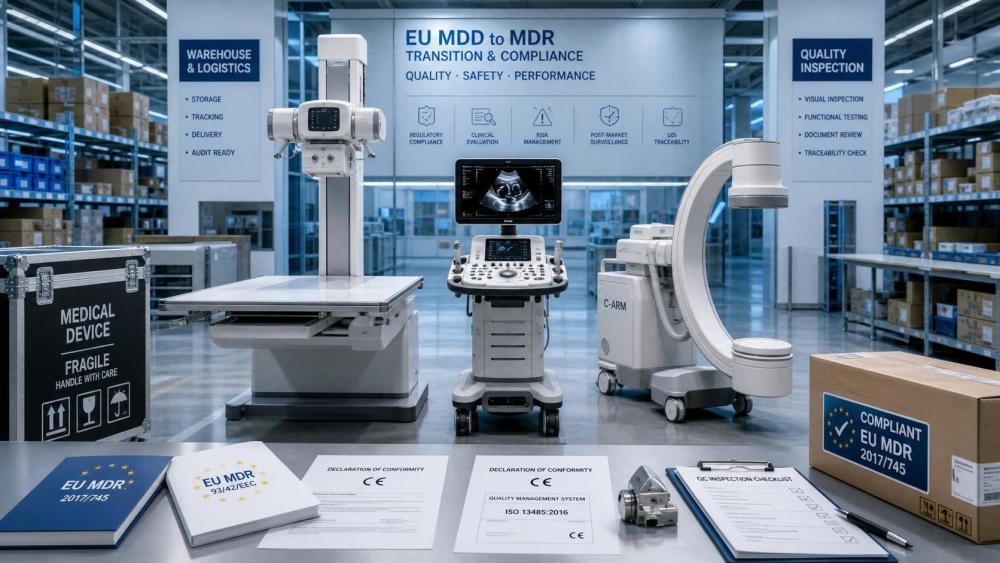
On June 27, 2026, the European Commission issued Commission Notice 2026/C 215/01, reaffirming that the original MDD framework will be fully phased out on December 31, 2026. For manufacturers, importers, distributors, and procurement teams involved in X-ray, ultrasound, C-arm, and related medical imaging equipment, the notice matters because devices still relying on MDD certification and not upgraded to MDR certification with updated technical documentation will no longer be allowed to be placed on the market, sold, or delivered in the European Economic Area from January 1, 2027.
What the Commission Notice Explicitly Confirms
According to the information provided, the European Commission published Commission Notice 2026/C 215/01 on June 27, 2026. The notice reiterates that the original MDD directive will be completely repealed on December 31, 2026. It states that medical imaging devices such as X-ray systems, ultrasound systems, and C-arm equipment that are still using MDD certification must transition to MDR certification and complete technical documentation upgrades. If that transition is not completed, those products will be barred from being placed on the market, sold, or delivered within the European Economic Area starting on January 1, 2027.
The notice also specifically states that China-made imaging devices account for 37% of the remaining stock of MDD certificates. In addition, importers are prompted to complete supplier compliance reviews during Q3.
Where the Pressure Will Appear Across the Supply Chain
Manufacturers still operating under legacy certificates
From an industry perspective, manufacturers of imaging devices are likely to face the most direct pressure because the change is tied to certification status and technical documentation readiness. The business impact is not limited to regulatory filing alone; it can affect product release timing, order acceptance, shipment planning, and whether a device can continue to be supplied into the European Economic Area after the deadline. What deserves closer attention is whether product files, declarations, and supporting documentation are aligned with the MDR transition requirement referenced in the notice.
Importers and European market operators under immediate review pressure
Analysis shows that importers are placed under a more immediate operational requirement because the notice explicitly points to Q3 supplier compliance review. For this group, the impact is likely to center on supplier screening, certificate verification, document collection, and transaction risk control. They will need to pay close attention to whether suppliers remain tied to MDD-based approvals, whether MDR transition evidence is available, and whether pending deliveries extend beyond the end-2026 cutoff.
Distributors, procurement teams, and delivery planning functions
Observably, channel operators and procurement-side teams may be affected through inventory decisions and delivery scheduling rather than first-line certification work. If a product remains on an MDD basis close to the deadline, purchasing plans, tender participation, and scheduled deliveries into the European Economic Area may all require reassessment. The practical issue is less about abstract policy change and more about whether the product being ordered can still be legally placed on the market or delivered after January 1, 2027.
Certification, testing, and document support providers
For firms supporting certification, testing, and compliance documentation, the notice points to a concentrated period of demand around document upgrades and status checks. Analysis shows that the key area of attention is not simply obtaining a certificate label, but ensuring the technical documentation package required for MDR transition is complete enough to support market access decisions by manufacturers and importers.
What Companies Should Check Now
Verify whether any active product still depends on MDD status
Analysis shows that companies should first identify which imaging products in their portfolio are still tied to MDD certification. This matters for export planning, order confirmation, and customer communication, especially where delivery dates may extend into 2027.
Review technical documentation readiness, not only certificate labels
What deserves closer attention is that the notice refers both to MDR transition and technical documentation upgrades. That means the compliance issue should not be understood narrowly as a certificate replacement exercise. Companies involved in manufacturing, import, or distribution should closely review whether the underlying documentation used in regulatory, tender, and delivery processes reflects the required upgrade status.
Recheck supplier files during the Q3 review window
Observably, the Q3 supplier compliance review signal is a practical deadline marker for importers and sourcing teams. Where supply depends on external manufacturers, current files, declarations, and product compliance representations should be checked in time to support procurement decisions and reduce late-stage delivery disruption.
Watch how procurement and contract documents respond
Because the provided information does not include detailed enforcement mechanics, it is more appropriate to understand this stage as a clear compliance signal rather than a fully described implementation framework. Companies should therefore monitor whether tender documents, purchase specifications, and delivery conditions begin to reflect stricter MDR-based entry requirements for imaging equipment intended for the European Economic Area.
Why This Reads as an Execution Signal
Analysis shows that this notice is more than a general reminder about regulatory transition. The combination of a fixed repeal date, a defined post-2026 market restriction, and an explicit Q3 compliance review prompt gives the market a concrete execution signal. At the same time, it should not be overstated as a fully closed enforcement picture, because the provided information does not include detailed interpretations on all transactional scenarios, documentation thresholds, or market-side handling practices.
From an industry perspective, the reference to China-made imaging devices accounting for 37% of the remaining stock of MDD certificates raises the visibility of the issue for exporters and import-dependent supply chains. That does not by itself determine outcomes for individual firms, but it does indicate where compliance screening pressure may be concentrated.
How This Update Is Best Understood Right Now
At this stage, the update is best understood as a firm regulatory timing signal with immediate consequences for compliance preparation, supplier review, and delivery planning in the imaging device trade. It does not by itself answer every implementation question, but it clearly narrows the room for delay. For companies exposed to European Economic Area sales, the prudent reading is that certification status, technical documentation, and contract timing now need to be checked against the end-2026 cutoff rather than treated as a routine future transition item.
Basis of This Article and What Still Needs Verification
This article is based on the user-provided news title, event date, and event summary. For developments of this kind, relevant source types typically include official notices, releases from regulatory authorities, trade or customs authorities, industry association updates, standard-setting documents, and reporting by established professional media. A specific official source link was not provided in the input, so the exact link still needs to be verified on an ongoing basis.
Further observation is still needed on detailed implementation language, certification interpretation in practice, procurement document changes, market feedback, and how affected companies execute supplier review and delivery adjustments before the stated deadline.