
On June 27, 2026, the U.S. FDA moved its final rule on Laboratory Developed Tests into effect, setting a 60-day window for FDA registration and quality system filing for LDTs distributed in the United States. The development deserves close attention from IVD exporters, U.S. laboratory customers, OEM partners, and compliance teams because it does not stop at tests built entirely inside a lab: it also brings into scope certain IVD products supplied by overseas manufacturers and then assembled or calibrated by U.S. laboratories before use, directly raising questions for cross-border supply models involving Chinese test kits.
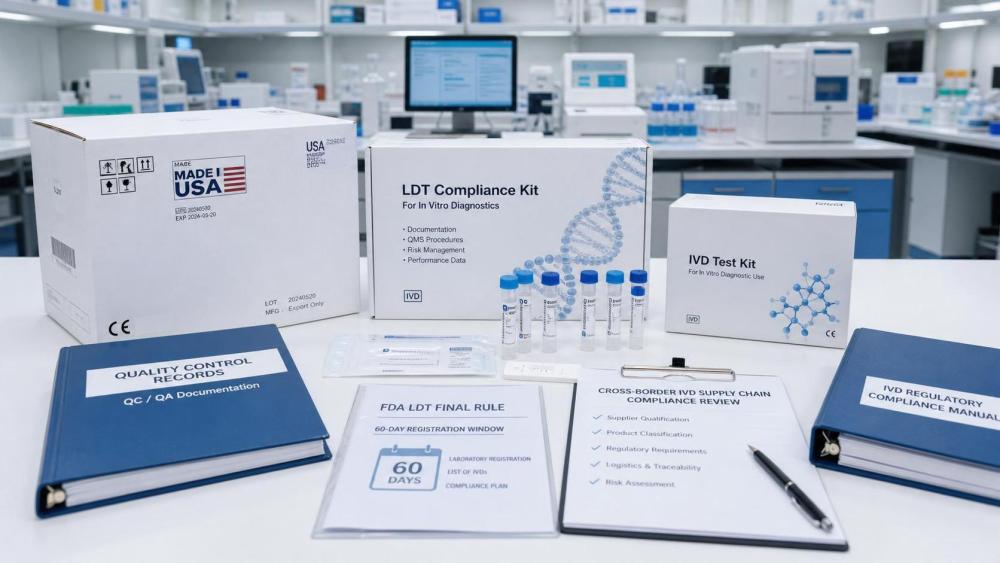
What the FDA Rule Now Covers
According to the information provided, the FDA issued the Laboratory Developed Tests Final Rule on June 27, 2026. The rule requires all LDTs distributed in the United States, including in vitro diagnostic test kits made in China, to complete FDA registration and quality system filing within 60 days from the effective date stated in the update.
The rule also explicitly includes IVD products that are not FDA approved but are supplied by overseas manufacturers and then assembled or calibrated by U.S. laboratories for use. Based on the event summary, this point is especially relevant to existing supply arrangements in which overseas manufacturers provide products to U.S. lab customers under direct supply or OEM structures.
Where the Pressure Will Likely Be Felt First
Direct export relationships with U.S. laboratories
From an industry perspective, direct trade companies supplying U.S. laboratory customers may be among the first to feel the impact because the rule reaches products that have been positioned outside traditional FDA-approved pathways but are still distributed into the U.S. market. The main pressure point is likely to be in product classification, registration readiness, and whether current delivery models remain workable within the 60-day compliance window.
OEM and contract supply arrangements
Observably, OEM cooperation terms may require closer review where a Chinese manufacturer supplies an IVD product that is later assembled or calibrated by a U.S. laboratory. The issue is not only the product itself, but also how responsibilities are described between supplier and laboratory customer. What deserves closer attention is whether current contractual language, documentation flow, and quality-related obligations still match the new regulatory framing.
Quality and documentation functions inside manufacturing companies
Processing and manufacturing enterprises may face immediate demands on internal compliance support because the rule links market access to FDA registration and quality system filing. The business effect is likely to appear in document readiness, record consistency, and coordination between export, regulatory, and customer-facing teams. Companies serving multiple U.S. lab accounts may need to review whether the same compliance approach can be applied across all shipments and customer formats.
Supply chain and delivery coordination
Supply chain service providers and fulfillment teams may also need to track the change closely. Analysis shows that when a regulatory scope expands, pressure often appears in shipment timing, release conditions, and customer communication around acceptance criteria. In this case, the immediate issue is less about logistics capacity and more about whether goods, paperwork, and customer expectations remain aligned during the 60-day window.
What Companies Should Be Watching Now
Whether current products fall into the newly clarified scope
A practical priority is to review which exported IVD products are supplied to U.S. laboratories in forms that are later assembled or calibrated before use. The key distinction in this update is that such arrangements are now expressly described as falling within the rule's regulatory scope.
Registration and quality system filing readiness
Companies with active U.S. distribution should focus on whether the required FDA registration and quality system filing can be completed within the stated 60-day period. This is a concrete operational issue, not just a policy reading exercise, because any gap between regulatory timing and internal readiness could affect delivery planning and customer commitments.
Customer communication and contract language
What deserves closer attention is the gap between policy wording and commercial practice. Businesses should examine how they describe product status, intended use, assembly or calibration steps, and compliance responsibilities in agreements with U.S. laboratory customers or OEM counterparts. This matters because the event summary indicates that the rule directly affects both direct-supply models and OEM terms.
Ongoing verification of official interpretation
Analysis shows that companies should keep watching for any further official wording, implementation clarification, or related interpretive signals tied to the final rule. Even where the headline requirement is clear, the practical impact on specific product categories and transaction structures may depend on how the rule is read and applied in real business settings.
Why This Looks Like More Than a Short-Term Notice
As an editorial observation, this development is more appropriate to understand as a concrete compliance signal rather than a routine policy update. The 60-day requirement creates a short-term operational deadline, but the broader significance lies in the FDA's stated inclusion of overseas-manufactured IVD products that are later assembled or calibrated by U.S. laboratories. That point suggests closer scrutiny of supply models that previously may have been treated as outside the main regulatory path.
At the same time, it would be premature to present every downstream consequence as settled. Observably, the confirmed facts establish the new rule and its stated scope, while the full business impact on individual exporters, laboratory customers, and OEM structures still requires case-by-case verification.
How the Market May Need to Read This Update
In practical terms, this update should be read as an immediate compliance window with longer-term implications for how cross-border IVD supply into the U.S. is structured. The short-term issue is readiness within 60 days. The broader issue is whether existing direct-sales and lab-assembly models can continue without adjustment under the clarified FDA approach. A balanced reading is that the rule already changes the compliance conversation now, while some commercial and operational consequences still need continued observation.
Basis for This Article
This article is based on the user-provided news title, event date, and event summary concerning the FDA's June 27, 2026 release of the Laboratory Developed Tests Final Rule. For this type of industry update, relevant source categories typically include official regulatory announcements, company disclosures, industry association releases, authoritative media reporting, and standard-setting or regulatory documents.
A specific official source link was not provided in the input, so the exact official publication path still needs continued verification. Follow-up attention should remain on any official clarification related to registration timing, quality system filing expectations, and how the rule is applied to overseas-manufactured IVD products supplied to U.S. laboratories for assembly or calibration.