
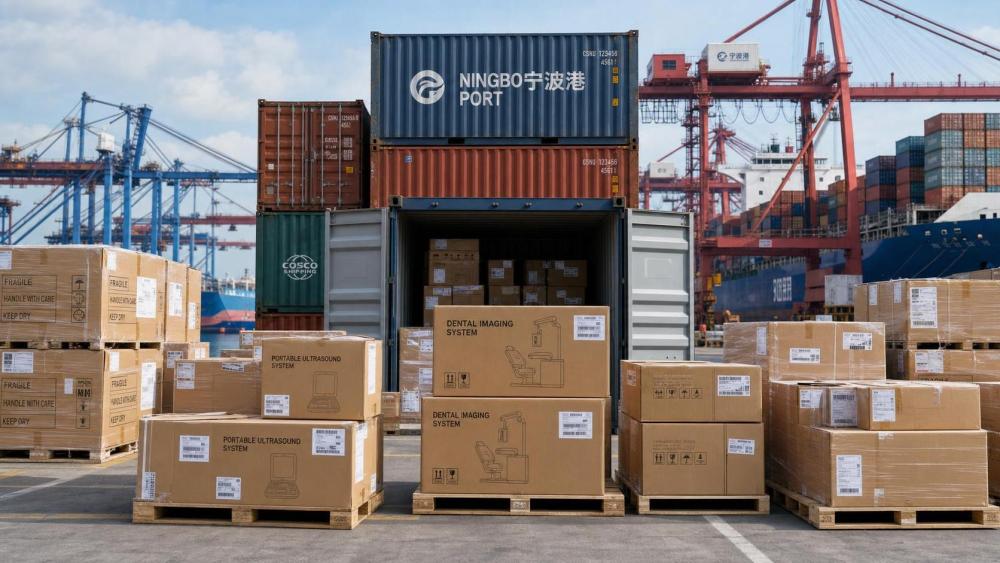
On June 28, 2026, a new export slot allocation rule for medical devices took effect at Ningbo Port following a trial notice issued by Ningbo Zhoushan Port Group on June 27. The change does not simply affect shipping schedules; it reshapes practical delivery conditions for exporters, distributors, and supply chain service providers handling dental imaging, portable ultrasound, rehabilitation equipment, and other medical device categories. The immediate reason this deserves industry attention is that port-side allocation priority has now become a direct operational variable in fulfillment planning, especially as longer booking waits are already overlapping with the continuing impact of Red Sea rerouting.
What the Trial Notice Confirms
According to the information provided, Ningbo Zhoushan Port Group issued a trial notice on June 27, 2026 to foreign trade enterprises regarding graded management of export shipping space for medical devices, with implementation starting June 28.
The notice introduces a slot allocation system for exported medical devices. High-value CT and MRI components remain in Category A priority. Dental CBCT, portable ultrasound, and electric rehabilitation beds are adjusted to Category B. For the downgraded categories, per-container allocation is reduced by 40%.
The same information also states that continuing Red Sea rerouting is compounding the effect of the port adjustment, resulting in actual booking wait times extending to 12 to 16 days. The change directly affects quarterly replenishment rhythms for distributors in Southeast Asia and Latin America.
Where the Pressure Will Be Felt First
Export planning moves from production timing to slot timing
For exporters of the affected product categories, the core issue is not only slower outbound movement but a shift in how delivery commitments need to be managed. When allocation priority changes and per-container quota falls, shipment scheduling, contract delivery windows, and booking coordination become more exposed to port-side rules. From an industry perspective, these companies need to pay closer attention to how product classification under the new allocation framework interacts with shipment documents, booking requests, and promised dispatch dates.
Distributors face replenishment friction rather than a simple freight delay
For channel and distribution businesses serving Southeast Asia and Latin America, the stated impact on quarterly replenishment cadence matters because inventory timing is linked to sales planning, after-sales support, and order turnover. Analysis shows that the issue is less about a single late shipment and more about whether recurring replenishment cycles for lower-priority categories can remain predictable under the new port rule and extended booking wait period.
Supply chain service providers will need tighter execution control
Freight forwarders, booking agents, and other supply chain service providers are likely to be affected at the execution layer. Their work may now require closer verification of product category, shipment sequencing, and available allocation under the trial management approach. What deserves closer attention is whether supporting paperwork, technical product descriptions, and cargo classification records are sufficiently clear to avoid additional friction during booking and dispatch coordination.
Procurement and after-sales teams may need to adjust delivery assumptions
Buyers and after-sales service teams connected to the affected devices may also need to revisit delivery assumptions. For product lines such as portable ultrasound or electric rehabilitation beds, any longer outbound cycle can influence installation scheduling, replacement planning, and service readiness. Observably, the main concern here is operational continuity rather than regulatory compliance alone.
What Companies Should Track in the Next Few Weeks
Watch how the category boundary is applied in practice
The notice confirms priority differences between Category A and Category B products, but the provided information does not include full operational detail on how product scope will be interpreted in day-to-day execution. It is more appropriate to monitor how booking and cargo handling teams apply category definitions to actual shipments, especially for exporters managing mixed product portfolios.
Recheck delivery promises and procurement calendars
Because actual booking waits are reported at 12 to 16 days, companies should review whether current delivery commitments, purchase orders, and replenishment plans still reflect workable lead times. Analysis shows that businesses exposed to quarterly restocking cycles may need to build more time into dispatch and receipt assumptions, even where product demand has not changed.
Keep shipment documentation and technical descriptions consistent
Where export slot priority depends on product grouping, consistency in shipment records becomes more important. Companies should pay attention to product descriptions, technical documents, and related trade paperwork used in booking and export coordination. The current information does not indicate new certification requirements, but it does suggest that document clarity may matter more when access to shipping space is being managed by category.
Monitor downstream contract and service implications
For businesses supplying distributors or service networks, the practical question is whether longer outbound timing could trigger changes in delivery terms, installation planning, or after-sales commitments. From an industry perspective, this is a point to watch rather than a confirmed outcome, because the provided information confirms slower booking access but does not define how customers or counterparties will formally respond.
Why This Looks Like an Execution Signal
Analysis shows that this development is better understood as an implemented operational rule change rather than a general market rumor. A named trial notice was issued, an effective date was specified, priority categories were differentiated, and a measurable reduction in per-container allocation was stated. At the same time, it is still a rule dynamic that requires continued observation because the provided information does not yet establish the full execution standard, duration, or any later adjustment mechanism.
Observably, the significance of the notice lies in how a port allocation rule can quickly become a commercial constraint for specific medical device segments. The overlap with Red Sea rerouting also means companies cannot treat the issue as a standalone port event; scheduling pressure is building from more than one operational source.
How This Update Is Best Understood Now
At this stage, the development is best read as a live change in export execution conditions for selected medical device categories moving through Ningbo Port. It does not confirm a broad regulatory overhaul for all medical device trade, but it does indicate that shipping access has become more selective for some product groups. A neutral reading is that the market should treat this as a concrete execution signal with immediate delivery implications, while still reserving judgment on longer-term effects until more implementation feedback becomes visible.
Basis of This Article
This article is generated from the user-provided news title, event date, and event summary. The information used here is limited to the provided description of the trial notice issued by Ningbo Zhoushan Port Group and the stated changes in export slot allocation, product priority, reduced per-container quota, longer booking waits, and effects on replenishment timing.
For events of this kind, relevant source types would typically include official port notices, regulatory or trade authority releases, customs or trade administration information, industry association updates, standard-setting documents, and reporting by authoritative media. No specific official source link was provided in the input, so the exact official link remains to be verified on an ongoing basis.
Further verification is still needed on later implementation details, operational interpretation of product categories, any updated execution guidance, changes in procurement or tender documentation, industry feedback, and how affected companies ultimately adjust delivery and replenishment practice.