
Ultrasound gel is often treated as a low-risk consumable because it is routinely applied to intact skin and used in small quantities. That assumption can become unsafe once the gel, bottle, dispenser tip, or dispensing process is contaminated. The consequence may range from no detectable harm to a preventable infection-control event, depending on the organism involved, the patient population, the examination type, and whether the gel contacts compromised skin, a wound, a mucosal surface, or an invasive procedure site.
For a sonographer or department manager asking what happens if ultrasound gel gets contaminated during use, the practical answer is straightforward: stop using the affected product or dispensing system, prevent further patient exposure, assess where and how it was used, and follow the facility's infection-prevention escalation process. The issue is not only the gel itself. It is also the possibility that contaminated material has transferred to transducers, hands, linens, procedure surfaces, and subsequent patients.
Why contamination changes the risk profile
Ultrasound gel supports acoustic coupling between the transducer and the patient. It is usually water-based and designed to spread easily, which also means it may be exposed repeatedly to hands, gloves, probe surfaces, bedding, clothing, and environmental surfaces during a busy imaging session. Once a container or dispensing tip is contaminated, each later use can become another opportunity for transfer.
The clinical impact is highly dependent on the use case. Gel applied externally to healthy, intact skin generally presents a lower risk than gel used near a fresh incision, pressure injury, burn, vascular access site, drainage area, or other disrupted skin. Risk rises further when gel is used in examinations involving mucous membranes or procedures where a probe cover, sterile barrier, sterile gel, or a dedicated single-use product may be required by local protocol.
A contaminated bottle does not automatically prove that an infection has occurred. It does, however, remove the assurance that the product is being handled as intended. That is enough to justify action, particularly in neonatal, intensive care, oncology, perioperative, interventional, and immunocompromised patient settings, where the consequences of avoidable exposure can be more serious.
Contamination may involve bacteria from hands or patient contact, residues introduced by touching the nozzle to skin or a probe, backflow from refill practices, or organisms that persist in a poorly cleaned dispenser. A bottle can also appear normal while still being unsuitable for continued use. Clear gel, an intact label, and an unexpired date do not establish that an opened container has remained hygienic.
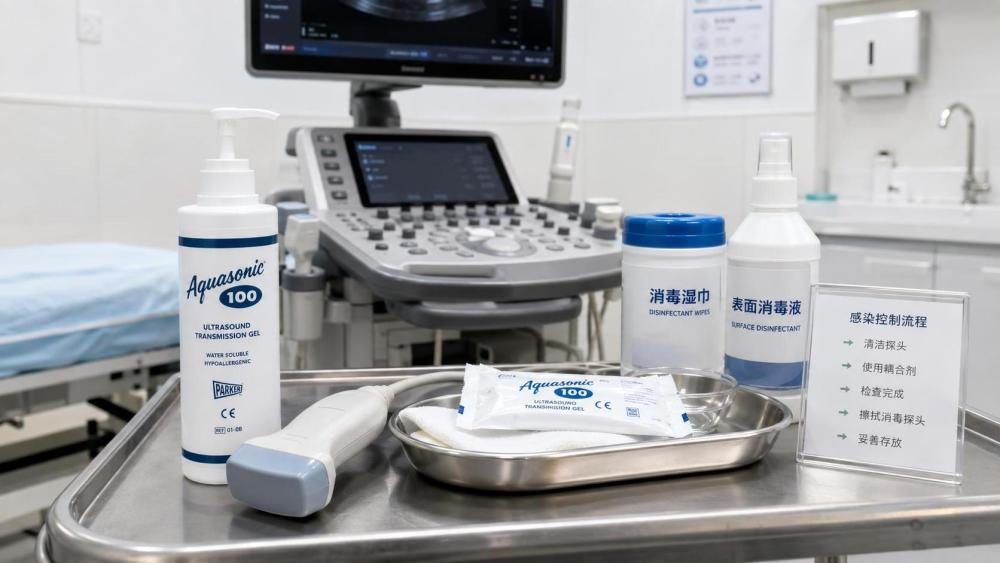
The first operational response: contain before investigating
When staff suspect contamination during an examination, the priority is to contain the situation without creating unnecessary disruption or concealing the chain of events. If the bottle tip has touched a non-clean surface, if gel has visibly changed in appearance, if a container has been improperly topped up, or if there is a credible concern about storage or handling, the product should be removed from service rather than returned to the cart for later review.
The probe and any surfaces that may have been exposed should be cleaned and disinfected using the equipment manufacturer's instructions and the facility's established workflow. This matters because transducer compatibility is not a minor maintenance detail. An overly aggressive chemical or an unapproved cleaning method may damage probe materials, while inadequate processing can leave a route for cross-contamination.
For the patient currently being scanned, the response should be proportionate to the exposure. Gel on intact skin can generally be removed as part of normal post-examination care. If the gel was used on non-intact skin, near a procedure field, or in a higher-risk examination, the clinical team and infection-prevention personnel may need to determine whether further documentation, observation, or follow-up is appropriate under local policy.
Staff should preserve enough information to support a meaningful review: product type, lot or batch identifier where available, date opened, location, dispenser type, examination category, and the number of potential exposures. Discarding a suspect bottle without recording basic traceability information may make it harder to determine whether the problem was isolated to handling, linked to a particular storage location, or associated with a broader product-control issue.
Actions that commonly make the situation worse
- Continuing to use the bottle because the nozzle was wiped after contact.
- Refilling a partly used bottle from a larger container without an approved, controlled process.
- Assuming the probe is clean because a disposable cover was used, even when gel or hands may have contacted the uncovered handle or cable.
- Applying a general-purpose gel in a setting that calls for sterile or single-use gel.
- Cleaning transducers with products that are not approved for that specific probe model.
- Treating a contamination concern as solely a nursing, sonography, or environmental-services issue rather than reviewing the full workflow.
Not every ultrasound examination requires the same gel controls
A useful mistake to avoid is applying one rule to every ultrasound workflow. Departments need controls that match exposure risk. Routine abdominal, vascular, musculoskeletal, and obstetric examinations on intact skin may use multi-use containers where local procedures permit, provided staff can dispense gel without the container tip touching the patient, probe, gloves, linens, or nearby surfaces.
That approach is less suitable where the examination involves vulnerable tissue or a sterile field. In those settings, the selection of gel is part of the procedure setup, alongside probe processing, barrier use, and staff technique. A department may need sterile gel, unit-dose packaging, or another approved single-patient-use format. The distinction should be made before the scan begins, rather than by trying to compensate after a contamination event.
The table is not a substitute for local clinical policy. Its value is in showing why a single bulk gel solution may be operationally convenient but clinically inappropriate across every department. Procurement teams should resist treating ultrasound gel as a uniform commodity when it is being purchased for materially different care environments.
Where contamination usually enters the workflow
The most common vulnerability is the dispenser tip. A bottle may be clean when opened, then become contaminated when its nozzle touches skin, a probe, a gloved hand, a bed sheet, or an equipment surface. In a crowded ultrasound room, that contact can happen quickly, especially when staff are focused on maintaining probe position, supporting the patient, and adjusting the console.
Refill practices create another weak point. Reusable bottles can reduce packaging waste and unit cost, but uncontrolled refilling introduces uncertainty: Was the bottle fully emptied? Was it cleaned and dried according to an approved process? Did the refill source remain protected? Did staff mix old and new gel? Unless the organization has a validated, consistently followed method, refilling can turn a simple consumable into a recurrent infection-control concern.
Storage also matters. Open bottles left on portable carts, in shared procedure areas, or near sinks may be exposed to splashes and repeated handling by multiple staff members. A container that moves between rooms without a clear ownership or replacement process can make traceability difficult. The operational problem often is not a single lapse but an unclear system in which everyone assumes someone else is checking dates, cleaning the holder, and removing compromised stock.
What procurement and clinical engineering teams should examine
For buyers, a lower unit price is not a complete comparison. The relevant question is whether the packaging and handling model supports the intended clinical workflow. A bulk bottle may be reasonable for lower-risk external scanning if staff can use it without tip contact and the department can manage opened-product controls. It may be a poor fit for mobile, critical-care, sterile, or high-turnover settings where opportunities for contamination are more frequent and documentation is harder to maintain.
Product evaluation should include practical questions that operators can answer before a contract is awarded:
- Is the product intended for external use only, or is there a sterile version for relevant procedures?
- Does the package clearly distinguish sterile, non-sterile, single-use, and multi-use formats?
- Can staff dispense the gel without touching the patient or probe with the bottle tip?
- Is the bottle shape stable on carts and easy to handle while wearing gloves?
- Are lot identification and expiry information visible after the product enters ward or ultrasound-room storage?
- Can the organization define an opened-date and discard process that staff can realistically follow?
- Does the department have compatible, approved cleaning and disinfection instructions for every transducer involved?
Clinical engineering teams have a related responsibility: probe cleaning instructions must be accessible at the point of use and aligned with the gels, covers, disinfectants, and accessories actually purchased. A technically correct infection-control policy can fail in practice when it calls for products that are unavailable, poorly stored, incompatible with the equipment fleet, or too cumbersome for the pace of care.
Distributors and manufacturers should also provide clear labeling and use information. Ambiguous packaging can lead staff to use a non-sterile gel where sterile gel was expected, or to assume a multi-use container is appropriate in a setting where the facility's procedure requires single-patient use. The commercial handoff is incomplete when the product arrives without the information needed to place it correctly in the clinical workflow.
A contamination event is often a process signal
One visibly contaminated bottle may be an isolated handling error, but it can also reveal a broader weakness: inadequate training for temporary staff, missing point-of-use supplies, poorly designed carts, unclear ownership of portable ultrasound systems, or an unrealistic protocol that is routinely bypassed under time pressure.
A short review should ask practical questions rather than search for blame. Was the correct gel format available? Could the operator keep the nozzle from touching surfaces in the normal scanning position? Was the bottle labeled with its opening date? Were there separate supplies for routine imaging and higher-risk procedures? Could staff identify which patients or rooms may have been affected? Answers to those questions often point to a workflow correction that is more valuable than simply replacing one bottle.
Contaminated ultrasound gel should therefore be treated as a patient-safety and process-control issue. The immediate response is to remove the suspected source, clean and process affected equipment correctly, document potential exposure, and involve the appropriate clinical and infection-prevention teams. The longer-term response is to match gel packaging, storage, dispensing practice, and probe-processing requirements to the clinical risk of each ultrasound workflow. That is where a routine consumable becomes part of a reliable imaging system.