
ICU infusion equipment should be selected as a medication-safety system rather than as a collection of individual pumps. A suitable configuration must maintain delivery accuracy under demanding conditions, present drug information clearly, detect meaningful faults without overwhelming staff with alarms, and fit the physical and digital environment around a critically ill patient. A low purchase price has limited value when the system creates frequent programming workarounds, incompatible consumable requirements, delayed alarms, or difficult service recovery.
The starting point is the intended therapy mix. Continuous vasoactive drugs, sedatives, analgesics, insulin, anticoagulants, antibiotics, parenteral nutrition, intermittent infusions, and high-volume fluids place different demands on the equipment. A general-purpose large-volume pump may be appropriate for some fluids but unsuitable for low-rate, high-risk drug delivery. Syringe pumps provide finer control at low flow rates, yet their performance is influenced by syringe size, syringe brand recognition, line compliance, mounting angle, and the time required to establish stable flow after a syringe change.
Match pump types to the clinical delivery profile
Selection should begin with a therapy map that records the usual concentration range, programmed rate range, delivery duration, line length, access route, and consequence of an interruption for each common infusion. This exposes whether the proposed fleet needs syringe pumps, volumetric pumps, patient-controlled devices where locally applicable, enteral feeding pumps, or a combination of these categories.
For vasoactive and other titrated infusions, low-flow performance deserves closer scrutiny than the maximum flow rate displayed in a brochure. A pump can be accurate over a broad test range while still showing delayed flow stabilization when a very low rate is initiated, when a syringe is replaced, or after downstream pressure changes. This matters because long, narrow tubing, extension sets, stopcocks, needleless connectors, and compliant syringes can store pressure before fluid movement becomes clinically apparent. The system should support a controlled transition between syringes or bags when uninterrupted delivery is required.
Volumetric pumps should be assessed for their ability to deliver the intended solution through the administration sets used in the ICU. Tubing material, cassette design, anti-free-flow mechanism, pumping segment placement, and compatibility with filters or specialized sets affect both operation and procurement. A pump should not be evaluated with a generic demonstration set if the hospital intends to use a different set configuration in routine care.
Interpret accuracy and occlusion data in context
Accuracy claims are often misunderstood because they describe controlled test conditions. The clinically relevant question is how the device behaves during the first minutes of an infusion, at very low rates, near the end of a syringe, after a downstream occlusion is released, and when a line is moved. Short observation windows can conceal flow variation that becomes visible over a longer period. Conversely, a longer averaging period can obscure a brief but meaningful delivery gap for a potent drug.
Occlusion performance requires the same context. A low pressure alarm threshold may identify downstream resistance sooner, but it can also increase nuisance alarms when patients move, lines are positioned awkwardly, or small-bore catheters generate normal resistance. A high threshold reduces interruptions but allows more pressure to build before the alarm occurs. When an occlusion is released, stored pressure in the syringe and tubing can produce a post-occlusion bolus. Review both the alarm delay and the volume released after occlusion, using representative syringes, tubing lengths, filters, and programmed rates.
- For low-rate infusions, examine start-up behavior, flow continuity after syringe changes, and the effect of different compatible syringe sizes.
- For high-volume therapy, assess rate stability, air detection, free-flow protection, and the usability of the loading path under routine ICU conditions.
- Where multiple infusions run through a common vascular access device, consider dead space, carrier fluid arrangements, and the delay between a pump adjustment and drug delivery at the patient end.
A technically correct pump setting does not guarantee an immediate clinical effect. The line configuration may be the source of delay or unintended bolus exposure, especially when several drugs share manifolds, extension lines, or multi-lumen access.
Assess the medication library as a controlled clinical asset
A dose error reduction system is valuable only when its drug library reflects local practice and is maintained with discipline. During evaluation, inspect how the library handles drug names, concentrations, units, dosing weight, rate limits, loading doses, and care-area profiles. Displayed names should remain distinguishable when abbreviated on the pump screen. Similar drug names, concentration variants, and unit formats create avoidable selection errors when the interface compresses information or requires scrolling.
Hard limits and soft limits should be reviewed separately. Hard limits can prevent an unsafe program from proceeding, but overly restrictive limits encourage staff to select an incorrect profile or seek a bypass. Soft limits generate a warning that may be appropriate when a treatment is intentionally outside the usual range, but repeated non-actionable alerts train people to dismiss prompts. The safety value lies in well-governed limits, clear escalation pathways, and regular review of alert data, rather than in maximizing the number of warnings.
Library management also needs practical controls. Determine who can create, approve, test, release, and retire a drug library version. A safe workflow separates clinical content approval from technical deployment, confirms that the intended version reaches every device, and preserves a record of what changed. Emergency drug updates require an especially clear process. A library that cannot be updated efficiently may remain clinically outdated; an update process without verification can introduce inconsistent configurations across a unit.
Alarm design affects attention at the bedside
Alarm assessment should cover audibility, visual indication, message clarity, priority logic, and the path from alarm to corrective action. An alarm that merely states “occlusion” provides less operational value than one that identifies the channel and guides the user toward the relevant tubing path or syringe. In a crowded room, the ability to identify the affected channel quickly matters as much as the volume of the alarm tone.
Evaluate the alarm set under realistic conditions: several active channels, dimmed lighting, bed movement, line repositioning, and concurrent patient-monitor alarms. Distinguish alarms caused by genuine delivery risk from those caused by set loading, a nearly empty container, a temporary pressure change, or a communication interruption. Excessive nuisance alarms do not simply create annoyance; they slow recognition of alarms that require immediate response.
Battery behavior deserves similar attention. The specified battery duration is less useful than understanding the actual channel load, screen brightness, wireless activity, battery age, and recharge process. During intrahospital transport, a pump may need to operate with multiple channels, frequent screen interaction, and intermittent network coverage. Confirm whether low-battery alerts provide enough time to act and whether the equipment remains functional during a controlled power transition.
Examine interoperability beyond the network connection
Network capability alone does not establish a safe interoperable workflow. The relevant questions are which data elements can move between systems, when they are transferred, how they are confirmed, and what happens when a connection fails. For example, electronic medication administration records, barcode workflows, patient association, central monitoring, and auto-programming features each introduce different safety dependencies.
Auto-programming can reduce manual transcription, but only if the source order, patient identity, concentration, route, channel assignment, and final displayed settings are reliably matched. A transferred order should not obscure the need for a visible confirmation on the pump. Test interruptions such as duplicate orders, canceled orders, delayed updates, a patient transfer, temporary network loss, and a pump assigned to the wrong bed location. These conditions often reveal integration weaknesses that are absent in a polished demonstration.
Central visibility of pump status can support surveillance, yet it should be clear which states are transmitted and with what latency. A remote screen that shows an infusion as active may not reveal a downstream issue, a paused channel, a local override, or a line disconnected from the patient. The display should support, not replace, direct bedside assessment.
Include cybersecurity and access control in the acceptance criteria
Connected infusion equipment forms part of the hospital network and should be assessed accordingly. Request documentation on user authentication, role-based permissions, encryption where applicable, audit trails, software update handling, vulnerability disclosure, and supported operating life. The practical issue is not whether the device has a cybersecurity statement; it is whether there is an actionable process for receiving, evaluating, and deploying updates without disrupting critical care activity.
Service access deserves scrutiny. Remote diagnostics can reduce downtime, but access should be controlled, logged, and aligned with local network policy. Clarify whether software changes can alter pump behavior, drug library content, network settings, or alarm configuration, and identify the approval process for each change. Legacy equipment that cannot receive security updates may require compensating network controls, but these controls should be defined before deployment rather than after an incident.
Test the physical workflow, not only the interface
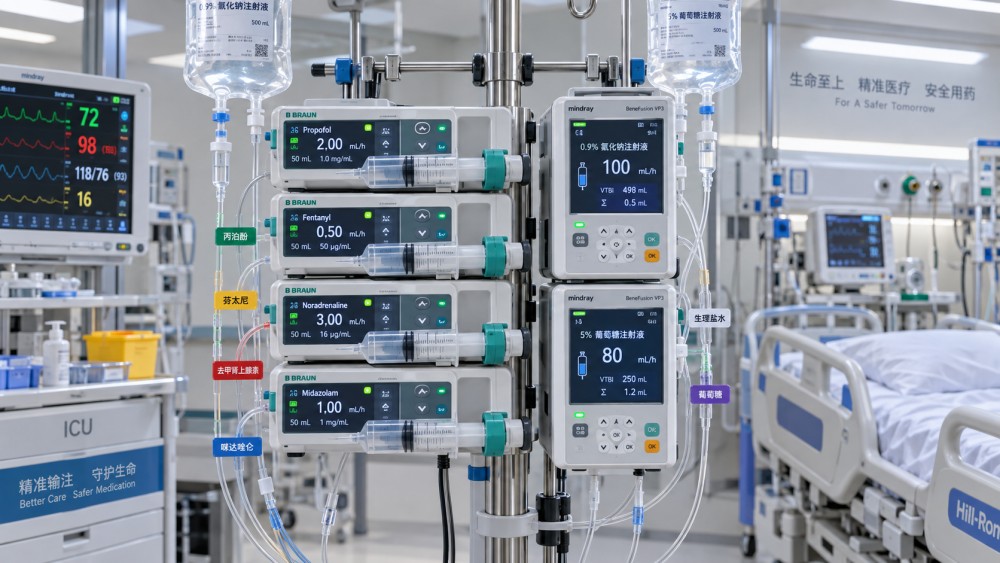
ICU bed spaces are dense with monitors, ventilators, syringe drivers, fluid warmers, line-management hardware, and transport accessories. The pole clamp, channel stacking arrangement, screen angle, cable routing, and center of gravity affect safety. A pump tower that is stable in a showroom may become difficult to access when positioned beside ventilator tubing and multiple medication lines.
Observe how a clinician loads a syringe or set, primes the line, identifies the channel, confirms the drug, starts the infusion, changes a container, acknowledges an alarm, and traces tubing to the patient. The sequence should be tested while wearing gloves and while managing several concurrent infusions. Small interface details become significant: whether the screen remains readable from the working position, whether a channel label stays visible, whether programming requires repeated navigation, and whether a paused infusion is unmistakable.
Line tracing should be considered part of the equipment configuration. Channel labels, drug labels, color conventions where locally approved, mounting order, and tubing routing need to remain legible despite cleaning, condensation, and frequent adjustments. Equipment that forces lines to cross or hides labels behind stacked modules increases the chance of connecting the wrong line during urgent treatment changes.
Procurement documents should define the whole operating model
A request for quotation should specify more than pump count and unit price. Include the required pump categories, compatible administration sets and syringes, drug library functions, alarm capabilities, mounting hardware, battery expectations, data interfaces, cybersecurity documentation, training materials, maintenance tools, and test equipment. Consumables should be evaluated for availability, labeling, storage conditions, shelf life, packaging integrity, and the risk of substitution with non-approved alternatives.
Service arrangements need operational detail. Confirm preventive maintenance tasks, calibration or performance verification requirements, battery replacement expectations, spare-parts availability, turnaround arrangements for failed devices, loan equipment provisions, and access to event logs. A fleet with a small number of spare pumps may be adequate in a unit with predictable utilization but insufficient where bed occupancy fluctuates or equipment must accompany frequent transports.
Before full deployment, conduct acceptance testing with the actual accessories, software version, drug library, network configuration, and mounting arrangement intended for clinical use. The test should include representative low-rate and high-rate therapies, alarm scenarios, battery operation, patient association where used, recovery after a communication interruption, and a controlled review of the displayed infusion history. This final stage often identifies mismatches between supplier configuration and local workflow that cannot be resolved by specification comparison alone.
The strongest selection outcome is a coherent infusion environment: the right pump type for each therapy, a governed medication library, alarms that direct attention effectively, compatible lines and accessories, and service processes that preserve performance after installation. Those elements reduce the number of assumptions required at the bedside, where ICU drug safety is ultimately tested.