
Which operating room sterilization system fits your surgical workflow?
Selecting hospital sterilization systems for an operating room is primarily a workflow decision, not a comparison of sterilizer chamber sizes or advertised cycle times. The right configuration is the one that can consistently process the actual instrument sets used by the surgical schedule, release them with complete records, and recover safely when a cycle is delayed or a unit is unavailable.
A small operating suite with predictable general surgery lists may work well with a straightforward steam sterilization setup and disciplined sterile supply procedures. A busy surgical department with complex instrument trays, implants, minimally invasive devices, and rapid turnover needs a more deliberate system: appropriate sterilization modalities, sufficient capacity, clean and dirty workflow separation, tracking integration, and a practical contingency plan. Buying one large sterilizer does not automatically create that resilience.
Start with the instrument journey, not the equipment list
The most useful evaluation begins by mapping an instrument set from the moment it leaves the operating room to the point at which it is available for the next procedure. This journey usually includes collection and transport, decontamination, inspection, assembly, packaging, sterilization, cooling or aeration where required, storage, and case-cart or point-of-use delivery.
Every handoff can create a bottleneck. A sterilizer may have adequate chamber capacity, yet the department can still fall behind because trays wait for inspection, packaging staff cannot keep pace, a load requires an unavailable accessory, or completed packs cannot be released until documentation is reviewed. For this reason, operating room sterilization planning should involve sterile processing leadership, operating room management, infection prevention, clinical engineering, facilities, and procurement from the beginning.
Build the assessment around real demand rather than a generic procedure count. Review the surgical specialties, the number and composition of instrument sets per case, the heaviest tray configurations, peak operating periods, emergency demand, and the expected interval between uses of the same set. A system that performs adequately on an average day may fail during a concentrated elective schedule or when urgent cases interrupt the planned sequence.
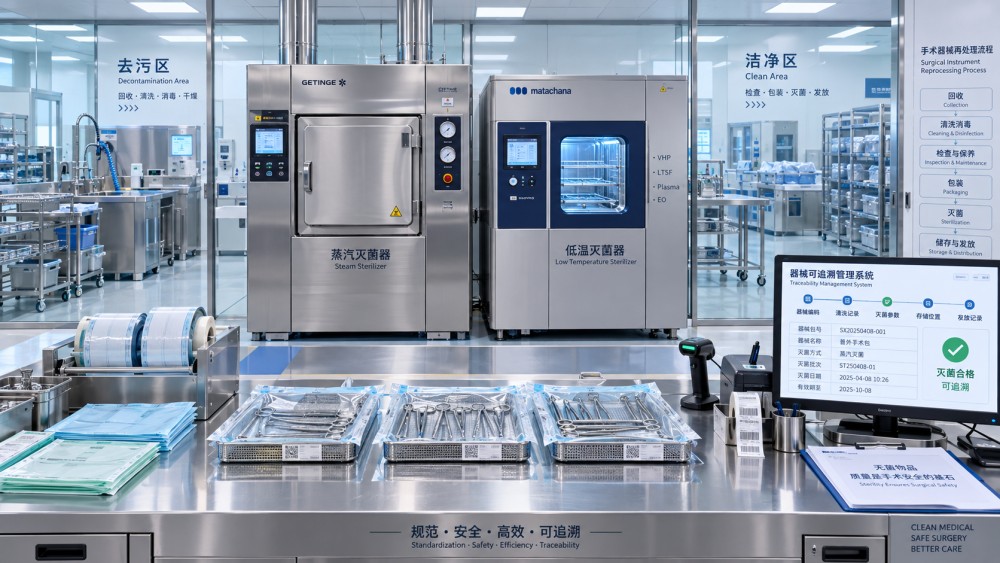
Match the sterilization method to device materials and processing instructions
Steam remains the core modality in many hospital sterilization systems because it is well suited to compatible metal instruments, linens, and many reusable surgical devices. It can support high-volume processing when the load is properly prepared and the facility can provide dependable steam, water, drainage, ventilation, and electrical infrastructure. But steam is not a universal answer. Heat-sensitive instruments, certain powered devices, flexible components, and complex lumen-containing devices may require a validated low-temperature process.
The correct choice is governed by the device manufacturer’s processing instructions and the hospital’s validated process, not by convenience. A low-temperature sterilizer may be necessary for specific device families, but it can bring different limitations around compatible materials, lumen dimensions, load configuration, consumables, aeration, or accessories. Treating it as a general backup for every surgical tray is a common planning mistake.
Cleaning must remain central to this evaluation. Sterilization does not compensate for ineffective cleaning, poor point-of-use treatment, retained soil, or inadequate inspection. Complex surgical instruments often place more pressure on decontamination capacity and staff technique than on the sterilizer itself. If the wash area, ultrasonic cleaning process, water quality, or inspection capability is weak, installing a new sterilizer will not resolve the underlying risk.
Calculate capacity around peaks, downtime, and load mix
Cycle time is only one part of available capacity. A more realistic calculation includes loading and unloading time, cooling time, chemical indicator review, documentation, transport, and the interval before a processed set is ready for use. It also considers whether the chamber is filled with the load types that produce the best use of its volume. A chamber that routinely runs half-full due to tray dimensions, packaging constraints, or specialty segregation has less practical throughput than its nominal capacity suggests.
Examine daily and weekly demand patterns. Orthopedic, cardiovascular, spine, ophthalmic, and minimally invasive programs can create very different load profiles. Heavy sets may reduce the number of trays that fit safely in a load. Loaner instrumentation can arrive late and require separate processing attention. A facility with several simultaneous rooms may need parallel processing capability even when total daily volume appears modest.
Redundancy deserves explicit consideration. Planned maintenance, qualification work, utility interruptions, failed cycles, and unexpected repairs are normal operational realities. The question is not whether one unit can process the expected volume when everything works perfectly. The question is whether the department can continue to support safe surgery when one part of the system is constrained. This may lead to multiple appropriately sized units, reserve instrument inventory, adjusted scheduling practices, or formal support arrangements. The appropriate mix depends on the hospital’s clinical services and acceptable disruption level.
Do not confuse immediate-use processing with normal turnover capacity
Pressure to turn a tray quickly can lead teams to view immediate-use steam sterilization as a routine capacity tool. It should not be used to conceal insufficient inventory, poor case planning, missing instruments, or an overloaded sterile processing department. Such dependence also adds coordination pressure at the point of care and makes traceability more difficult.
When urgent turnaround requests are common, investigate the cause. The issue may be an unrealistic surgical sequence, insufficient duplicate sets, lengthy inspection requirements for a specialty device, late arrival of loaner trays, or a handoff failure between the operating room and sterile processing. Solving that constraint usually creates a more reliable workflow than purchasing a system based on its shortest possible cycle.
Evaluate the facility as part of the sterilization system
A sterilizer is inseparable from its installation environment. Technical evaluations should include available floor space, access routes for delivery and replacement, floor loading where relevant, door clearance, drainage, steam or water supply, electrical capacity, heat rejection, ventilation, and room layout. These considerations affect installation cost, maintenance access, staff movement, and the ability to maintain segregation between contaminated and clean activities.
Water quality is especially important because it can influence equipment reliability, chamber condition, and process performance. The required water treatment arrangement should be assessed with the equipment supplier and facilities team early, rather than treated as a minor installation detail after procurement. The same applies to steam quality where plant steam is used, condensate handling, and room environmental conditions.
Layout should support a one-direction movement of instruments from contaminated to clean areas. Staff should not need to cross through clean packaging zones while handling used devices, and completed sterile packs should not compete for space with incoming contaminated loads. In a constrained renovation, workflow drawings often reveal problems that equipment specifications alone do not show.
Traceability must work during routine pressure
For operating room sterilization, documentation is not an administrative add-on. It allows the hospital to connect a load, cycle record, operator action, and released instrument set to the relevant surgical use. That connection supports recall response, quality review, maintenance investigation, and accountability when a process deviation occurs.
Evaluate how records are created and retrieved in normal work, not just during a supplier demonstration. Consider whether the system can capture operator identification, sterilizer and cycle identification, load contents, biological or chemical monitoring records as applicable, exception handling, and release status. If a tracking platform is used, assess interoperability with the sterilizer interface, instrument set labels, sterile processing workflow, and operating room documentation.
A technically capable tracking system can still fail in practice when scanning adds friction, labels do not survive processing, staff must enter duplicate information, or exceptions are handled outside the system. The best approach is usually the simplest one that creates complete, retrievable records without forcing staff into workarounds.
Service support and consumables change the long-term value
Purchase price should be separated from lifecycle cost. A lower-cost unit can become expensive when it has frequent downtime, difficult access to parts, limited local technical support, or a consumable model that does not align with expected activity. Conversely, a higher initial investment may be justified when it reduces workflow disruption, fits the existing utility infrastructure, or supports a broader range of validated loads.
Ask suppliers to describe preventive maintenance tasks, typical service access requirements, training scope, recommended spare parts, software support, remote diagnostics where available, and response arrangements for a critical outage. Request clarity on which components are included, which supplies are recurring, and which responsibilities sit with the hospital facilities team. The assessment should also consider whether biomedical engineering can safely perform designated first-line checks or whether all intervention depends on external service.
Training needs should be evaluated beyond the initial installation. Sterile processing work relies on consistent loading, packaging, monitoring, release, and deviation management. Staff turnover, new surgical programs, and new device types can all create a training requirement later in the equipment lifecycle.
A practical selection sequence
Technical evaluators can reduce weak assumptions by following a staged process:
- Collect procedure schedules, instrument inventories, tray weights and dimensions, reprocessing instructions, and emergency demand patterns.
- Map the current route from operating room use through sterile processing and back to point of use. Mark queues, manual handoffs, repeated urgent requests, and areas where clean and dirty flow intersect.
- Separate loads into those suited to steam and those requiring another validated modality. Identify accessories, adapters, packaging, and cleaning requirements that shape the usable load.
- Model peak demand, not only annual or average activity. Include cooling, release, transport, planned maintenance, and loss of one critical unit.
- Validate room utilities, layout, drainage, ventilation, access, and water treatment before shortlisting equipment.
- Compare suppliers on process compatibility, records, serviceability, installation support, training, consumables, and operational resilience rather than on cycle duration alone.
- Document the acceptance, qualification, monitoring, and escalation approach before the system becomes operational.
Questions that expose an unsuitable proposal
A proposal needs closer examination when it assumes every instrument can be processed by one modality, uses average procedure volume as the capacity basis, omits cooling and release time, or treats low-temperature sterilization as a generic convenience option. It is also incomplete when it does not show how contaminated and sterile items move through the space, how tracking records are connected to operating room use, or how surgery will continue during planned maintenance and unexpected downtime.
For hospitals building an equipment shortlist, a structured information source can help compare technical terms and procurement questions across sterilization equipment, operating room infrastructure, and clinical engineering requirements. Global MedTech & Healthcare Intelligence Hub (MTHH) focuses on organizing these decision factors so teams can assess operational fit alongside equipment specifications, service expectations, and long-term management needs.
The strongest choice is rarely the system with the fastest claimed cycle or the largest chamber. It is the configuration that matches the instrument portfolio, maintains validated processing discipline, fits the physical facility, creates usable records, and supports the surgical program when demand is high or a component is unavailable. That is the standard by which an operating room sterilization system should be judged.
Have questions about the global trade trends discussed here, or planning your expansion and supply chain strategy? Leave a message below and let the trade experts at MTHH guide you.
We respect your privacy. Your information is strictly confidential.
Related News
- Hong Kong Outlines Medical Device Legislation and Plans for Statutory RegulatorNov 14, 2026Hong Kong medical device legislation could reshape regulatory oversight. Explore the proposed regulator and what businesses should monitor.
- AAMI Issues TIR115 Guidance on Public Cloud Use in Medical DevicesNov 13, 2026AAMI TIR115:2026 guides public cloud use in medical devices. Explore its focus on risk management, supplier assessment and device boundaries.
- How are critical care devices regulated in the United States?Nov 12, 2026Critical care devices face FDA requirements based on intended use and risk. Explore classifications, marketing pathways, and practical compliance checks.
- Hong Kong Drafts Medical Device Bill to Establish Statutory OversightNov 12, 2026Hong Kong's Medical Devices Bill could introduce risk-based statutory oversight. Discover what the proposed framework may mean for suppliers.