
From October 1, 2026, companies shipping in vitro diagnostic reagents to the United States will face a more specific import compliance requirement: clinical performance validation reports and localized translations must be submitted in eCTD v6.3 format. The change follows an FDA import compliance alert issued on July 17, 2026, and deserves attention because it affects not only regulatory filing preparation, but also document readiness, importer coordination, and customs timing for exporters serving the U.S. IVD market.
What the FDA notice requires
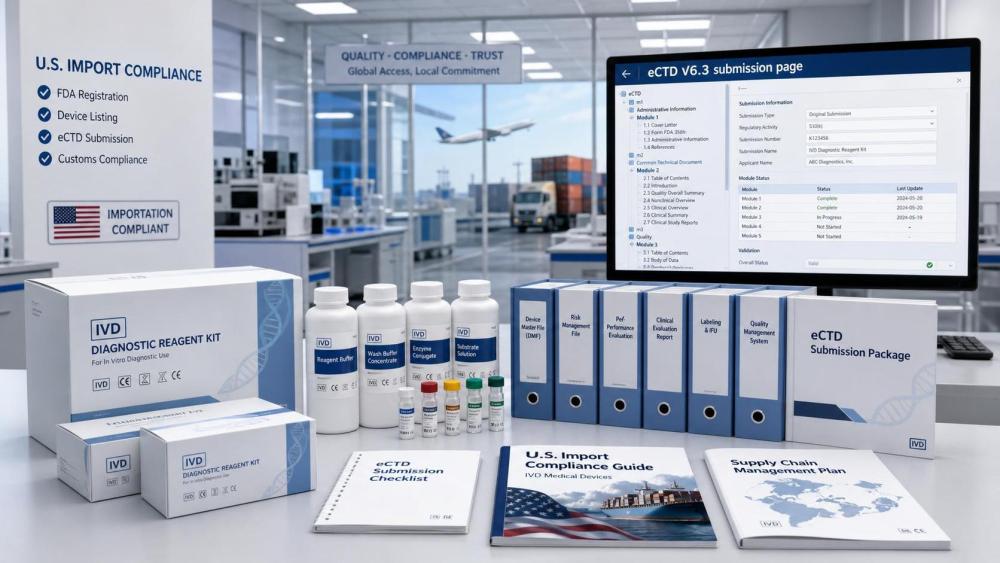
According to the information provided, the FDA issued IVD Import Compliance Alert No. 26-07 on July 17, 2026. The notice applies to all IVD reagents exported to the United States, including POCT, molecular testing, and immunoassay reagents. Starting on October 1, 2026, these products must be accompanied by clinical performance validation reports submitted in eCTD v6.3 format, together with localized translation versions. The same information indicates that the new requirement directly affects the registration submission path, document preparation cycle, and customs clearance timeliness of Chinese IVD exporters, while importers need to coordinate in advance with suppliers on format conversion and FDA portal account linkage.
Where the operational pressure is likely to appear
Export filing teams will face a document workflow shift
From an industry perspective, the immediate effect for export-oriented IVD manufacturers is not limited to content preparation. The rule change points to a filing format and submission workflow requirement, which means regulatory teams must pay closer attention to whether clinical evidence files and translation materials are ready in the required structure before shipment and submission milestones are reached. For businesses already working on U.S.-bound registration or import documentation, the pressure is likely to appear in internal review sequencing and handoff timing between technical, clinical, and regulatory staff.
Importers will need earlier supplier coordination
For importers, the update matters because the requirement is tied not only to the existence of supporting documents, but also to format conversion and FDA portal account linkage. That creates a stronger dependency on upstream supplier readiness. What deserves closer attention is whether importers can obtain compliant files from manufacturers early enough to avoid delays in filing preparation or product release schedules. In practice, this may push importer-supplier coordination further upstream in the transaction cycle.
Clearance and delivery planning may become more sensitive to documentation timing
For supply chain and delivery functions, the provided information specifically mentions customs clearance timeliness. Analysis shows that any mismatch between shipment planning and compliant document submission could affect delivery predictability. This does not by itself confirm a uniform outcome across all transactions, but it does signal that logistics planning, document collection, and submission readiness will need closer alignment where U.S.-bound IVD products are involved.
What companies should watch before the effective date
Readiness of clinical evidence files
Companies should closely review whether existing clinical performance validation reports can be organized and submitted in eCTD v6.3 format within current preparation timelines. The practical issue here is less about adding new marketing language and more about whether existing technical and clinical documentation can move through the required submission path without creating avoidable bottlenecks.
Consistency and availability of localized translations
The requirement includes localized translation documents, so businesses should watch the completeness and consistency of translated materials alongside the source reports. Observably, translation is no longer a peripheral supporting task in this context; it becomes part of the submission package that may influence filing readiness and downstream timing.
Importer account linkage and submission responsibility
Because the summary specifically notes FDA portal account linkage, companies involved in cross-border supply should clarify early which party is responsible for account access, submission preparation, and final package coordination. Where multiple entities share the workflow, unclear ownership may create delays even if the underlying technical documents already exist.
Lead times in procurement and shipment scheduling
For procurement, order planning, and outbound delivery teams, it is more appropriate to understand this update as a lead-time issue as well as a compliance issue. Businesses serving U.S. customers may need to reassess document cut-off dates, supplier submission readiness, and shipment timing assumptions, especially where product release depends on synchronized document handling.
Why this should be read as an execution signal
Analysis shows that this update is best understood as a concrete execution signal rather than a general policy discussion. The effective date is clearly stated, the affected product scope is identified at a category level, and the required submission format is named. At the same time, it remains necessary to watch how filing expectations, documentation review practice, and market-side implementation are reflected in later official wording or operational feedback. In other words, the rule direction appears defined, while some execution details still warrant continued observation.
How the market is likely to interpret the change
At this stage, a balanced reading is that the FDA update raises the practical compliance threshold for U.S.-bound IVD reagent imports by making format, clinical evidence, and translation readiness part of the same operational requirement. It should not be overstated as a stand-alone market outcome, but it should be taken seriously as a filing and delivery management issue. For affected companies, the most rational view is to treat it as an already effective compliance expectation with implementation details that still need to be tracked closely.
Basis of this article and points that still require verification
This article is based on the user-provided news title, event date, and event summary. For developments of this type, relevant source categories typically include official regulatory notices, customs or trade administration releases, industry association updates, standard-setting documents, and reporting from authoritative trade media. A specific official source link was not provided in the input, so the precise official publication path still requires follow-up verification. Continued attention should also be given to any later clarification on implementation details, certification and filing practice, tender document changes, industry feedback, and how affected companies execute the new requirement in practice.