
On July 23, 2026, the FDA revised its emergency use authorization pathway for IVD products used during a public health emergency, introducing a faster review route for multiplex respiratory tests such as combined COVID-19, influenza, and RSV assays. For exporters, distributors, and procurement teams tied to the U.S. IVD market, the update matters because it changes the rhythm of submission preparation, affects how clinical data may be organized for filing, and can alter launch and replenishment timing in a market where approval windows and inventory decisions are closely linked.
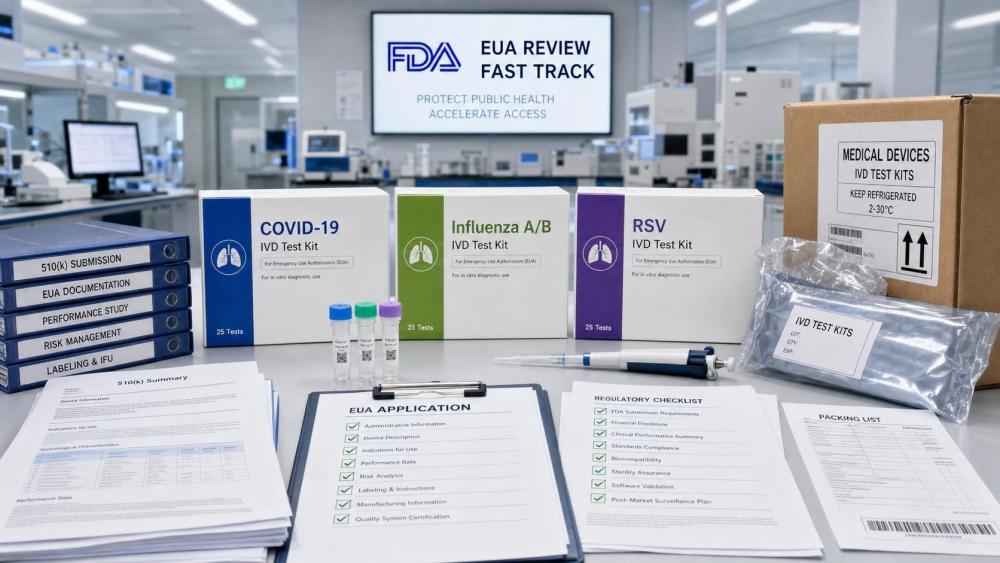
What the FDA Changed on July 23
According to the provided event summary, the FDA issued revised guidance on July 23, 2026 to simplify the EUA application process for IVD products in a public health emergency. The update specifically applies a pre-validated template and a 48-hour initial response mechanism to multiplex pathogen tests, including products such as COVID-19, influenza, and RSV combination assays. The same summary states that the adjustment directly affects the filing pace of registration materials submitted to the U.S. market by Chinese IVD exporters, as well as clinical data requirements and the timing window for market entry. It also has immediate reference value for distributor inventory planning and procurement cycles.
Where the Immediate Pressure Points May Appear
Export filing teams may face a shorter preparation cycle
From an industry perspective, exporters are likely to feel the impact first because a faster EUA channel can compress internal timelines for dossier assembly and review readiness. What deserves closer attention is whether existing technical files, submission formats, and supporting materials can be aligned quickly enough with the revised template-based process. Even without additional execution details in the input, the compliance focus clearly shifts toward submission discipline, document completeness, and timing control.
Clinical and regulatory functions may need tighter coordination
Analysis shows that any change tied to clinical data requirements can affect how regulatory and evidence packages are prepared. For manufacturers and compliance teams, the practical issue is not only what data are needed, but also how quickly those materials can be organized in a form suitable for the updated EUA route. This may influence review sequencing, internal approval workflows, and the handoff between product, quality, and regulatory personnel.
Distributors and channel buyers may need to reset planning assumptions
Observably, distributors and procurement-side participants are exposed because a faster initial FDA response can change assumptions around availability windows. That does not automatically mean approval outcomes are guaranteed, but it does mean inventory planning, replenishment timing, and purchase cycle decisions may need to be reviewed against a potentially shorter regulatory response loop. For channel operators, the relevant business points are stock positioning, ordering cadence, and document readiness linked to product onboarding.
Supply chain and delivery scheduling could become more time-sensitive
For supply chain service providers and downstream delivery planners, the rule change may matter less as a policy headline and more as an execution signal. If filing and feedback cycles accelerate, shipment preparation, packaging schedules, and delivery coordination may need to match a narrower commercial window. The key issue is not confirmed volume expansion, which is not stated in the input, but the possibility that operational timing becomes less forgiving.
What Companies Should Watch Next
Alignment between submission files and the revised template
Analysis shows that one of the most immediate tasks is to review whether current EUA submission materials can be mapped cleanly to the pre-validated template referenced in the update. Companies should pay attention to the structure of technical documentation, consistency across supporting materials, and whether internal review teams can respond at the speed implied by the new pathway.
How clinical data expectations are expressed in practice
The provided information confirms that clinical data requirements are affected, but it does not define the exact execution standard. It is therefore more appropriate to understand this as an area requiring continued monitoring rather than as a settled operational rule. Regulatory, quality, and product teams should closely track later official wording, review feedback patterns, and any market-facing documentation that reflects how the revised pathway is being applied.
Procurement timing and channel documentation discipline
For distributors, import-side planners, and procurement teams, the immediate question is how to manage purchase timing without overcommitting stock. What deserves closer attention is whether product onboarding files, technical support materials, and transaction-related documents are ready to move in step with a potentially faster review process. The event summary supports attention to inventory planning and procurement cycles, but not any assumption of uniform market acceleration.
Post-market support and traceability readiness
Observably, a compressed authorization pathway can place more operational weight on after-sales coordination, document traceability, and quality follow-through once a product enters the market window. The input does not provide specific post-market obligations, so this should be treated as a compliance watchpoint rather than an established new requirement. Even so, companies involved in export and distribution would be prudent to review how quickly they can provide records, technical explanations, and quality-related support if market activity accelerates.
Why This Looks More Like an Execution Signal Than a Final Rule Endpoint
Analysis shows that this update is best read as a concrete execution signal within an emergency regulatory pathway rather than as a fully self-contained endpoint for market interpretation. The presence of a pre-validated template and a 48-hour initial response mechanism indicates procedural acceleration, but the provided information does not establish how broadly the revised approach will be applied across product categories, nor does it settle all practical review expectations. That is why the market should distinguish between a real process change already announced and the still-developing details of how that change will be interpreted in filings, procurement behavior, and downstream commercial planning.
How the Market May Best Read This Development
At this stage, the FDA update is most appropriately understood as an implemented procedural change with immediate relevance for filing pace and planning discipline, especially for multiplex respiratory IVD products targeting the U.S. market. It should not yet be treated as a basis for broad conclusions about demand, approval outcomes, or uniform market expansion. A measured reading is more useful: the rule change is already meaningful for exporters, distributors, and compliance teams, but its full operational impact still depends on how the revised pathway is applied in practice.
Basis of This Article and What Still Needs Verification
This article is generated from the user-provided news title, event date, and event summary. For developments of this type, source categories commonly relevant to later verification include official regulatory announcements, publications from supervisory authorities, trade or customs-related notices, industry association updates, standard-setting documents, and reporting by established professional media. No specific official source link was provided in the input, so the exact official reference still needs to be verified on an ongoing basis. Continued attention should remain on later policy detail, practical review interpretation, procurement document changes, tender-language shifts, market feedback, and how affected companies implement the revised EUA route in actual operations.