
On July 1, 2026, the FDA released a new guidance document for exported IVD technical documentation that sets a much tighter response expectation for Chinese manufacturers shipping in vitro diagnostic devices to the U.S. The change matters beyond a procedural update: it directly touches customs timing, registration continuity, and the pace of new submissions, while also giving overseas distributors a more concrete basis for judging a supplier’s compliance readiness and document control capability.
A narrower response window now sits at the center of export compliance
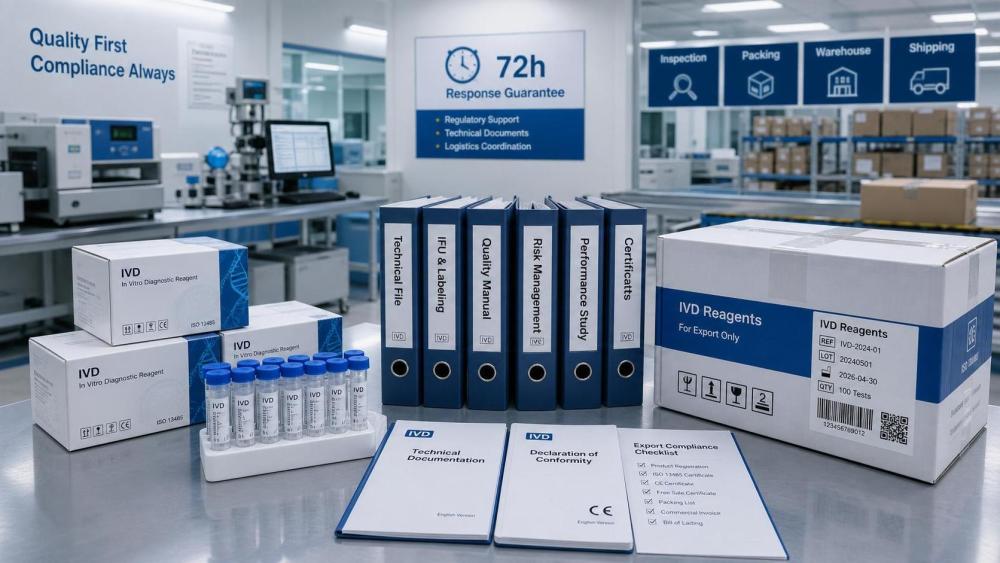
According to the information provided, the FDA issued the Guidance on Rapid Response for IVD Export Technical Documentation on July 1, 2026. The guidance requires all Chinese manufacturers exporting IVD products to the United States to submit complete English technical documentation within 72 hours after receiving a written FDA inquiry.
The required documentation includes performance validation, software confirmation, risk analysis, and a summary of clinical evaluation. If the manufacturer does not provide the full English documentation within that time frame, import review suspension will be triggered.
The stated impact of this requirement falls on customs clearance efficiency, renewal of registrations, and the progress of new submissions. The same requirement also becomes a key reference point for overseas distributors when assessing supplier responsiveness and compliance maturity.
Where the pressure will likely appear across the chain
Exporting manufacturers will face a documentation timing test
From an industry perspective, the most immediate exposure sits with IVD exporters themselves. The issue is not only whether technical files exist, but whether they can be assembled in complete English form quickly enough after a formal FDA written query. What deserves closer attention is the operational link between regulatory records, quality documentation, software-related evidence, and clinical summary materials, because the rule connects those materials directly to import review continuity.
Distributors may treat response capability as a supplier screening factor
For overseas distribution channels, the update may affect supplier qualification and ongoing portfolio management. Analysis shows that response speed to regulator questions can become part of how distributors judge whether a manufacturer is dependable for registration maintenance, shipment continuity, and new product rollout. In practice, procurement and channel teams may pay closer attention to whether a supplier can provide complete English technical packs without delay.
Submission and delivery planning may need tighter coordination
Supply chain and commercial teams may also feel the effect where export scheduling, customs clearance, and registration milestones are linked. Observably, any inability to respond within the stated 72-hour window may create downstream pressure on delivery commitments, distributor inventory planning, and submission sequencing. For companies active in the U.S. market, document readiness becomes more closely tied to shipment and market access timing.
Practical points companies should keep under review
Check whether English technical files are truly submission-ready
Analysis shows that companies should pay close attention to whether the required materials already exist in a complete English set rather than in partially translated or fragmented form. The guidance specifically points to performance validation, software confirmation, risk analysis, and clinical evaluation summaries, so those elements warrant immediate internal review.
Watch how the requirement affects registration and new filing workflows
What deserves closer attention is how this response rule interacts in practice with registration continuity and the pace of new submissions. The input states that these areas are directly affected, but it does not provide detailed execution mechanics. That means companies should treat workflow alignment, internal ownership, and response escalation as active watchpoints rather than assume a settled enforcement pattern.
Revisit supplier qualification and procurement review criteria
For distributors, importers, and procurement teams, it is reasonable to review whether current supplier assessment standards capture responsiveness to formal regulatory questions. This is especially relevant where supplier approval, reorder decisions, or launch planning depend on stable import review and predictable compliance support.
Keep an eye on follow-on clarification and market practice
The published requirement is specific on timing and document scope, but the input does not include further detail on implementation language or supporting procedures. Observably, companies should continue monitoring subsequent official wording, execution interpretation, and any changes in transaction documents or market-side compliance expectations.
Why this looks more like an execution signal than a background policy note
Analysis shows that this development is better understood as an operational compliance signal tied to actual export execution rather than as a broad policy statement with distant effects. The rule does not simply ask whether a manufacturer has technical evidence on file; it emphasizes whether that evidence can be delivered in full, in English, and within a fixed response period after a written inquiry. That makes responsiveness itself part of compliance performance.
At the same time, it is also appropriate to keep some caution in interpretation. The information provided confirms the rule and its direct areas of impact, but it does not yet establish how market participants will adjust internal review thresholds, contract terms, or filing timelines in practice. For that reason, continued observation remains necessary.
What the market should take from this update now
At this stage, the FDA guidance is most appropriately understood as a concrete tightening of documentary response expectations for Chinese IVD exporters to the U.S. market. The significance lies less in adding a new category of documents than in compressing the time allowed to present complete English technical support once questioned. In practical terms, the update should be read as a near-term compliance and execution issue affecting import review continuity, submission rhythm, and supplier evaluation standards.
Basis of this article and what still needs verification
This article is based on the user-provided news title, event date, and event summary. For events of this type, relevant source categories commonly include official regulatory notices, releases from supervisory authorities, customs or trade administration information, industry association updates, standard-setting documents, and reporting by authoritative trade media.
No specific official source link was provided in the input, so the exact official publication link still needs to be verified on an ongoing basis. Further observation is also needed on detailed implementation language, certification and review interpretation, possible changes in tender or procurement documentation, market feedback, and how affected companies execute the requirement in practice.