
On June 30, 2026, the FDA updated its fast-response guidance for IVD export pre-review, introducing a new timing requirement for Chinese manufacturers exporting IVD reagents, analyzers, and related software to the U.S. The change matters because it links technical documentation response speed directly to review progress, which can affect export timing, customs clearance rhythm, distributor expectations, and supplier qualification discussions across the IVD trade chain.
A tighter response window now sits inside pre-review
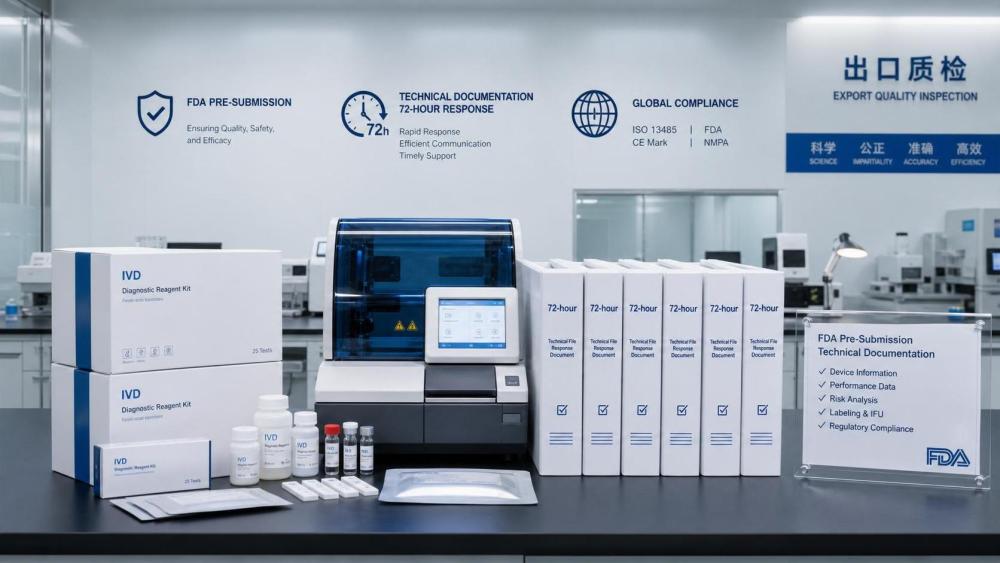
According to the provided event summary, the FDA updated the IVD Export Pre-Review Rapid Response Guidance on June 30, 2026. Under the updated requirement, Chinese manufacturers exporting IVD reagents, analyzers, and supporting software to the U.S. must submit complete technical documentation within 72 hours after receiving an FDA pre-review inquiry.
The required documentation includes performance validation, software verification, and a clinical evaluation summary. If the manufacturer does not provide the full materials within that 72-hour period, an automatic review delay will be triggered.
The same provided information states that this policy directly affects customs clearance timing and market access rhythm for IVD exporters, and also creates a new benchmark for overseas distributors when assessing the responsiveness and compliance maturity of Chinese suppliers.
Where the rule change is likely to be felt first
Export operations may face pressure at the documentation handoff stage
From an industry perspective, exporters are likely to feel the impact first because the rule ties review timing to the speed and completeness of technical document submission. The most exposed business steps are likely to be internal document retrieval, version control, cross-functional review, and submission readiness once an FDA inquiry is received. What deserves closer attention is whether performance validation files, software confirmation records, and clinical evaluation summaries can be assembled in a form that supports a 72-hour turnaround.
Distributors may raise supplier screening standards
Analysis shows that overseas distributors may treat this update as a practical test of supplier responsiveness rather than as a paperwork issue alone. The immediate effect may appear in supplier qualification, onboarding review, and ongoing account management, where response capability and compliance preparedness become more visible procurement criteria. For channel partners, the key concern is not only whether a product can be supplied, but whether the manufacturer can sustain review continuity without avoidable delay.
Supply chain and delivery planning may need more buffer
Observably, supply chain service providers, planning teams, and buyers may need to pay closer attention to timing risk around export review. Where shipment schedules or launch plans depend on predictable review progress, an automatic delay mechanism can affect delivery sequencing and replenishment assumptions. This does not prove a specific disruption outcome, but it does make document readiness a more relevant part of scheduling and handover control.
Compliance support functions may be drawn closer to commercial execution
For teams handling regulatory documentation, testing records, software evidence, and post-submission support, the change may narrow the gap between compliance work and front-line trade execution. What deserves closer attention is whether documentation is stored, updated, and reviewed in a way that allows fast retrieval when questioned, rather than being treated as a static filing requirement.
What companies should watch in day-to-day execution
Document completeness is no longer separate from timing
Analysis shows that the new requirement should be read as a combined expectation on both completeness and response speed. A company may therefore need to review whether performance validation materials, software verification records, and clinical evaluation summaries are maintained in a submission-ready condition instead of being compiled only after a question arrives.
Internal escalation paths may matter as much as the files themselves
Because the response clock begins after an FDA pre-review inquiry is received, companies should pay attention to who receives the inquiry, who owns the response, and how technical, regulatory, and commercial teams coordinate within a short window. The provided information does not describe the detailed execution method, so this remains an operational point to monitor rather than a confirmed enforcement pattern.
Supplier qualification and procurement reviews may become more document-driven
For distributors and buyers, this update may justify closer checks on a supplier's document control discipline, response workflow, and compliance preparedness. It is more appropriate to understand this as a likely shift in review focus, not as confirmed uniform market behavior, because the input does not provide direct evidence on how every buyer or channel partner will respond.
Further official wording and market practice still need verification
What deserves closer attention is whether subsequent official communication, tender documents, partner questionnaires, or transaction terms begin reflecting this faster response expectation more explicitly. Since the provided information does not include detailed implementation language beyond the 72-hour requirement and the consequence of automatic delay, companies should continue tracking execution interpretation carefully.
Why this looks like an execution signal, not just a policy notice
Observably, this update is more significant as an operational rule signal than as a general policy headline. The core change is not simply that the FDA asked for technical materials, but that it attached a short and explicit response window to pre-review interaction and linked non-response to automatic delay. From an industry perspective, that shifts attention from broad compliance status to real-time compliance responsiveness.
At the same time, it is more appropriate to understand this as a rule with immediate practical relevance and still-evolving execution implications. The confirmed facts establish the timing requirement and the delay consequence, but they do not yet answer every question about how market participants will standardize reactions, how internal workflows will change, or how consistently counterparties will incorporate the new expectation into qualification and purchasing processes.
How this update is best understood for now
At this stage, the development is best read as a concrete tightening of review responsiveness expectations for Chinese IVD exporters to the U.S. Its practical significance lies in the way technical documentation readiness now bears more directly on review pace, delivery rhythm, and partner confidence. A measured conclusion is that the update already matters at the execution level, while its full commercial and compliance impact still depends on how official interpretation, buyer behavior, and market practice develop after the rule change.
Basis of this article and what still requires follow-up
This article is generated from the user-provided news title, event date, and event summary. For developments of this type, commonly relevant source categories may include official regulatory releases, notices from supervisory authorities, customs or trade-administration information, industry association updates, standards body documents, and reporting by authoritative trade media.
No specific official source link was provided in the input, so the exact source document link still requires follow-up verification. Further observation is also needed on detailed policy language, certification and compliance interpretation, changes in tender or procurement documents, industry feedback, and how companies implement the requirement in actual export operations.