
On July 27, 2026, the FDA updated its guidance for remote assessment of pre-market IVD submissions, signaling a practical change in how overseas manufacturers may interact with U.S. market review procedures. Under the updated approach, technical documentation for 510(k), De Novo, and PMA pathways can be submitted and assessed fully through electronic means, without an on-site inspection being required for market clearance. For IVD exporters, compliance teams, and regulatory service providers, this is worth close attention because it directly touches registration timing, documentation readiness, and the cost structure tied to U.S. market entry.
What the updated guidance confirms
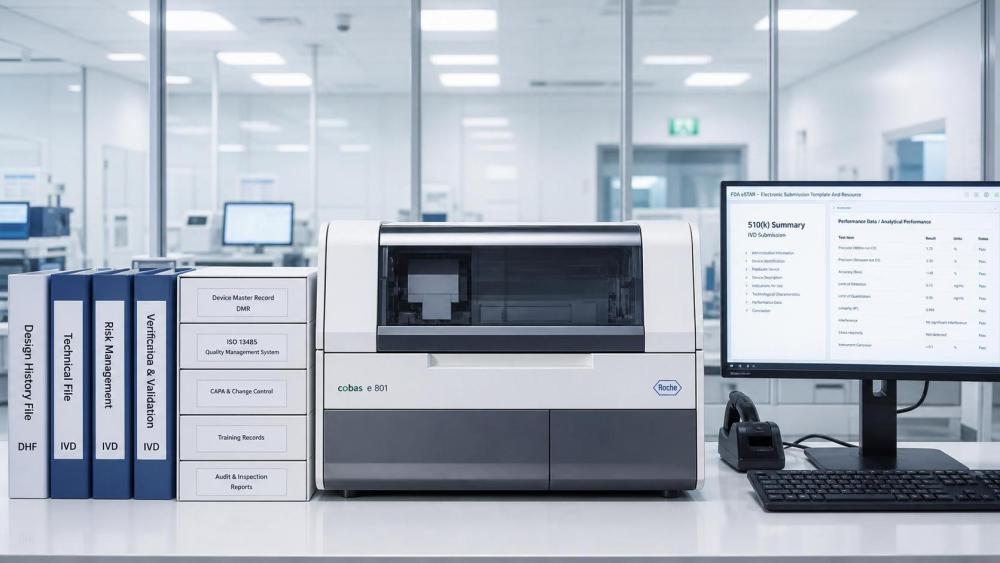
The confirmed facts are limited but clear. The FDA issued IVD Pre-Market Submission Remote Assessment Guidance v2.1 on July 27, 2026. The update explicitly allows overseas manufacturers, including suppliers from China, to provide technical documentation electronically and undergo remote conformity assessment across 510(k), De Novo, and PMA routes. Based on the provided event summary, market authorization may be obtained without an on-site review. The same summary also states that the adjustment directly affects registration timing and compliance costs for IVD exporters to the United States, and is particularly favorable to Chinese manufacturers that already maintain complete UDI, QMS, and electronic documentation systems.
Where the change is likely to be felt first
Export registration teams may face a different preparation sequence
From an industry perspective, companies preparing IVD submissions for the U.S. market are likely to feel the change first because the review interface shifts further toward digital document readiness. The main effect is likely to appear in dossier preparation, internal document control, and coordination between regulatory, quality, and product teams. What deserves closer attention is whether existing submission files, traceability records, and technical evidence can be presented in a form that is complete, searchable, and review-ready in a remote setting.
Manufacturing and quality functions will be judged more through system evidence
For manufacturing sites and quality teams, the adjustment points attention toward how clearly UDI, QMS records, and supporting technical files can be organized and maintained. Analysis shows that where on-site review is no longer a default step in the pathway described by the event summary, documented consistency may carry greater operational weight in day-to-day compliance preparation. In practical terms, this affects document governance, version control, and the ability to retrieve materials quickly during assessment.
Regulatory support and testing-related service providers may need to adapt deliverables
Certification-related service providers, testing support organizations, and regulatory consultants may also be affected because client expectations are likely to move toward documentation formats that are easier to transmit and evaluate electronically. The relevant business impact is less about a new market claim and more about workflow alignment: reports, supporting records, and technical packages may need to fit a more fully digital review environment. Observably, the change increases the importance of document usability, not only document completeness.
Procurement and channel partners may pay closer attention to supplier readiness
For buyers, distributors, and channel partners involved with U.S.-bound IVD products, the policy signal may matter because supplier approval timelines and launch scheduling are often linked to registration progress. Analysis shows that partners may need to pay closer attention to whether an upstream manufacturer has a mature electronic documentation system and stable quality traceability records. That does not guarantee faster approval in any individual case, but it can affect how market-entry planning and delivery expectations are assessed.
What companies should monitor now
Documentation quality is becoming a front-line compliance issue
What deserves closer attention is not only whether documents exist, but whether they are structured for remote technical assessment. Companies involved in U.S. submissions should closely review the completeness and internal consistency of technical files, UDI-related records, and QMS documentation because the event points to a review process that depends on electronic accessibility.
Execution details still need verification in practice
Although the guidance change is already described as effective, the provided information does not include detailed operating procedures, review expectations, or case-handling nuances. It is therefore more appropriate to understand this as an implemented regulatory shift with execution details that still require observation. Companies should monitor official wording, assessor practice, and any subsequent clarification that may affect how remote review is carried out in real submissions.
Submission planning and delivery commitments may need recalibration
For export-oriented IVD manufacturers, registration timing and compliance cost are the most directly referenced business variables in the event summary. Analysis shows that this may influence launch sequencing, customer commitments, and internal resource allocation. The practical issue is not to assume uniformly faster outcomes, but to reassess planning assumptions where remote assessment could change document preparation workloads or reduce dependence on on-site review arrangements.
Supplier qualification may increasingly include digital compliance capability
For firms selecting manufacturing or supply partners, the event suggests a more concrete reason to evaluate digital regulatory readiness. In this context, supplier qualification may increasingly focus on whether a partner can maintain complete, current, and auditable electronic records. That is especially relevant where U.S. submission support, post-market traceability, and quality follow-up depend on fast retrieval of approved documentation.
How this should be read at this stage
Observably, this development is more than a procedural footnote because it changes the accepted review format for overseas IVD manufacturers across major FDA pre-market pathways named in the event summary. At the same time, it would be premature to treat it as a uniform outcome accelerator for every exporter. Analysis shows that the immediate value of the change depends heavily on whether a company already has disciplined electronic records, stable quality systems, and documentation that can withstand remote scrutiny without relying on in-person clarification.
It is also more appropriate to understand this as both a landed rule change and an execution signal. The rule change itself is clear in the summary provided; the market effect, however, will still depend on how companies, service providers, and downstream buyers adjust their review expectations and operating practices.
A practical reading for the market
In practical terms, the FDA update points to a more digital route for IVD pre-market review involving overseas manufacturers, including Chinese suppliers. The event matters because it may reshape how compliance effort is distributed across registration, quality documentation, supplier evaluation, and delivery planning. A balanced reading is that the change is already meaningful at the procedural level, while its full commercial and operational effect still needs to be assessed through actual implementation, official clarifications, and market feedback.
Basis of this article and what still needs checking
This article is based on the user-provided news title, event date, and event summary. For developments of this type, commonly relevant source categories include official regulatory notices, releases from supervisory authorities, trade or customs information, industry association updates, standard-setting documents, and reporting by established professional media. No specific official source link was provided in the input, so the exact official link still needs to be verified on an ongoing basis.
Further observation is still needed on practical enforcement details, review interpretation, any later clarification in certification or compliance practice, possible changes in tender or procurement documentation, industry feedback, and how enterprises implement the new remote assessment route in real submission workflows.