
Central Sterile Services Department Standards: Key Compliance Risks to Watch
Central Sterile Services Department Standards: Key Compliance Risks to Watch
For quality and safety leaders, central sterile services department compliance is not just about passing an inspection. It sits right in the middle of infection prevention, OR continuity, equipment protection, and legal exposure. In practice, the biggest problems rarely start with a dramatic equipment failure. They usually start with a small gap that people learn to work around: an unclear dirty-to-clean boundary, an incomplete sterilization record, a skipped routine test, a technician doing a step from memory instead of from a validated process.
If you are reviewing a central sterile services department, the useful question is not “Do we have a sterilizer?” It is “Can we prove that every stage, from decontamination to release, is controlled, traceable, and consistently executed?” That is where standards matter. Depending on the country and facility type, the reference set may include ISO 13485-related supplier documentation, ISO 17665 for moist heat sterilization, ISO 11135 for ethylene oxide, ISO 11138 for biological indicators, ISO 11140 for chemical indicators, AAMI ST79, HTM guidance in some markets, and local infection control or hospital licensing rules. The exact framework must be checked against your jurisdiction, but the risk patterns are very consistent.
Start with flow segregation, because everything downstream depends on it
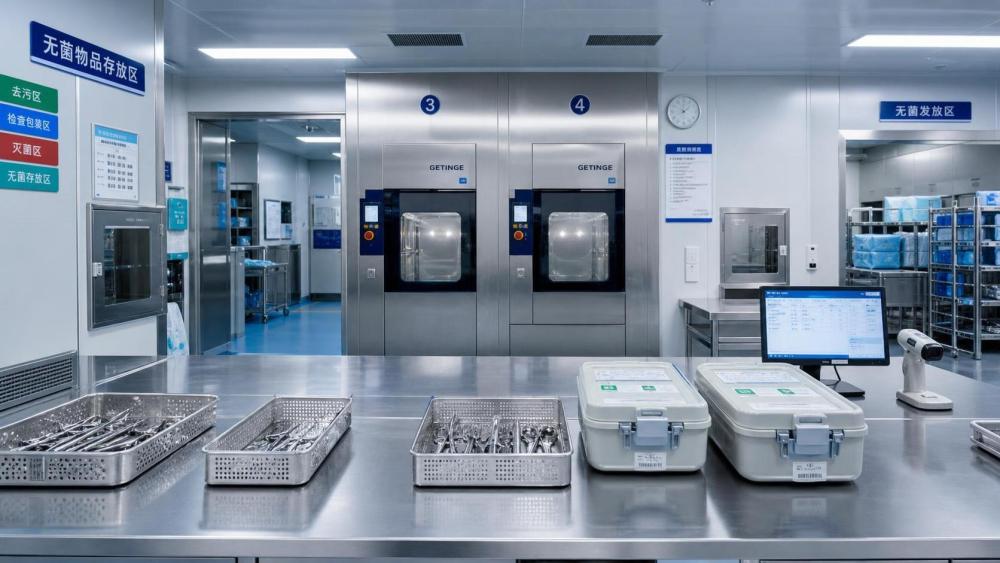
A central sterile services department can have good equipment and still fail basic compliance if the workflow is physically or operationally mixed. Dirty receiving, cleaning, inspection, packaging, sterilization, sterile storage, and dispatch should not blur into one another. When they do, the problem is not only visual untidiness. It means cross-contamination risk is being built into the process.
- Check whether staff, carts, instruments, and air movement follow a one-way logic.
- Look for pass-through washers or pass-through sterilizers where the design requires them, and verify they are used as intended.
- Confirm that clean and dirty items are not staged in the same corridor during peak hours.
- Review whether rework loops are defined. Instruments sent back from inspection or from failed packaging should have a controlled return path, not an informal shortcut.
This is one of the first things auditors notice because layout weakness often predicts larger process weakness.
Cleaning failure is still the most underestimated risk
Sterilization does not compensate for poor cleaning. Residual soil, biofilm, retained protein, and debris in hinges, lumens, or insulated shafts can compromise the sterilization process and damage instruments over time. In many departments, the paperwork around sterilization is stronger than the control of cleaning itself. That imbalance is risky.
What to review:
- Whether device-specific cleaning instructions from the manufacturer are available at point of use or in the CSSD documentation system.
- Whether manual cleaning steps for complex devices are documented, especially for cannulated, robotic, microsurgical, and powered instruments.
- Whether washer-disinfectors are qualified, maintained, and challenged with routine performance tests appropriate to the load type.
- Whether water quality used in final rinse meets the equipment and instrument manufacturer’s expectations. Water quality problems often show up later as staining, corrosion, or repeated rework.
If your department cannot show how it verifies cleaning effectiveness for hard-to-clean devices, treat that as a live compliance gap, not a documentation detail.
Validation records are often present, but not always usable
Many facilities will tell you their sterilizers are “validated.” Ask to see the evidence and the scope. Installation qualification, operational qualification, and performance qualification should match the actual equipment, load types, packaging systems, utilities, and cycle parameters in use. A validation report from years ago that does not reflect current trays, current software version, or current loading patterns is weak protection.
Pay attention to these warning signs:
- Cycle changes made after maintenance or software updates without documented requalification.
- New packaging materials or tray configurations introduced without assessing compatibility.
- Implant loads processed under a general cycle without the additional controls required by local standards or facility policy.
- EO or low-temperature sterilization processes being run on product families that were never clearly included in validation scope.
For steam processes, ISO 17665 and AAMI ST79 are commonly referenced. For low-temperature methods, the applicable standard depends on the sterilant technology. Do not assume one validation logic covers all modalities.
Routine monitoring is where “validated” processes still drift
A process can be validated and still be badly controlled in daily use. That is why release criteria matter. Mechanical data, chemical indicators, biological indicators where required, Bowie-Dick or equivalent air removal testing for pre-vacuum steam sterilizers, and load documentation should all work together.
The practical point here is simple: monitoring data should trigger decisions. If staff cannot explain what causes a load quarantine, recall, or reprocessing action, your release system is weaker than it looks.
Traceability breaks more often at the tray level than at the machine level
Most departments can identify which sterilizer ran which cycle on a given day. The harder question is whether they can trace a specific instrument set used on a specific patient back to cleaning, assembly, sterilization, release, storage, and dispatch records. That is the level of control you want when a complaint, infection investigation, or recall happens.
Look for missing links between tray labels, batch numbers, operator IDs, implant documentation, and clinical usage records. Paper systems can still work if they are disciplined, but partial handwriting, duplicate load numbers, and relabeling without formal correction control are recurring failure points.
If the central sterile services department supplies high-risk surgical sets, traceability should be tested periodically by mock recall exercise, not assumed.
Packaging and storage are a quiet source of nonconformity
Departments spend a lot of time on the sterilizer and then lose control after the cycle. Packaging material compatibility, seal integrity, load configuration, handling damage, shelf arrangement, and storage environment all affect sterility maintenance. This is not theoretical. Torn wraps, compressed packs, wet loads, and overstacked shelves are common findings.
- Verify that packaging systems are suitable for the sterilization modality in use.
- Check sealers, seal width consistency, and routine verification where heat sealing is used.
- Inspect sterile storage conditions: temperature, humidity control where required, dust exposure, traffic, shelving clearance, and stock rotation.
- Review event-related sterility policy and make sure staff actually understand it. Some teams still apply fixed shelf-life labels without aligning with current facility policy or local guidance.
When sterile items are stored in overloaded rooms or transported through uncontrolled pathways, sterile assurance becomes difficult to defend.
Competency is not the same as attendance
One of the more persistent audit weaknesses is training evidence that shows people attended a session, but does not show they can perform the work correctly. In a central sterile services department, that distinction matters. Instrument reprocessing is procedural, repetitive, and highly sensitive to shortcuts.
Good departments maintain competency by task category: decontamination, inspection, assembly, packaging, sterilizer loading, release, storage, and handling of specialty devices. They also reassess competency after changes in device mix, equipment upgrade, nonconformity trend, or incident investigation.
Ask a simple operational question during review: can the technician explain why this step exists, what failure looks like, and when the item must be rejected? The answer will tell you more than a signed training sheet.
Maintenance and utilities deserve the same scrutiny as the sterilizer itself
A surprising number of compliance problems trace back to utilities: steam quality, compressed air, water treatment, drainage, ventilation, and room pressure relationships. Clinical engineering, facilities, infection prevention, and CSSD leadership need to be aligned here. A sterilizer may be serviced on schedule while the upstream utility condition is drifting out of spec.
Review preventive maintenance records, calibration status, alarm histories, downtime logs, and change control for utilities affecting reprocessing equipment. If there has been a building project, pipe replacement, generator event, or water treatment modification, check whether CSSD process impact was assessed. That step is easy to miss.
Document control sounds administrative, until an incident happens
Outdated SOPs, mixed versions of work instructions, and supplier IFUs stored in someone’s email folder are classic weaknesses. They are also avoidable. Reprocessing instructions for medical devices can change, and hospitals do not always notice quickly. If a manufacturer revises cleaning steps or sterilization parameters, the central sterile services department needs a controlled way to capture that change and train staff accordingly.
This is especially important for loaner sets, imported devices, and multi-brand instrument inventories. Before those devices enter routine circulation, confirm that usable IFUs are available, legible, and aligned with your equipment capability. If the instructions require a process your site cannot perform, that is a procurement and risk management issue, not a floor-level workaround.
A short review list that catches a lot
- Can you walk one tray from dirty receipt to patient use without losing traceability?
- Are cleaning instructions available for every complex device currently in service?
- Do current validation records still reflect actual loads, packaging, and cycle settings?
- Are failed indicators, wet packs, packaging defects, and positive biological results tied to a formal response process?
- Is competency assessed by observed task performance, not only by attendance record?
- Have recent maintenance, software, utility, or facility changes been reviewed for reprocessing impact?
That is usually enough to tell whether a central sterile services department is operating with real control or with habits that have not been challenged yet.
The safest approach is to treat CSSD compliance as a live operating system, not as an annual audit file. For quality and safety teams, the useful work is in the interfaces: between procurement and IFU review, between clinical engineering and utilities, between infection control and daily practice, and between documentation and what staff actually do on the bench. When those interfaces are managed well, standards become practical tools instead of inspection-day paperwork.
Have questions about the global trade trends discussed here, or planning your expansion and supply chain strategy? Leave a message below and let the trade experts at MTHH guide you.
We respect your privacy. Your information is strictly confidential.
Related News
- Hong Kong Outlines Medical Device Legislation and Plans for Statutory RegulatorNov 14, 2026Hong Kong medical device legislation could reshape regulatory oversight. Explore the proposed regulator and what businesses should monitor.
- AAMI Issues TIR115 Guidance on Public Cloud Use in Medical DevicesNov 13, 2026AAMI TIR115:2026 guides public cloud use in medical devices. Explore its focus on risk management, supplier assessment and device boundaries.
- How are critical care devices regulated in the United States?Nov 12, 2026Critical care devices face FDA requirements based on intended use and risk. Explore classifications, marketing pathways, and practical compliance checks.
- Hong Kong Drafts Medical Device Bill to Establish Statutory OversightNov 12, 2026Hong Kong's Medical Devices Bill could introduce risk-based statutory oversight. Discover what the proposed framework may mean for suppliers.