
How to Evaluate a Contrast Media Consumables Manufacturer for Supply Stability and Compliance
How to Evaluate a Contrast Media Consumables Manufacturer for Supply Stability and Compliance
Choosing a reliable contrast media consumables manufacturer is not just about unit price. For procurement teams, supply stability, regulatory compliance, documentation quality, and after-sales coordination all affect imaging workflow, patient safety, and long-term purchasing risk. This article explains how to evaluate manufacturers more systematically, so buyers can reduce supply disruptions, compare capabilities with greater confidence, and support more stable procurement decisions.
If you buy for CT, MRI, angiography, or injector-related workflows, you already know the problem: a consumable is a small item until it stops a scan list, delays a patient, or creates a compatibility dispute between the imaging team and the supplier. That is why a contrast media consumables manufacturer should be reviewed more like an operational partner than a simple packaging source.
Start with the product scope, not the brochure
Some suppliers present themselves broadly, but their real strength may be limited to a narrow set of injector syringes, tubing sets, connectors, or pressure-rated accessories. Before comparing price, ask for a current product list by imaging modality and injector compatibility. You want to know exactly which SKUs are standard production items, which are made to order, and which are still being validated for certain equipment platforms.
This sounds basic, but it catches a common procurement mistake: buyers assume that “compatible with major brands” means verified fit across specific injector models. It may only mean the dimensions are similar. For contrast delivery consumables, that gap matters. A mismatch can show up as leakage risk, priming issues, pressure alarm problems, or workflow delays in the imaging department.
- Request a SKU-level compatibility list tied to exact injector models.
- Check whether sterile barrier type, pressure tolerance, connector format, and packaging configuration are clearly specified.
- Ask which items are regular stock and which depend on forecast or minimum order quantity.
Look at manufacturing consistency before asking for discounts
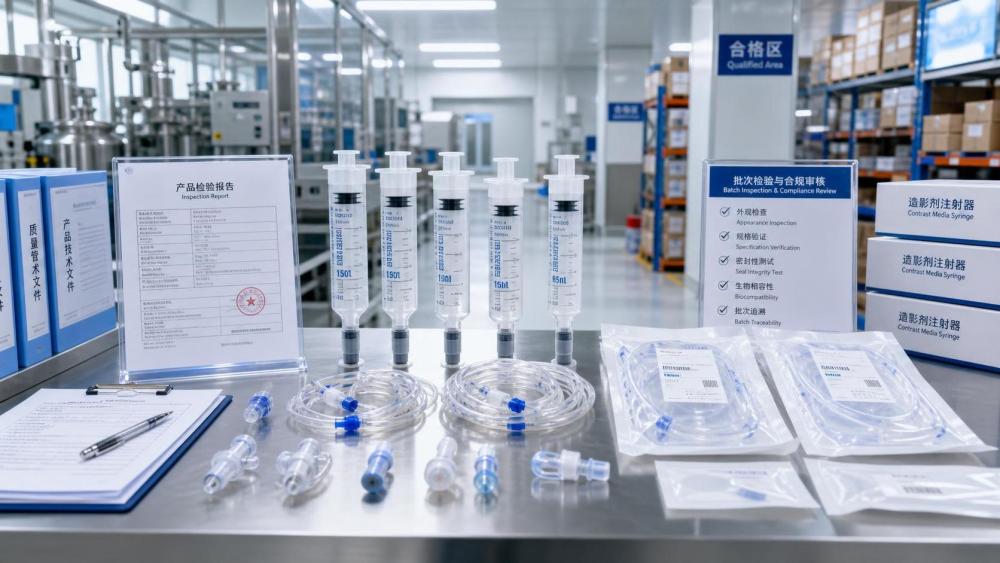
A low quotation is easy to get. Consistent lots are harder. With a contrast media consumables manufacturer, production discipline usually matters more than aggressive initial pricing. If the supplier changes resin source, sterilization subcontractor, pouch material, or assembly process without strong change control, your receiving team may still accept the goods, but the imaging department may notice usability differences later.
Ask practical questions that reveal process maturity. How often do they conduct in-process checks? Who approves material changes? How are lot records maintained? What is their retention period for production and quality documentation? They may not disclose every internal detail, and that is normal, but a capable manufacturer should answer in a structured way.
If they avoid basic quality process questions and keep steering the discussion back to price, take that seriously.
Verify quality system status, but do not stop at the certificate
For medical consumables, buyers often ask for ISO 13485 first, and they should. But a certificate alone does not tell you how well the system is functioning. Check the certificate scope carefully. It should match the relevant product category and manufacturing activities. A certificate covering unrelated devices or only partial operations may not support the product you are evaluating.
Then go one layer deeper. Ask whether critical processes are handled in-house or outsourced, especially sterilization, cleanroom assembly, and packaging validation support. If outsourcing is involved, the manufacturer should be able to explain supplier control and release responsibility. That is not an unusual request. It is standard due diligence.
For target-market compliance, the documents you ask for depend on where you will register, distribute, or use the products. CE marking, FDA listing, local registration, UDI handling, labeling language, and importer obligations all vary by market. Do not assume that approval in one region transfers cleanly to another. If the supplier says “global compliance,” ask them to map that claim product by product and market by market. Anything vague here should be treated as 【待核实】.
Documentation quality tells you a lot about future workload
Procurement teams sometimes underestimate how much internal time is lost chasing incomplete paperwork. For contrast media consumables, weak documentation slows qualification, customs clearance, distributor onboarding, hospital approval, and complaint handling.
Ask for a sample document pack before awarding business. Not a promise. An actual sample set. You want to see whether the manufacturer can provide, in a clean and controlled format, items such as product specifications, instructions for use, labeling samples, declaration documents where applicable, shelf-life information, sterilization statement where relevant, lot traceability approach, and complaint contact details.
A supplier that sends mixed versions, unsigned drafts, or inconsistent part numbers will usually create more downstream work than expected. That affects real procurement cost even when the unit price looks attractive.
Check supply stability like an operations person
This is where many evaluations become too shallow. Buyers ask lead time, the supplier says four weeks, and everyone moves on. That answer is not enough. What matters is whether the manufacturer can sustain supply when demand shifts, transport slows, or one raw material source tightens.
Ask about production capacity in practical terms: monthly output range, peak expansion capability, normal safety stock policy, and how customer forecasts are used. If you are sourcing for a hospital group or distributor network, ask whether your key SKUs can be reserved under a rolling forecast. Some manufacturers will support this; some will not. Better to know before a tender is awarded.
If the answers are vague, your supply chain is probably more fragile than the quotation suggests.
Compatibility risk deserves a separate review
This is especially important in imaging departments using multiple injector brands across sites. A consumable that works in one room may not be accepted in another, even within the same hospital group. Procurement should ask the manufacturer whether validation evidence exists for the injector platforms in scope, and whether field support is available during first implementation.
Do not let “compatible” remain a marketing word. Ask what that claim is based on. Internal dimensional check? Functional testing? Customer field use? Formal OEM authorization? The answer changes the risk level. If the product will be used in a market or site with strict policy on third-party consumables, that issue should be escalated early to biomedical engineering, radiology leadership, and compliance reviewers.
Pay attention to packaging, shelf life, and warehouse reality
Not every cost problem starts at the purchase order. Some start in the storeroom. If case quantity is awkward, labels are hard to scan, expiry dating is too short for your ordering cycle, or carton protection is weak for cross-border shipments, the operational cost climbs quietly.
Review outer carton labeling, storage conditions, transport sensitivity, and standard shelf life. Ask whether the manufacturer can support FEFO-based stock handling and whether shipping documents consistently match product labels. This matters for distributors and for hospital central supply teams that process large numbers of sterile consumables.
A short shelf life is not always a deal breaker, but it should change your reorder planning and safety stock assumptions.
Complaint handling and post-market response are part of procurement value
Every supplier looks responsive before the first order. The useful question is what happens after an incident report. If a radiology team raises a leakage concern, packaging defect, or connector fit issue, who owns the investigation? How quickly can the manufacturer issue a preliminary response, collect samples, and provide a documented conclusion?
Ask for their complaint workflow and field corrective action contact path. You do not need confidential CAPA records, but you should understand whether the company has a mature process. For buyers managing multiple sites, this is not administrative detail. It is service continuity.
Build the total cost picture properly
A cheaper item from a contrast media consumables manufacturer may still cost more over a 12-month period if it creates extra validation work, emergency freight, higher buffer stock, more staff complaints, or recurring documentation follow-up. Procurement decisions in healthcare rarely fail because of list price alone. They fail because hidden handling cost was ignored.
When comparing offers, include at least these cost elements:
- Unit price and packaging conversion cost
- Freight mode and customs documentation workload
- Required safety stock due to lead-time risk
- Internal validation or compatibility review effort
- Potential downtime exposure if substitute supply is limited
That comparison usually produces a more honest decision than a unit-price ranking sheet.
What experienced buyers usually prepare before approval
Before moving a supplier into routine purchasing, it helps to complete a short internal readiness check. Not because policy says so, but because it reduces surprises after onboarding.
- Confirm exact product scope, injector compatibility, and intended clinical settings.
- Review quality system documents and target-market compliance evidence.
- Check sample labeling, shelf life, and traceability format.
- Test supplier responsiveness on technical and documentation questions.
- Agree lead time, forecast method, shortage handling, and escalation contacts in writing.
- Align radiology, biomedical engineering, QA, and procurement before volume rollout.
A capable manufacturer will usually welcome this level of review. It means the buyer understands what stable supply actually requires.
For MTHH readers, the practical takeaway is simple: when evaluating a contrast media consumables manufacturer, treat supply continuity, documentation control, and compatibility evidence as part of the product itself. In imaging procurement, the cheapest consumable is rarely the one that creates the least work. The better choice is usually the supplier that can keep routine deliveries stable, answer technical questions clearly, and support your compliance burden without constant chasing.
Have questions about the global trade trends discussed here, or planning your expansion and supply chain strategy? Leave a message below and let the trade experts at MTHH guide you.
We respect your privacy. Your information is strictly confidential.
Related News
- How does order volume affect disposable medical supplies cost?Nov 07, 2026Discover how order volume affects disposable medical supplies cost and learn to balance bulk discounts, storage, expiry risk, and reliable supply.
- How to choose suction consumables in South Africa that fit your pumpOct 29, 2026Buying suction consumables South Africa suppliers offer? Learn how to verify pump compatibility, compare system costs and choose the right fit before ordering.
- How to assess a bandage manufacturer's batch-to-batch consistencyOct 25, 2026Choosing a bandages manufacturer? Learn how to compare production lots, verify test data, and check traceability to reduce sourcing risks and buy with confidence.
- How to verify a surgical gown manufacturer’s barrier level claimsOct 24, 2026Evaluating a surgical gowns manufacturer? Learn how to verify barrier level claims, review test reports, and confirm critical-zone protection before approving your next supplier.