
On July 26, 2026, the European Commission issued Commission Implementing Regulation (EU) 2026/1389, introducing a near-term compliance change for imported in vitro diagnostic medical devices entering the EU market. From August 1, 2026, IVD products will need to submit both the UDI-DI and a structured performance evaluation summary through EUDAMED at the same time as the CE-IVDR declaration of conformity is completed. For manufacturers, Chinese exporters, and EU importers, the immediate concern is not only regulatory filing itself, but also the effect on registration sequencing, technical documentation preparation, customs clearance, and launch timing.
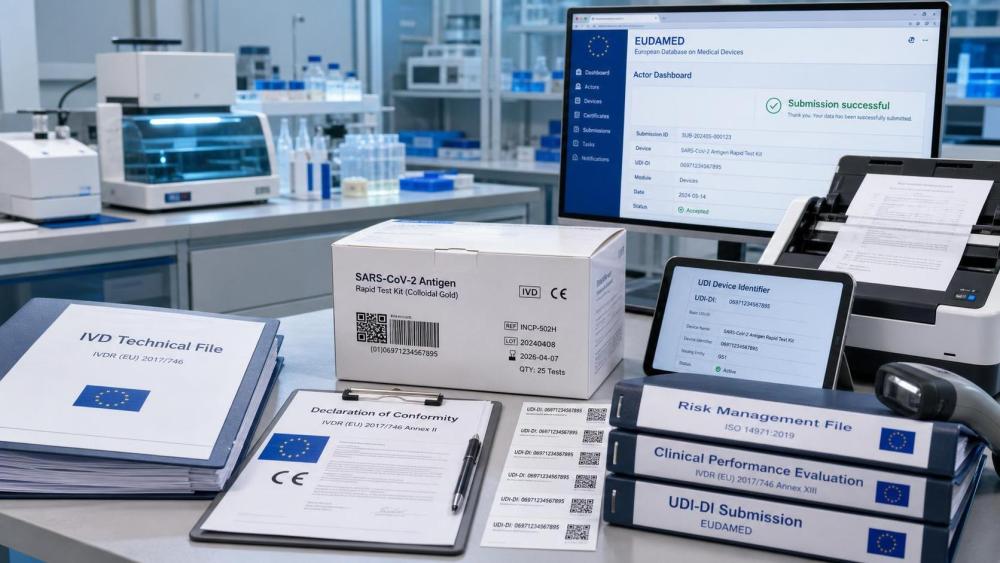
What the new filing requirement confirms
The confirmed change is tied to Commission Implementing Regulation (EU) 2026/1389, released by the European Commission on July 26, 2026. Under this rule, from August 1, 2026, all imported IVD devices entering the EU market must submit the Unique Device Identification - Device Identifier (UDI-DI) and a structured Performance Evaluation Summary through the EUDAMED system in parallel with completion of the CE-IVDR declaration of conformity.
The summary provided in the input also states that products failing to meet this requirement will be refused customs clearance. The change therefore links market entry more directly to synchronized data submission and document readiness at the point of regulatory completion.
Where the pressure will likely appear first
Documentation work moves closer to the shipment gate
From an industry perspective, global IVD manufacturers may feel the impact first because the new requirement connects conformity declaration with simultaneous EUDAMED submission. This can affect how regulatory teams sequence technical file preparation, internal review, and release planning. What deserves closer attention is whether document packages are operationally ready at the same time, rather than being completed in separate stages.
Export execution becomes more sensitive to filing timing
Chinese exporters may be affected through shipment scheduling and customs-related preparation. Analysis shows that where export plans depend on products moving quickly after CE-IVDR documentation is completed, any mismatch between declaration timing and EUDAMED submission readiness could create delay risk. The practical issue is less about commercial demand and more about whether compliance records are synchronized before goods reach the clearance stage.
EU importers face greater exposure at the entry point
For EU importers, the most visible impact may fall on intake review and border-entry coordination. Because non-compliant products may be rejected at customs, importers will need to pay closer attention to whether upstream manufacturers and exporters have completed the required UDI-DI and PE Summary submissions in line with the rule. The operational exposure sits at the point where compliance status and physical delivery meet.
What companies should watch now
Whether internal timelines still match the August 1 start date
Analysis shows that the short interval between the July 26 release date and the August 1 enforcement date makes timing a core issue. Companies involved in EU-bound IVD trade should review whether their current registration, document finalization, and shipment plans still align with the new filing sequence.
The completeness of UDI-DI and PE Summary preparation
What deserves closer attention is whether the required UDI-DI data and structured performance evaluation summary are ready at the same stage as the CE-IVDR declaration of conformity. The rule described in the input does not frame these as later administrative steps, but as synchronized submission elements tied to market entry.
Communication across manufacturer, exporter, and importer
Observably, this is a cross-border coordination issue as much as a regulatory one. Companies should pay attention to how product information, filing status, and documentation confirmation are communicated across the manufacturer-exporter-importer chain, especially where different parties control technical files, shipment release, and customs-facing paperwork.
Any further official clarification still needs monitoring
The rule itself is identified in the input, but analysis shows that businesses should continue monitoring whether there are further official statements, implementation clarifications, or procedural details affecting actual submission practice in EUDAMED. That is particularly relevant for teams managing ongoing registrations or near-term shipments.
Why this looks like more than a routine filing update
Analysis shows that this development is better understood as an operational tightening of EU market access for imported IVD devices, rather than a minor documentation adjustment. The core signal is that identifier data and performance summary information are being treated as part of the same practical gate as conformity completion, with customs consequences for non-compliance.
At the same time, it is more appropriate to understand this as a concrete short-term compliance change with longer-term signaling value. The confirmed fact is the August 1 requirement and the customs risk stated in the input. The broader significance, which still requires observation, is how consistently this changes preparation cycles, importer controls, and launch planning across the IVD supply chain.
How the market is likely to read this change
In practical terms, this update should be read as an immediate compliance checkpoint for EU-bound IVD products. It does not by itself confirm wider market outcomes, but it clearly raises the importance of synchronized regulatory data submission before products move into the EU. For companies already active in the region, the near-term priority is execution discipline around filing readiness, document sequencing, and cross-party coordination.
It is more appropriate to understand this news as both a short-term operational requirement and a longer-term signal of stricter linkage between regulatory documentation and market-entry control. Further observation is still needed on implementation details, but the immediate compliance expectation described in the input is already clear.
Basis of this article and follow-up points
This article is based on the user-provided news title, event date, and event summary concerning Commission Implementing Regulation (EU) 2026/1389 and the August 1, 2026 filing requirement for imported IVD devices in the EU. The specific official source link was not provided in the input, so continued verification remains necessary.
For this type of industry update, relevant source categories commonly include official government or regulator notices, company disclosures, industry association communications, authoritative media reporting, and standards-related documents. Based on the input, the areas that still warrant continued monitoring are any further official clarification, implementation wording, and practical EUDAMED submission requirements affecting registration workflow and customs handling.