
How to Evaluate an Imaging Informatics Vendor in 2026
How to Evaluate an Imaging Informatics Vendor in 2026
Choosing the right imaging informatics vendor in 2026 requires more than comparing product features or pricing. Technical evaluators need to look at interoperability, cybersecurity, scalability, workflow fit, service depth, and upgrade readiness across complicated healthcare environments. In practice, the wrong choice usually does not fail during the demo. It fails six months later, when the PACS is slow, the RIS interface breaks, the archive grows faster than expected, or nobody can explain who is responsible for a cybersecurity patch.
If you are screening an imaging informatics vendor for a hospital group, imaging center, distributor project, or public procurement plan, treat the evaluation like an operational risk review, not a software beauty contest. The checklist below is the one most technical teams end up building anyway, usually after learning a few things the hard way.
Start with the real scope, not the vendor’s product name
“Imaging informatics” can mean very different things: PACS, VNA, diagnostic viewers, reporting tools, workflow orchestration, AI routing, cloud archive, enterprise imaging, or some bundled combination of them. Before comparing suppliers, pin down what your organization is actually buying.
- Is this a department-level replacement or an enterprise imaging project?
- Will cardiology, pathology, or point-of-care imaging be added later?
- Do you need a long-term archive strategy, or only a reading workflow refresh?
- Are you replacing legacy hardware, migrating data, or both?
A vendor may be strong in diagnostic reading but weak in enterprise content management. Another may have a solid archive but limited workflow tools. If your scope is fuzzy, every demo will look acceptable.
Check interoperability the hard way
Every imaging informatics vendor will say they support DICOM, HL7, and integration with EMR or HIS environments. That statement alone tells you very little. The useful question is how much interface work is standard, how much is custom, and who carries the integration risk.
Ask for a practical interface matrix. Not marketing slides. A real matrix should show modality connectivity, worklist behavior, report distribution, user authentication options, archive migration support, and exceptions handling. If the site has mixed vendors for CT, MRI, ultrasound, mammography, and mobile X-ray, test those assumptions explicitly.
You also want to know whether the vendor has worked with your EMR, RIS, HIS, or broker before. Prior experience is not a guarantee, but it lowers project friction. If they have not, the evaluator should mark that as a delivery risk, not just a neutral fact.
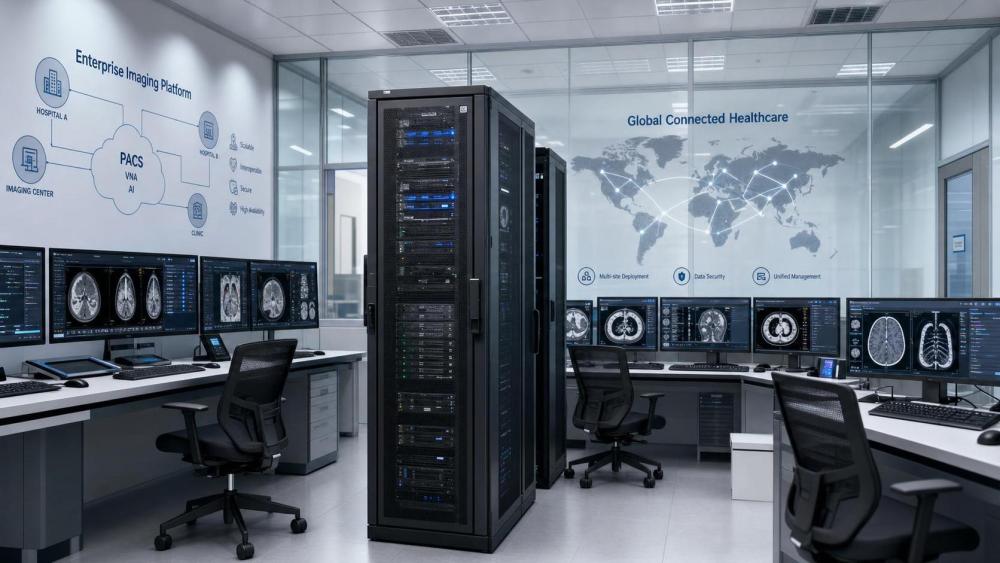
One more point that gets missed: migration quality. A system can go live and still leave years of prior studies hard to retrieve, poorly indexed, or missing metadata. Data migration plans should cover legacy image integrity, patient identifier mapping, priors access, and rollback contingencies. If the answer is “we will assess later,” press harder.
Do not separate workflow from clinical reality
Technical evaluators sometimes get trapped in infrastructure questions and leave workflow to end users. That split causes trouble. Workflow is part of technical fit.
A vendor should be able to explain how studies move from acquisition to reading, second review, reporting, distribution, and long-term storage. Watch for delays around hanging protocols, priors loading, worklist filtering, critical result communication, and cross-site access. Reading speed matters, but consistency matters more. If radiologists or technologists need repeated manual workarounds, the system cost will show up in staff time and user resistance.
For multi-site groups, ask how the system handles bandwidth variation, remote reading, study prefetching, and downtime at one location without interrupting the rest of the network. For hospital procurement teams, this is where “good enough in one flagship site” often turns into “not good enough across the full estate.”
Cybersecurity is now part of product quality
By 2026, no serious evaluation should treat cybersecurity as a side document. Imaging systems are connected clinical infrastructure. They carry patient data, depend on network availability, and often sit between modalities, archives, and hospital identity systems.
Useful review points include patch management policy, vulnerability disclosure process, access control model, logging, encryption in transit and at rest, remote service access, and backup or recovery design. Ask how long security updates are supported for the version being quoted. Also ask whether upgrades require major downtime or hardware refreshes.
If the vendor claims compliance with specific standards or certifications, verify what is current and what applies to the offered deployment model. Do not assume a corporate certification automatically covers every hosted service, regional deployment, or subcontracted support layer. Where documentation is incomplete, mark it clearly as 【待核实】.
Look closely at deployment architecture
On-premises, private cloud, public cloud, hybrid: the label matters less than the operational detail. Many evaluation mistakes come from approving an architecture diagram that nobody translated into actual performance, support, and ownership boundaries.
If the solution depends heavily on third-party cloud services, ask which layers the vendor directly controls. This matters when incidents happen. Support tickets move differently when one company owns the application, another hosts the environment, and a third manages local networking.
Service capability is often the real differentiator
A technically decent platform with weak service support becomes an expensive distraction. For hospital engineering teams and procurement officers, vendor service maturity deserves the same weight as the software feature list.
Review implementation staffing, escalation paths, project governance, local language support if required, training model, and post-go-live coverage. If the supplier works through a distributor or regional partner, ask who actually owns integration troubleshooting, server incidents, and user retraining. Do not accept a blurred answer here.
Also look at change management. Can the vendor support adding a new modality, satellite clinic, AI tool, or reporting template without treating every change as a custom redevelopment project? That question usually separates adaptable vendors from rigid ones.
Ask what happens after year two
A lot of evaluations stop at implementation. That is too short a horizon. Imaging informatics systems stay in place for years, and the problems that matter most usually surface after volumes grow, clinical departments expand, and interface complexity increases.
Ask the imaging informatics vendor how version upgrades are delivered, how often major releases occur, what breaks most often, and how legacy integrations are protected. If AI orchestration, cloud archive, enterprise viewer expansion, or regional data hosting may matter later, get those roadmap assumptions on the table now. Roadmaps are not commitments, but they show whether the vendor is building toward your environment or away from it.
Be cautious with vague language around “future-ready architecture.” Ask what that means in concrete terms: API availability, modular licensing, containerization approach if relevant, hardware dependency, and support lifecycle.
Price comparison without TCO is misleading
This is a familiar procurement mistake. One bid looks cheaper because it excludes migration effort, archive expansion, viewer licenses, interface development, cybersecurity tools, or advanced support tiers. Another looks expensive because it includes those items upfront.
Build the comparison around total cost of ownership: implementation, data migration, storage growth, software maintenance, support response level, training refresh, interface changes, hardware replacement if needed, and decommissioning of old systems. For cross-border projects, add tax structure, local hosting cost, regulatory documentation, and distributor markups where applicable. If a line item is unclear, flag it instead of smoothing the model with assumptions.
References matter, but only if they match your use case
A reference site is useful when it resembles your own reality. A university hospital with a large IT team is not a clean reference for a private imaging chain with outsourced support. Likewise, a single-site radiology center does not tell you much about enterprise imaging complexity.
When checking references, focus less on general satisfaction and more on transition pain points. What slowed down the deployment? Which integrations took longest? How did the vendor handle user resistance, performance issues, and support escalations? Those answers are usually more informative than the polished project summary.
A short decision filter that saves time
Before final scoring, many teams benefit from a simple elimination screen:
- Can this vendor prove workable integration with our current and planned systems?
- Is the cybersecurity and support model acceptable to our IT and clinical governance teams?
- Does the workflow fit actual reading, reporting, and multi-site operating conditions?
- Can they support growth without forcing a near-term replatform?
- Is the commercial model transparent enough to defend internally?
If the answer is shaky on two or three of those points, the vendor is probably not a finalist, even if the demo went well.
The best imaging informatics vendor is rarely the one with the longest feature sheet. It is the one that can fit your environment, survive your operational realities, and still make sense when volumes rise, sites expand, and support demands become less forgiving. That is the standard technical evaluators should use in 2026.
Have questions about the global trade trends discussed here, or planning your expansion and supply chain strategy? Leave a message below and let the trade experts at MTHH guide you.
We respect your privacy. Your information is strictly confidential.
Related News
- How to choose diagnostic imaging equipment for small clinicsNov 14, 2026Choose diagnostic imaging equipment for clinics with confidence. Compare clinical needs, costs, space, workflows, and supplier support before you buy.
- How to size medical gas pipelines for peak demandNov 09, 2026Medical gas pipeline systems design starts with peak demand. Learn how to size pipes, calculate pressure loss, and check critical paths for reliable performance.
- What Trendelenburg angle should an operating table provide?Nov 05, 2026Compare operating tables Trendelenburg angles, load limits and accessories. Discover what to check before choosing the right table for your procedures.
- How to estimate the total cost of hospital imaging equipmentNov 04, 2026Plan hospital capital equipment imaging investments with confidence. Learn to estimate installation, service and operating costs and compare bids fairly.