
On July 11, 2026, the EU Medical Device Coordination Group (MDCG) issued MDCG 2026-12, introducing a new packaging requirement for CE-marked in vitro diagnostic kits. From October 1, 2026, the smallest sales unit of covered IVD kits will need a tamper-evident RFID label compliant with ISO/IEC 18000-63. For companies involved in IVD exports, packaging conversion, product traceability, and UDI connectivity, this is worth close attention because the change reaches beyond label design and into execution across packaging and supply chain workflows.
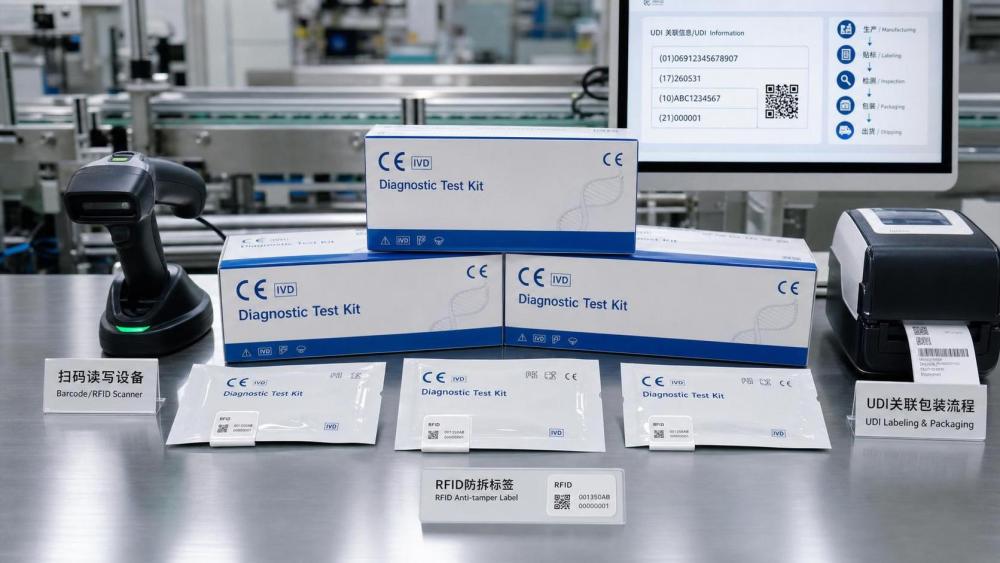
What the Notice Clearly Requires
According to the information provided, MDCG 2026-12 was released on July 11, 2026 by the EU Medical Device Coordination Group. The notice applies to all CE-certified in vitro diagnostic reagent kits, including biochemical, immunological, and molecular categories.
The requirement takes effect from October 1, 2026. From that date, the smallest sales unit packaging must integrate a tamper-evident RFID label that complies with ISO/IEC 18000-63. The stated purpose of the label is supply chain traceability and authenticity verification.
The provided information also indicates that Chinese IVD exporters will need to upgrade packaging lines and strengthen their ability to connect with UDI systems in parallel with this requirement.
Where the Immediate Pressure May Appear
Export-oriented IVD manufacturers face packaging execution issues first
From an industry perspective, manufacturers shipping CE-marked IVD kits into the EU are likely to feel the impact first because the new obligation is tied to the smallest saleable package, not only to outer logistics packaging. The practical effect may concentrate on packaging design changes, packaging line adaptation, and consistency between physical labels and product identification data.
Packaging and labeling operations may become a critical control point
Analysis shows that the packaging stage could become one of the main implementation points. A tamper-evident RFID label is not simply a printed artwork change; it introduces a packaging-level identification element that must be integrated into existing production and release workflows. What deserves closer attention is whether packaging operations can support the added RFID step without disrupting normal shipment preparation.
Traceability and system-linked workflows will likely draw more scrutiny
Observably, the requirement is framed around traceability and authenticity verification, which means data linkage matters alongside the physical label itself. For teams handling product coding, regulatory documentation, and UDI-related processes, the issue is likely to center on whether identifiers, packaging records, and downstream verification needs remain aligned.
Supply chain service providers may need to adjust coordination methods
For service providers involved in packaging support, labeling, logistics coordination, or compliance execution, the change may affect delivery timing, packaging specifications, and communication with exporters and buyers. The key point is not only whether a label can be added, but whether the packaging and data process can be carried through consistently for EU-bound products.
What Companies Should Track Now
Watch for any further official wording around implementation
Analysis shows that companies should closely follow whether any additional official clarification appears around scope, execution details, or enforcement language. The current confirmed facts establish the requirement, the standard reference, the product scope, and the effective date, but practical interpretation often depends on how later official wording is framed.
Review which SKUs are affected at the smallest sales unit level
What deserves closer attention is product-level mapping. Because the requirement applies to the smallest sales unit packaging, companies should identify which biochemical, immunological, and molecular IVD kits sold under CE certification will need packaging changes at that exact unit level, rather than assuming the rule can be addressed only at carton or shipment level.
Assess packaging line readiness together with UDI connectivity
Observably, the provided information points to a dual workload: packaging line upgrades and UDI system interfacing. For management, regulatory, and operations teams, this means the packaging question and the data question should be reviewed together. A partial response on only one side may leave execution gaps in actual shipment preparation.
Prepare customer and supplier communication early
From an industry perspective, companies dealing with EU customers, packaging suppliers, or outsourced service partners should pay attention to lead times, document alignment, and responsibility boundaries. The issue is likely to be less about broad strategy and more about whether every participating party is working to the same packaging requirement and delivery expectation.
How This Signal Should Be Read
Analysis shows that this development is more than a narrow packaging adjustment, because the requirement explicitly combines tamper-evident RFID, traceability, and authenticity verification. That said, it would be premature to extend the meaning beyond the confirmed notice. Based on the available information, it is more appropriate to understand this as a concrete compliance requirement with wider operational implications, rather than as a full market restructuring signal.
Observably, the short time gap between the July 11, 2026 notice and the October 1, 2026 implementation date makes the timing itself notable for affected exporters. The industry should continue watching how this requirement is interpreted in practice, especially where packaging execution and UDI-linked processes meet.
Why the Update Matters in Practical Terms
This notice matters because it places a specific technical and packaging obligation on CE-marked IVD kits and connects that obligation directly to traceability and authenticity verification. For companies serving the EU market, the issue should currently be understood as an actionable compliance and operations matter, not as a distant policy signal. The most reasonable reading at this stage is that affected businesses need to focus on packaging-unit applicability, implementation readiness, and system coordination while continuing to monitor any follow-up clarification.
Basis of This Article
This article is based on the user-provided news title, event date, and event summary concerning MDCG 2026-12, the RFID packaging requirement for CE-certified IVD kits, and the stated need for Chinese exporters to upgrade packaging lines and UDI connectivity.
For this type of industry update, commonly relevant source categories may include official notices, company disclosures, industry association information, authoritative media coverage, and standards organization documents. A specific official source link was not provided in the input, so that point still requires ongoing verification. Follow-up attention should remain on any later official clarification, implementation wording, and operational interpretation related to packaging execution and UDI system connection.