
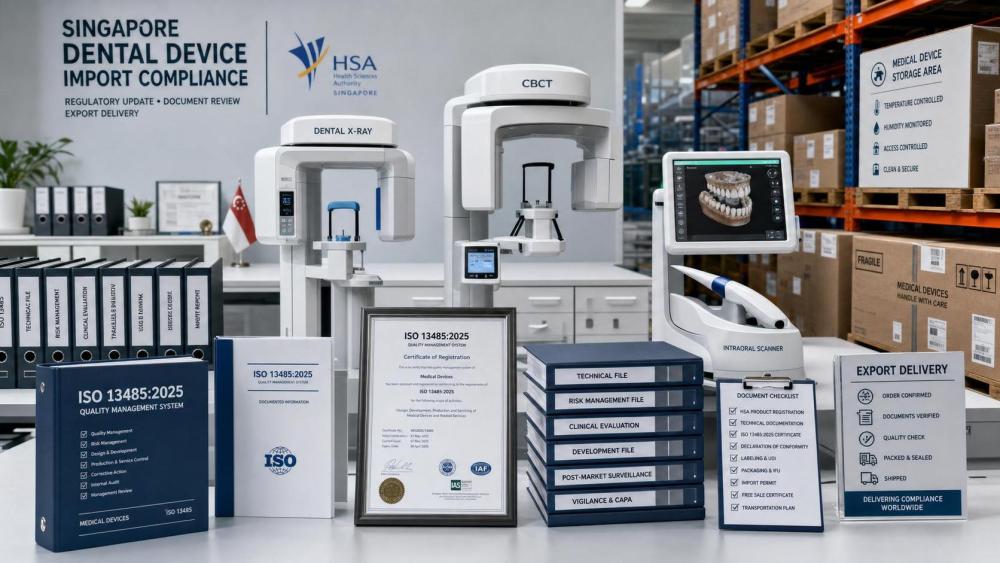
On June 28, 2026, Singapore’s Health Sciences Authority (HSA) introduced an immediate documentation change for dental imaging device import licence applications and renewals. For dental X-ray units, CBCT systems, intraoral scanners and related products, manufacturers must now submit the latest ISO 13485:2025 certificate together with the filing. Because the transition period for ISO 13485:2016 ended on June 27, this update matters directly to exporters, import licence applicants, certification coordination teams, distributors and delivery planning functions that depend on complete and accepted documentation.
What the HSA notice changed on June 28
According to the provided event summary, HSA issued emergency notice HSA/MED/NOTICE/2026/017 on June 28, 2026. The notice requires that all new applications and renewal applications for import licences covering dental X-ray machines, CBCT equipment and intraoral scanners include the manufacturer’s current ISO 13485:2025 quality management system certificate.
The same summary states that the earlier transition arrangement under which ISO 13485:2016 certificates were accepted ended on June 27. From the date of the notice, the updated certificate requirement is therefore being applied immediately to the relevant import licence filings.
The provided information also states that this adjustment has caused average document review delays of five working days for Chinese dental equipment exports to Singapore.
Where the pressure now appears in the transaction chain
Export documentation teams face a narrower filing threshold
From an industry perspective, exporters of covered dental imaging devices may be affected first because the rule change sits at the document submission stage rather than at a later commercial step. The immediate issue is whether application files and renewal files already contain the ISO 13485:2025 certificate in a form that can be submitted together with the import licence materials. What deserves closer attention is the risk of incomplete files, resubmission cycles and avoidable timing gaps when older certificate versions are still circulating in internal or partner-managed records.
Importers and distributors may see scheduling pressure
For importers, local distributors and other channel participants, the impact is likely to show up in licence processing rhythm and delivery coordination. Analysis shows that when document review is delayed, even by an average of five working days as stated in the provided summary, procurement timing, shipment release expectations and customer delivery commitments may require closer coordination. The rule change does not in itself confirm broader market disruption, but it does raise the operational value of checking whether each filing package reflects the new certificate requirement before submission.
Certification and compliance support functions become more time-sensitive
Certification-related service providers, regulatory affairs teams and internal compliance reviewers may also be affected because the accepted certificate version has changed from the expired transition arrangement to ISO 13485:2025. Their role becomes more time-sensitive in verifying certificate validity, matching document sets across applications and renewals, and reducing mismatches between manufacturer records and filing materials. Observably, the key issue is not only possession of a certificate, but whether the submitted version aligns with the requirement now being enforced by HSA for the listed product categories.
What companies should check immediately
Review pending and renewal filings against the new certificate requirement
Analysis shows that companies involved in new applications or renewals for the affected devices should first review whether every current file includes the manufacturer’s latest ISO 13485:2025 certificate. This is particularly relevant where submission packages were assembled close to the end of the transition period or where document sets were prepared under the earlier acceptance of ISO 13485:2016.
Recheck document consistency across trade and technical files
What deserves closer attention is consistency across the full filing package. Where import licence materials, technical documents or supporting trade paperwork were prepared at different times, companies may need to confirm that the certificate version used in each document set is aligned with the current HSA requirement. The provided information does not specify a broader implementation checklist, so this should be treated as a practical compliance review point rather than a confirmed formal procedure.
Adjust delivery and procurement timing with added review lag in mind
Observably, the reported average five-working-day delay for Chinese dental equipment exports to Singapore gives companies a concrete execution signal at the documentation review stage. Businesses handling procurement plans, shipment sequencing or customer delivery commitments may need to factor that delay into near-term scheduling. This should be understood as an operational response to the reported review impact, not as proof of a fixed processing timeline for every case.
Keep watching for further clarification in execution practice
The event summary confirms the immediate certificate requirement, but it does not provide full detail on how every filing scenario will be handled in practice. From an industry perspective, companies should continue monitoring later official wording, application handling patterns, and any changes in supporting document expectations for covered product categories. That is especially relevant for firms managing renewals, repeated shipments or multi-party filing arrangements.
How this change is best understood at this stage
Analysis shows that this is more appropriately understood as an executed compliance change rather than a policy proposal still awaiting implementation. The transition period for ISO 13485:2016 has already ended, and the HSA notice is described as taking effect immediately. At the same time, it should not yet be overstated as evidence of a wider market shift beyond the defined filing requirement and the reported review delay. What deserves closer attention is how consistently the new documentation threshold is applied across upcoming applications and renewals, and whether market participants begin adjusting bid files, purchasing schedules or internal compliance workflows in response.
Why the market should keep this on the watchlist
From an industry perspective, the significance of this development lies in its direct effect on market access paperwork for a defined group of dental devices. It links a standards update to import licence execution, and it introduces an immediate checkpoint that can affect documentation readiness and delivery timing. At present, it is more appropriate to understand the event as a rule already entering operational practice, while the full range of execution impacts still deserves continued observation.
Basis of this article and points that still need verification
This article is based on the user-provided title, event date and event summary. For developments of this kind, relevant source types typically include official regulator notices, regulatory agency releases, customs or trade authority information, industry association updates, standards organization documents and reporting from authoritative industry media. A specific official source link was not provided in the input, so the exact source document path still requires continued verification. Follow-up attention should remain on any detailed implementation language, certification interpretation in practice, changes to application or tender documentation, industry feedback and how companies are executing against the updated requirement.