
How to Evaluate IVD Equipment for Accuracy, Throughput, and Lab Fit
How to Evaluate IVD Equipment for Accuracy, Throughput, and Lab Fit
Choosing the right IVD equipment requires more than comparing specifications or price.
The stronger question is whether the system supports accurate results, dependable workflow, and daily laboratory reality.
That means looking beyond brochures.
A good evaluation of IVD equipment connects analytical performance, throughput, staffing, maintenance, consumables, and service support.
In practice, the best system is rarely the one with the longest feature list.
It is the one that delivers stable results under real operating conditions.
Start with Accuracy, Not Marketing Claims
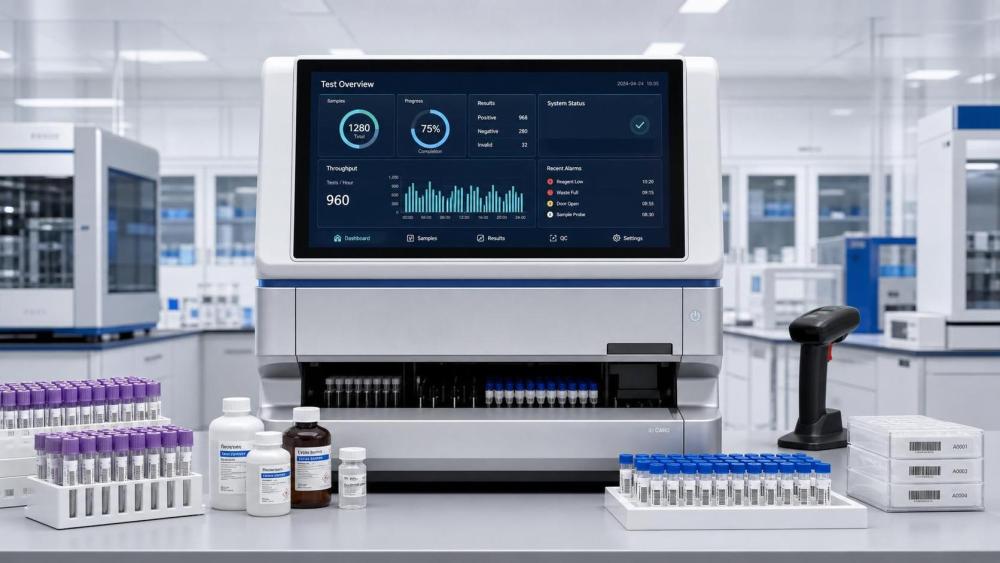
Accuracy is still the first filter when comparing IVD equipment.
If the results are inconsistent, high speed offers little value.
Start by reviewing method validation data, calibration frequency, internal quality control rules, and external quality assessment performance.
Ask whether the claimed performance comes from controlled studies or routine laboratory use.
That distinction matters more than many buyers expect.
What to review in analytical performance
- Precision at low, normal, and high control levels
- Linearity across the expected reportable range
- Sensitivity and specificity for intended assays
- Carryover risk between samples
- Interference from hemolysis, lipemia, or icterus
- Calibration stability over time
It also helps to ask for comparison data against a reference method or incumbent analyzer.
Bias trends that look small on paper can become operational problems later.
For IVD equipment used in critical care or oncology, result consistency matters even more.
Measure Throughput the Way the Lab Actually Works
Rated throughput often looks impressive in supplier material.
Real throughput is different.
It depends on sample mix, STAT interruptions, reruns, reagent loading, calibration events, and operator attention.
This is where many IVD equipment evaluations become too theoretical.
A system with lower headline speed may perform better during peak hours.
Questions that reveal practical throughput
- How many reportable results per hour are realistic with your assay menu?
- What happens when urgent samples enter the queue?
- How long is startup, shutdown, and daily maintenance?
- How often does the analyzer pause for recalibration or consumable replacement?
- Can loading continue during operation?
Turnaround time often gives a clearer picture than nominal test capacity.
That is especially true for emergency departments, outpatient labs, and high-volume hospital cores.
When evaluating IVD equipment, request workflow simulations using your expected daily sample profile.
Check Whether the System Fits the Laboratory, Not Just the Bench
Lab fit is where technical evaluation becomes practical decision-making.
A capable analyzer can still fail in daily use if it does not match staffing, layout, utilities, or information flow.
This also means the best IVD equipment for one laboratory may be the wrong choice for another.
Operational fit areas to review
- Footprint and access space for service
- Power, water, drainage, and ventilation needs
- Noise, heat, and waste handling
- Sample loading design and barcode workflow
- Interface with LIS or middleware
- User permissions, audit trails, and data export
From a workflow angle, simple interface design can be a major advantage.
If routine tasks require too many steps, operator error and training time both increase.
In actual procurement reviews, this point is often underestimated.
Look Closely at Reagents, Consumables, and Cost Stability
An IVD equipment decision is never only about the analyzer.
It is also about the long-term supply model behind it.
Closed reagent systems may improve control, but they can limit sourcing flexibility.
Open systems offer options, yet they may demand stronger validation discipline.
The better approach depends on risk tolerance, test menu, and local supply conditions.
Cost items worth comparing
This broader view gives a more honest picture of total operating cost.
It also helps reduce surprises after installation.
Evaluate Service Readiness and Risk Before Purchase
Support quality can make or break IVD equipment performance over time.
Even accurate systems face downtime, software issues, and replacement needs.
That is why service capability should be evaluated before contract signing.
Key service and compliance checkpoints
- Local installation and application support availability
- Engineer certification and training depth
- Remote diagnostics and software update process
- Warranty scope and exclusions
- Regulatory documents and quality system traceability
- Business continuity plans for reagent shortages or part delays
A lower-priced option may carry higher service risk.
More clearly, weak support can delay reporting and raise clinical pressure.
This becomes even more serious in facilities with limited backup capacity.
Build a Practical IVD Equipment Evaluation Process
A structured process usually leads to better selection outcomes.
It keeps technical review tied to real procurement decisions.
For most laboratories, the following sequence works well.
- Define test volume, assay menu, and turnaround targets.
- List non-negotiable requirements for accuracy, connectivity, and utilities.
- Shortlist IVD equipment based on intended use and support coverage.
- Request performance documents, workflow data, and cost breakdowns.
- Run site demonstrations or sample-based evaluations.
- Score technical, operational, and commercial factors together.
This method reduces decisions driven by price alone.
It also creates a clearer record for approval, planning, and supplier discussion.
When evaluating IVD equipment, the goal is simple: choose a system that stays accurate, keeps pace, and fits the laboratory without adding avoidable risk.
Have questions about this sector analysis, or seeking best practices specific to your niche? Drop us a line below and let the senior consultants at MHLS assist you.
Related News
- Abbott Launches Next-Generation Whole-Genome Sequencing Oncodetect MRD TestOct 27, 2026Explore Abbott’s Oncodetect MRD test, using whole-genome sequencing to track up to 5,000 ctDNA variants. Discover key clinical evidence and procurement considerations.
- SCIEX Starts Beijing Plant Project, Danaher's Tenth Manufacturing Site in ChinaOct 24, 2026SCIEX's Beijing plant project marks Danaher's tenth manufacturing site in China. Explore how its RMB 100 million-plus investment could strengthen local mass spectrometer supply.
- How laboratory workflow solutions reduce sample processing delaysOct 23, 2026Discover how laboratory workflow solutions reduce sample processing delays, improve tracking, and streamline reporting. Explore practical steps to cut waiting times without compromising quality.
- How to evaluate a web-based LIMS for lab instrument integrationOct 22, 2026Evaluate a web based LIMS for reliable lab instrument integration. Learn how to verify connectors, test failure recovery, and compare costs before choosing your system.