
Home-based stroke recovery technology should match the movement being practiced, the amount of supervision available, and the realities of the living space. A device that supports repeated hand opening may be useful when finger control is the immediate goal, while a walking trainer may be unsuitable if transfers remain unsafe. The most appropriate rehabilitation technology solutions are usually the ones that can be used correctly and consistently without creating avoidable fatigue, fall risk, skin irritation, or complicated setup.
Start with the current functional barrier rather than the most advanced-looking equipment. Recovery needs may involve reaching for kitchen items, stabilizing the trunk while sitting, improving ankle clearance during walking, practicing speech exercises, or remembering a medication and exercise routine. Each problem calls for a different category of support. A clinician's assessment should guide the starting level, movement restrictions, exercise dosage, and signs that require a change in the plan.
Match the technology to the recovery task
Upper-limb rehabilitation often centers on repetition with enough quality control to avoid reinforcing poor movement patterns. Simple options include therapy putty, textured grip aids, peg boards, finger extension supports, and tabletop exercise systems. These can fit a small home and require little installation. They are most practical when the affected arm has some voluntary movement and the exercises have been demonstrated clearly.
Interactive hand trainers may add sensors, guided games, resistance settings, or movement feedback. They can make repetitive practice easier to track, but their value depends on whether the movement requested is achievable. A system that requires full grasp-and-release may frustrate someone with limited finger activation. Before selecting one, confirm the minimum hand opening, grip strength requirement, hand-size range, and whether the device supports the affected side without forcing painful wrist or shoulder positions.
For more pronounced weakness, passive or assisted movement devices may be considered. Some use motorized assistance to guide the wrist, hand, elbow, or shoulder through programmed movement. Others use springs, counterweights, or arm supports. Motorized systems need particular attention because force settings, joint alignment, emergency stop arrangements, and contraindications matter. A poorly aligned shoulder device can increase discomfort rather than improve practice quality.
Lower-limb needs are different. A compact pedal exerciser may support seated leg activity, but it does not replace gait practice or balance training. If the foot slips from the pedal, the crank turns too quickly, or the hips shift repeatedly in the chair, the setup should be reassessed. Devices with non-slip feet, pedal straps, adjustable resistance, and stable frames are generally easier to manage. The chair must be heavy enough not to slide, and the pedals need clearance from rugs, coffee tables, and nearby furniture.
Wearable stimulation systems may be used for selected movement problems, such as difficulty lifting the front of the foot during walking. These systems typically use electrodes and timed electrical pulses. Fit depends on skin tolerance, correct electrode placement, walking ability, and the ability to don and remove the components safely. They should not be treated as a universal walking aid. If gait is unstable because of poor balance, severe weakness, dizziness, or unsafe transfers, stimulation alone does not address the main risk.
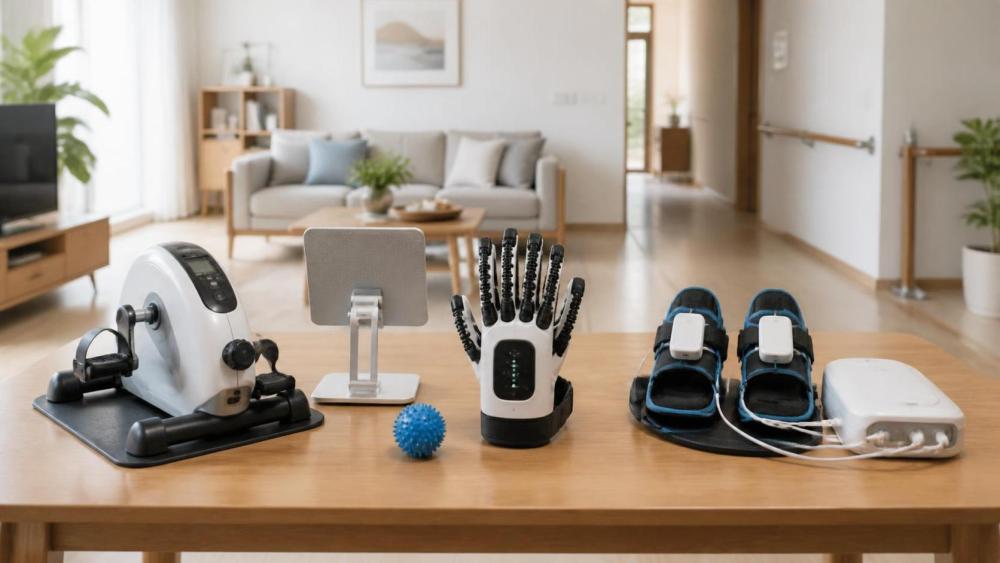
When robotics fit the home environment
Robotic rehabilitation equipment ranges from small hand units to powered arm trainers, ankle devices, and walking systems. The appeal is understandable: robotics can provide repeatable movement, adjustable assistance, and session data. Yet home suitability is determined by physical and practical limits, not by the presence of a motor or screen.
A compact tabletop robotic trainer may work where there is a stable work surface, accessible electrical power, and enough room for correct seating. It should be possible to approach the device without twisting or reaching across the body. The table height, wheelchair clearance where relevant, forearm support, and screen visibility all influence whether the prescribed movement can be performed with good posture.
Large robotic gait systems require much greater caution. They may need floor space, a clear turning path, stable flooring, transfer support, storage, and trained assistance during every session. A narrow hallway, uneven threshold, loose rug, or crowded living room can make a technically capable device impractical. Weight also affects delivery and relocation. Confirm package dimensions, assembled dimensions, device mass, doorway widths, lift access, and whether setup involves lifting components or anchoring equipment.
Do not assume that a robotic device automatically adjusts to changing recovery status. Assistance levels, range limits, body supports, and exercise programs may need regular review. A setting that was appropriate during early weakness could become too restrictive once voluntary control improves. Conversely, reducing assistance too quickly can lead to compensatory movement, shoulder strain, or loss of balance.
Telerehabilitation and video-guided practice
Telerehabilitation can be a strong fit when travel is difficult but regular feedback is still needed. It may involve scheduled video sessions, exercise libraries, secure messaging, movement tracking, or remote review of progress. Its main advantage is continuity: questions about exercise form, fatigue, pain, and daily barriers can be discussed without waiting for an in-person appointment.
The technology itself should be simple enough to operate on a difficult day. Large on-screen controls, clear audio, captions, adjustable volume, a stable device stand, and a camera position that shows the relevant movement are practical requirements. For walking or standing tasks, the camera should be placed before the exercise begins. Trying to reposition a phone while standing can create a fall hazard.
Internet reliability matters, but privacy and account management also need attention. Shared tablets may expose health information if screens remain logged in or notifications appear. Use a protected device account, strong sign-in credentials, and a plan for technical support when an update changes the interface. A platform that records movement data should clearly state what is collected, where it is stored, and who can access it.
Video review is particularly useful for exercises where form is hard to judge alone, such as shoulder reach, sit-to-stand practice, balance tasks, and gait drills. It is less suitable as the only safeguard for tasks that require hands-on guarding. A live video connection cannot physically prevent a fall or correct a slipping brace.
Smart monitoring without turning recovery into constant surveillance
Activity trackers, motion sensors, connected blood pressure monitors, smart scales, and medication reminders can support routine building. Their usefulness depends on a clear action linked to the reading. Step counts may show whether daily walking is changing, but they do not reveal gait quality, fatigue, or whether steps were taken safely. A wrist tracker may also misread movement on an affected side with limited arm swing.
Monitoring tools work best when measurements are limited to information that is actually reviewed. A flood of alerts can create anxiety and obscure the few changes that matter. Set practical thresholds with the clinical team where appropriate, especially when monitoring blood pressure, heart rate, or symptoms during exercise. Seek prompt clinical advice for new chest discomfort, severe shortness of breath, fainting, sudden weakness, new speech difficulty, or a major change from the established recovery pattern.
Fall detection devices may add reassurance for someone who spends time alone, but they are not a substitute for reducing hazards. Detection can be delayed, a device may not be worn, and some falls may not trigger an alert. Clear pathways, adequate lighting, secure footwear, reachable phones, and correctly fitted mobility aids remain part of the home setup.
Fit, materials, and daily maintenance
Braces, gloves, electrodes, straps, and harnesses contact skin repeatedly. Look for smooth edges, breathable fabrics where prolonged wear is expected, washable covers, and fastening systems that can be managed with one hand when necessary. A rigid plastic orthosis should have rounded, finished edges and enough adjustment to accommodate swelling or changes in footwear. Pressure marks that persist, broken skin, numbness, burning, or increasing pain are reasons to stop using the item until fit is reviewed.
Consumables can determine whether a device remains usable over time. Electrode pads, replacement straps, batteries, chargers, sensor covers, software subscriptions, and disposable liners may all be required. Ask how often these items may need replacement, whether they are readily available, and whether the device can still be used safely if a component wears out. A low initial price can become less attractive when essential consumables are difficult to obtain.
Cleaning instructions should match the home environment. Wipeable hard surfaces are usually easier to maintain than deeply textured housings. Fabric components may require air drying, which affects whether they can be reused the next day. Electrical devices should be unplugged before cleaning unless their instructions specify otherwise, and liquids should not enter charging ports, control panels, or motor housings.
A practical selection sequence
Begin by identifying one or two daily activities that have become difficult and the movement limitations behind them. Then map each possible device to that task. A hand trainer may support reaching and grasp practice; it will not solve poor standing balance. A reminder app may improve routine adherence; it will not correct an unsafe transfer technique.
- Try the intended setup in the actual room whenever possible. Measure the usable area, not only the open floor visible before a chair, walker, or caregiver is present.
- Review the complete operating sequence: charging, fitting, switching on, selecting a program, cleaning, storing, and responding to an error message. A device can be effective in theory yet abandoned when these steps are too demanding.
- Ask whether settings can be locked after professional configuration. This can reduce accidental changes to resistance, stimulation intensity, or range limits.
- Confirm the support route for repairs, replacement parts, software issues, and training refreshers. Equipment that cannot be serviced locally may lead to long interruptions in practice.
Training should include the person recovering, anyone assisting with setup, and the clinician responsible for the rehabilitation plan. It is useful to practice the full routine before relying on the device independently: transfer into position, place supports correctly, complete a short session, stop safely, and document any discomfort or technical problem.
The strongest home setup is often modest and well integrated: a stable exercise surface, an appropriate mobility aid, a targeted digital program, and a simple way to communicate progress. Rehabilitation technology solutions should reduce barriers to meaningful practice while leaving room for rest, ordinary daily activity, and professional reassessment as recovery changes.