
How to compare anesthesia delivery systems for operating rooms
Choosing an anesthesia delivery system for an operating room is not a matter of comparing a short specification sheet or selecting the lowest acquisition cost. For technical evaluators, the practical question is whether a system can deliver controlled anesthesia and ventilation safely across the hospital’s real case mix, room conditions, staffing model, service capability, and regulatory environment.
That distinction matters because an anesthesia workstation sits at the intersection of medical gas infrastructure, respiratory support, physiologic monitoring, surgical workflow, infection control, and clinical risk management. A system that appears well equipped in a demonstration may still create difficulties if its ventilator modes do not fit the intended patients, its alarms are difficult to manage during complex cases, its consumables are hard to source, or local engineers cannot maintain it without extended vendor intervention.
When comparing anesthesia delivery systems for operating rooms, the aim should be to identify the combination of clinical capability, operational resilience, and lifecycle support that fits the institution. The right answer may differ substantially between a tertiary referral hospital, a day-surgery center, a maternity theatre, a pediatric hospital, and a new-build operating suite.
Begin with the actual clinical and operational scope
Technical comparisons are often weakened when procurement teams begin with features rather than use cases. The first step is to define what the operating rooms are expected to handle during the useful life of the equipment. This should include not only current surgical volumes, but also expected service expansion, specialty development, and backup requirements.
A general operating theatre handling adult elective surgery may have different priorities from a room supporting neonatal, thoracic, bariatric, trauma, or cardiac procedures. Pediatric and neonatal use raises particular questions around low tidal-volume performance, leak compensation, fresh gas control, and the accuracy of delivered ventilation at the lower end of the patient range. For hospitals that routinely manage long and physiologically unstable cases, ventilation flexibility, integrated monitoring, data visibility, and alarm usability may carry more weight than optional convenience features.
It is also important to establish the intended anesthesia technique mix. A facility that mainly uses inhalational anesthesia has different dependencies from one that increasingly uses total intravenous anesthesia. This does not make the anesthesia machine irrelevant in intravenous practice: airway management, ventilation, oxygen delivery, gas scavenging, emergency backup, and monitoring remain essential. But the expected use of vaporizers, agent consumption, and gas delivery configurations may change.
- What patient populations and surgical specialties will the rooms support?
- Are the systems needed for routine cases, high-acuity work, or both?
- Will each operating room require the same configuration, or should capability be tiered by specialty?
- What downtime can the hospital realistically tolerate before a backup machine is needed?
- Does the planned room design include compatible medical gas, electrical, network, and scavenging infrastructure?
These questions prevent an all-too-common mistake: purchasing a technically sophisticated standard configuration that is either overbuilt for most rooms or underprepared for the cases that create the highest clinical risk.
Assess gas delivery as a system, not as an isolated machine feature
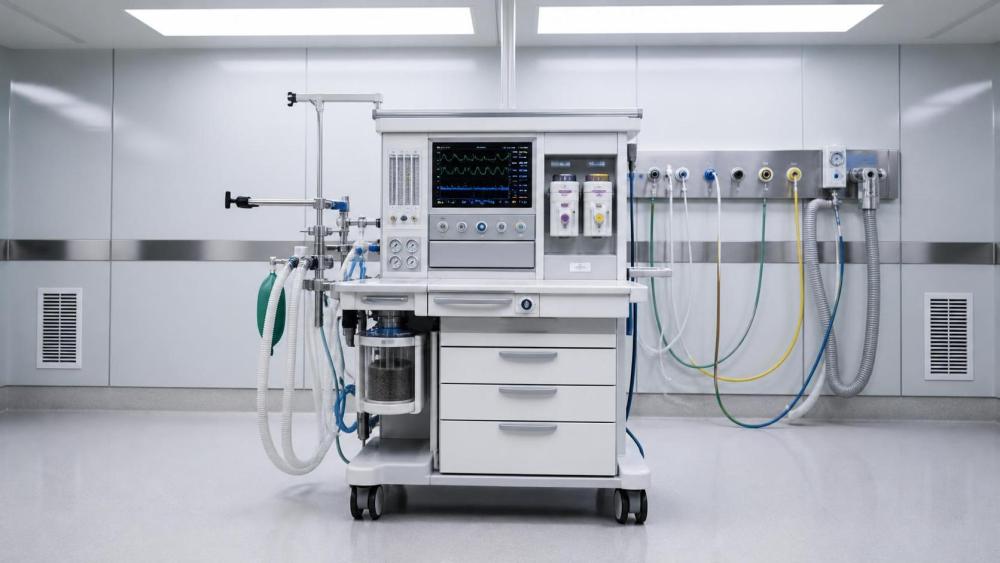
An anesthesia delivery system depends on a reliable upstream gas supply as much as it depends on its own internal controls. Evaluators should therefore review the workstation together with the medical gas pipeline, cylinder backup arrangements, connectors, pressure conditions, oxygen monitoring, and anesthetic gas scavenging pathway.
Modern systems commonly provide electronic gas mixing and safety mechanisms intended to reduce the risk of hypoxic mixtures. However, technical teams should confirm exactly how the device behaves when pipeline pressure falls, a cylinder is depleted, a gas source is disconnected, or the oxygen concentration differs from the configured target. Terms such as “hypoxic guard,” “oxygen ratio control,” and “automatic backup” should be examined in the manufacturer’s documentation and demonstrated under controlled acceptance-test conditions. Names alone do not establish equivalent behavior across platforms.
Low-flow and minimal-flow anesthesia capability is another area where simple claims can mislead. A workstation may support low fresh-gas flows, but safe routine use also depends on agent monitoring, accurate oxygen measurement, absorber performance, leak management, clinician familiarity, and institutional protocols. The economic benefit from lower agent and gas consumption can be meaningful, yet it should not be assumed without reviewing local clinical practice and gas pricing.
Scavenging deserves the same level of attention. Poorly matched scavenging systems can affect room air quality, interfere with ventilator performance, or create avoidable installation work. The evaluation should clarify whether active or passive scavenging is used, what interfaces are required, and whether the facility’s exhaust capacity and local safety controls are appropriate.
Ventilation performance should be tested against representative patients
The built-in anesthesia ventilator is often the most consequential technical comparison point. Procurement documents may list volume control, pressure control, pressure support, synchronized modes, recruitment tools, and compliance compensation. The more useful question is whether the machine provides stable, understandable, and clinically usable ventilation for the patient groups the hospital serves.
For adult general surgery, reliable volume and pressure control, clear waveform display, accurate spirometry, and predictable alarm behavior may be the core requirement. For pediatric work, teams should pay closer attention to minimum deliverable tidal volume, fresh gas decoupling or equivalent compensation mechanisms, leak handling, circuit compliance compensation, and the accuracy of displayed versus delivered values. For obese, laparoscopic, thoracic, or critically ill patients, pressure support capabilities, PEEP range, recruitment functionality, and respiratory mechanics displays may be more relevant.
Technical evaluators should not rely entirely on simulated bench figures supplied in tenders. During a site demonstration or factory acceptance process, ask suppliers to show performance using test lungs representing different compliance and resistance conditions. Observe the time required to change modes, the clarity of alarm messages, the effect of fresh-gas flow changes, and the availability of manual ventilation during equipment faults. The point is not to recreate every clinical event, but to identify controls or limitations that could matter under time pressure.
Integrated monitoring is valuable only when it reduces decision burden
Anesthesia workstations increasingly incorporate gas monitoring, spirometry, respiratory loops, trends, and network connectivity. In some environments, integration can simplify the workspace and reduce the need for separate displays. In others, an independent patient monitor and gas analyzer may remain part of the preferred clinical architecture. Neither model is automatically better.
The evaluation should focus on display hierarchy and workflow. Can the anesthetist identify oxygen concentration, end-tidal carbon dioxide, volatile-agent concentration, airway pressure, minute volume, and active alarms without navigating through several screens? Are trends easy to retrieve during prolonged cases? Can alarm limits be adjusted in a controlled manner? Does the display remain readable from realistic working positions around the anesthesia machine and operating table?
Alarm burden requires particular attention. A system with more measured parameters is not necessarily safer if it produces frequent non-actionable alerts or makes urgent alarms difficult to distinguish. Review how the workstation prioritizes visual and audible alerts, whether settings can be standardized through user profiles, and how alarm information is retained for post-event review. Clinical users should participate directly in this assessment; biomedical engineering alone cannot judge alarm ergonomics adequately.
Where monitoring data will be connected to hospital systems, integration claims should be translated into concrete questions. What data are exported? Which interface or middleware is required? Does the connection support the hospital’s existing information architecture? Who validates cybersecurity controls, software versions, user permissions, and downtime procedures? Interoperability should be treated as a project deliverable, not a checkbox on a supplier brochure.
Compare workflow design and infection-control implications
Operating room equipment is used under conditions where space is limited, attention is divided, and case turnover matters. The physical design of the system influences daily workload. Consider the reach and stability of drawers, work surfaces, vaporizers, circuit supports, cable routing, auxiliary gas outlets, suction arrangements, wheels, brakes, and battery access. A feature can appear minor until it repeatedly interferes with positioning, cleaning, or emergency access.
System footprint is especially important in compact theatres, hybrid rooms, and facilities with mobile imaging. A large workstation may offer ample storage but restrict circulation around the anesthesia provider. Conversely, a minimal configuration may force staff to add aftermarket shelves, external monitors, or unsecured accessories that create clutter and cleaning difficulties.
Infection-control review should cover surfaces, seams, detachable parts, reusable breathing system components, filters, water traps, sample lines, absorber canisters, and cleaning-agent compatibility. Procurement teams should request clear reprocessing instructions and determine which tasks belong to anesthesia staff, central sterile services, environmental services, or clinical engineering. The right question is not simply whether a component is reusable or disposable. It is whether the chosen approach is compatible with the hospital’s validated cleaning process, labor capacity, waste policy, and supply continuity.
Separate acquisition price from the cost of dependable operation
The purchase price of an anesthesia workstation is visible during tender evaluation. Many of the cost drivers are not. These include scheduled preventive maintenance, repairs, software updates, batteries, sensors, flow cells, gas sampling consumables, breathing circuits, CO2 absorbent, vaporizer service, accessories, training, loan equipment, and service-call response times.
A lower-priced system can become costly when it relies on proprietary consumables with unstable availability, requires frequent module replacement, or has limited local technical coverage. Conversely, a more expensive platform may be justified where its reliability record, standardization benefits, service access, and monitoring integration reduce operating disruption. The objective is not to assume that premium equipment has the lowest lifecycle cost, but to compare cost exposure transparently.
Technical evaluators should ask bidders for a multi-year cost model based on stated assumptions. The hospital should then challenge those assumptions using its expected annual case volume, planned clinical applications, service model, and local supply conditions. Consumable prices, preventive-maintenance intervals, expected replacement parts, and software licensing terms should be documented rather than discussed informally.
Standardization across operating rooms can also have operational value. A common platform can simplify user training, accessory management, preventive maintenance, spare-parts stocking, and emergency substitution. However, standardization should not become an excuse to place an unsuitable entry-level configuration into a specialist theatre. A practical approach is often to standardize the underlying platform while specifying different accessory or software configurations for different room types.
Serviceability and supplier capability are part of the technical assessment
For capital equipment used in high-consequence clinical settings, after-sales support is not a commercial footnote. It is a core performance requirement. Technical teams should determine whether local engineers can perform first-line diagnostics and preventive maintenance, what training and tools they require, and which repairs must be escalated to the manufacturer or an authorized service partner.
Request evidence of local installed base, service staffing, spare-parts availability, escalation routes, and maximum response commitments. A service-level agreement should distinguish between remote support, on-site attendance, planned maintenance, software issues, and situations requiring replacement equipment. It should also clarify whether the supplier holds local inventory for critical parts and how long discontinued components will remain supported.
Software lifecycle management is increasingly relevant. Workstations with connected components may require cybersecurity patches, version management, interface validation, and change-control procedures. Hospitals should know who is responsible for these activities, how updates are communicated, whether updates may affect clinical configuration, and how the system is returned to service after intervention.
Compliance review should start before the preferred supplier is selected
Regulatory documentation requirements differ by market, and the procurement team should not assume that a device sold in one jurisdiction is ready for another. The required evidence may include product registration status, declarations of conformity, quality-system documentation, labeling, instructions for use, electrical safety information, risk-management records, service manuals, and local-language materials. Specific requirements should be confirmed against the relevant national authority and hospital policy.
For new facilities or major operating room upgrades, equipment compliance must also be coordinated with room-level infrastructure requirements. Electrical supply quality, emergency power, medical gas standards, scavenging connections, ventilation conditions, fire safety, grounding, network architecture, and physical access routes can all affect installation readiness. A device can be compliant in itself while the project still fails because site preparation was incomplete.
Acceptance testing should be planned before delivery. The protocol should define which configuration, accessories, vaporizers, monitors, cables, and software versions are expected; what functional tests will be performed; which faults or alarms will be simulated; who signs off; and what documentation is required before clinical use. This reduces disagreement after installation, when project schedules may already be under pressure.
A disciplined comparison process produces better decisions
Technical evaluation is strongest when clinical users, anesthesiology leadership, biomedical engineering, infection control, facilities, IT, procurement, and finance each contribute within a defined role. Clinical teams should judge usability and patient-care relevance. Engineering teams should assess maintainability, infrastructure fit, and acceptance criteria. Procurement should make commercial terms and supply obligations comparable. Finance should test lifecycle assumptions rather than only initial quotations.
Supplier demonstrations are useful, but they should follow a scripted scenario instead of a sales-led presentation. Ask each bidder to configure the system for the same representative cases, show daily checks, replace common consumables, change ventilation modes, respond to specified alarms, demonstrate emergency backup functions, and explain maintenance workflows. Record observations in a weighted matrix that separates mandatory requirements from desirable options.
The final choice should be defensible in plain terms: this system supports the intended patients and procedures; it works with the hospital’s infrastructure; clinicians can use it safely under pressure; engineering can maintain it; consumables and service are available; and the total operational commitment is understood. That is a more durable procurement outcome than selecting the workstation with the longest feature list or the most attractive initial price.
Have questions about the global trade trends discussed here, or planning your expansion and supply chain strategy? Leave a message below and let the trade experts at MTHH guide you.
We respect your privacy. Your information is strictly confidential.
Related News
- Hong Kong Outlines Medical Device Legislation and Plans for Statutory RegulatorNov 14, 2026Hong Kong medical device legislation could reshape regulatory oversight. Explore the proposed regulator and what businesses should monitor.
- AAMI Issues TIR115 Guidance on Public Cloud Use in Medical DevicesNov 13, 2026AAMI TIR115:2026 guides public cloud use in medical devices. Explore its focus on risk management, supplier assessment and device boundaries.
- How are critical care devices regulated in the United States?Nov 12, 2026Critical care devices face FDA requirements based on intended use and risk. Explore classifications, marketing pathways, and practical compliance checks.
- Hong Kong Drafts Medical Device Bill to Establish Statutory OversightNov 12, 2026Hong Kong's Medical Devices Bill could introduce risk-based statutory oversight. Discover what the proposed framework may mean for suppliers.