
On July 15, 2026, a revised MDR implementation guideline from the European Commission entered mandatory application for rehabilitation devices that include AI-assisted decision functions. The update matters not only to manufacturers of products such as intelligent gait training systems and neurofeedback rehabilitation platforms, but also to importers, certification teams, regulatory service providers, and buyers involved in placing rehab products on the EU market. What deserves closer attention is that AI functionality is now being handled as a distinct review element within CE certification rather than remaining embedded in a broader device assessment.
What the revised MDR guidance confirms
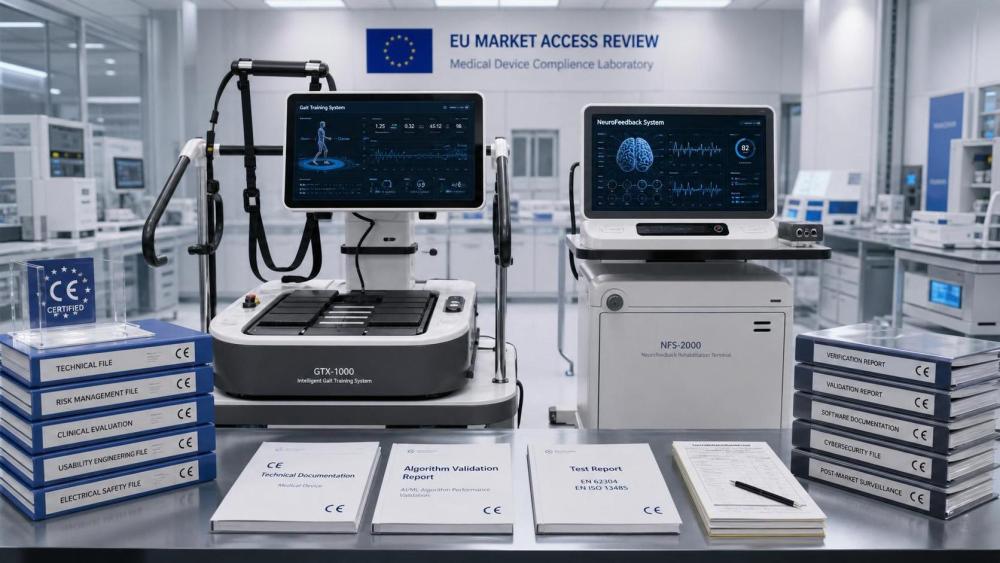
According to the provided information, the European Commission issued a revision to the MDR implementation guidance on July 5, 2026, under reference EC/2026/189. The revision states that all rehabilitation devices with AI-assisted decision functions must submit a separate AI clinical evaluation report as part of CE certification. The same products must also undergo algorithm validation by a designated Notified Body (NB).
The scope described in the input applies to rehabilitation products placed on the EU market, including products imported from China. Examples specifically mentioned in the input include intelligent gait training systems and neurofeedback rehabilitation platforms.
Where the impact is likely to be felt first
Manufacturers moving AI-enabled rehab products into CE review
From an industry perspective, manufacturers are the first group likely to feel the direct effect because the new requirement is tied to the CE certification file itself. The impact is concentrated in regulatory documentation, clinical evaluation preparation, and coordination with the NB for algorithm validation. Companies with rehab devices that include AI-assisted decision functions will need to pay closer attention to whether their existing submission package already separates AI-related evidence clearly enough for review.
Import and market-entry teams handling EU placement
Businesses responsible for placing products on the EU market may also face practical implications. The reason is straightforward: the new rule applies to all covered rehab products entering the EU market, including those imported from China. The business effect is likely to appear in market-entry planning, shipment readiness, and documentation checks tied to certification status. What deserves closer attention is whether commercial timelines assume a certification pathway that no longer matches the revised guidance.
Notified Body coordination and external compliance support
Regulatory consultants, testing coordinators, and other service providers around CE projects may be affected because the guidance explicitly points to NB-based algorithm validation. In practice, the pressure point is likely to be project sequencing: technical teams, clinical teams, and certification partners may need to align earlier on what belongs in the AI clinical evaluation report and what must be presented for algorithm validation.
Buyers and channel partners assessing product readiness
Distributors, procurement teams, and channel partners may not be the formal certification applicant, but they still have reason to watch the change closely. Their exposure is tied to product onboarding, tender timing, and supply continuity for AI-enabled rehabilitation equipment. The immediate concern is less about technical interpretation and more about whether products offered for the EU market can demonstrate that the revised certification steps have been addressed.
Practical points companies should watch now
Identify which products actually fall within the new trigger
Companies should first distinguish between general software-enabled functions and the narrower category described in the input: AI-assisted decision functions in rehabilitation devices. That distinction matters because the revised pathway is framed around that function, not around all digital features in general.
Review whether the CE submission file isolates AI evidence clearly
The revision specifically requires a separate AI clinical evaluation report. For companies already preparing CE submissions, an immediate practical question is whether current documentation already separates AI-related clinical support in a way that matches this requirement, or whether the file structure still treats AI content only as part of the wider device dossier.
Confirm NB engagement assumptions before delivery commitments
Because algorithm validation must go through a designated NB, companies should pay close attention to how this affects project timing, document readiness, and customer communication. Analysis shows that the operational issue is not only compliance interpretation, but also whether sales, delivery, and regulatory milestones are still aligned after the rule becomes mandatory on July 15, 2026.
Keep watching for further official clarification in application practice
Although the rule in the input is already framed as mandatory from July 15, 2026, companies should still monitor how official wording is applied in actual certification workflows. Observably, there can be a practical difference between a published requirement and the way review expectations are implemented across individual projects.
Why this reads as more than a filing update
Analysis shows that this development is not just a minor documentation adjustment. By requiring a separate AI clinical evaluation report and NB algorithm validation, the guidance indicates that AI-assisted decision functionality in rehabilitation devices is being treated as a review subject that warrants dedicated scrutiny inside the CE process. It is more appropriate to understand this as a concrete regulatory signal with immediate operational relevance, while still recognizing that the full shape of implementation may need continued observation through certification practice.
How the market may interpret the signal
At this stage, the most balanced reading is that the EU has moved from general concern about AI-enabled medical functionality toward a more explicit review path for covered rehabilitation devices. This should not be overstated as a complete redefinition of the market, but it is clearly more than a symbolic policy statement. For companies selling into Europe, especially those handling AI-enabled rehab systems, the current development is best understood as an enforceable compliance change with broader long-term implications for documentation, validation, and market-entry planning.
Basis of this article and what still needs checking
This article is based on the user-provided news title, event date, and event summary. For this type of industry update, relevant source categories usually include official government or regulator notices, company disclosures, industry association releases, authoritative media coverage, and standards-related documents. The specific official source link was not provided in the input, so continued verification is still necessary. Follow-up attention should remain on any additional official clarification around implementation wording, review expectations for AI clinical evaluation reports, and the practical handling of NB algorithm validation.