
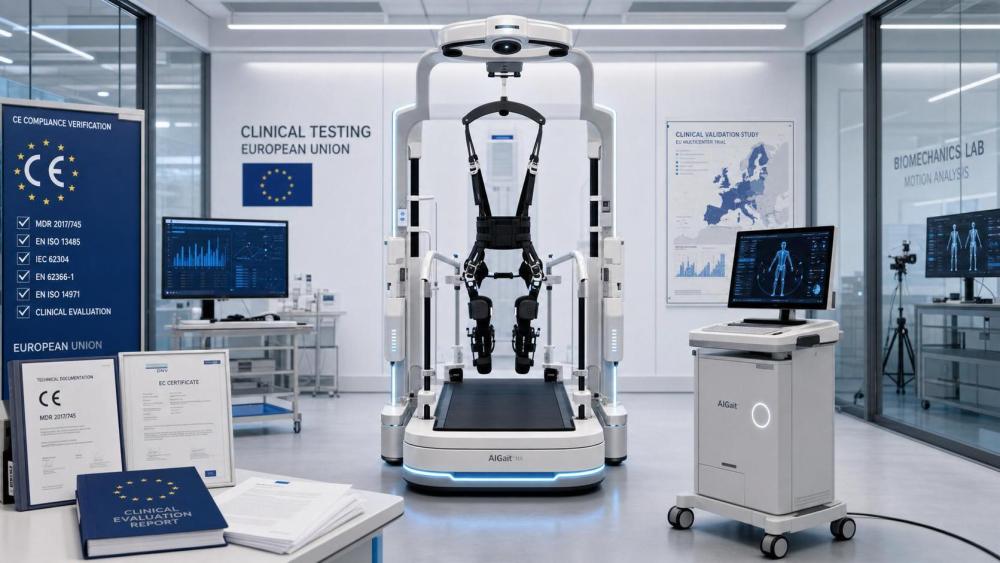
On July 9, 2026, the European Commission issued Commission Notice 2026/C 218/03, formally extending the scope of MDR Annex XVI to rehabilitation devices that include AI-driven decision modules, including products such as intelligent gait analyzers and neurofeedback training systems. For CE applications submitted on or after that date, companies must now provide a clinical algorithm validation report aligned with ISO/IEC 23053:2026, and the validation data must come from an EU-recognized third-party clinical center. This matters to manufacturers, exporters, certification teams, and procurement functions because it changes the entry requirements for affected products and is likely to reshape certification timing and cost planning.
What the July 9 notice changes
The confirmed change is narrow but operationally significant. According to the provided event summary, the European Commission's notice brings rehabilitation devices with AI-driven decision functionality into the formal scope of MDR Annex XVI. The examples explicitly mentioned are intelligent gait analyzers and neurofeedback training systems.
The same notice also sets a documentation condition for new CE certification submissions made from July 9, 2026 onward. Those applications must include a clinical algorithm validation report that complies with ISO/IEC 23053:2026. In addition, the validation data used for that report must be generated by an EU-recognized third-party clinical center.
No further execution detail, transition arrangement, or product-by-product interpretation is provided in the input, so those points remain outside the confirmed facts available here.
Where the pressure is likely to appear first
For manufacturers of AI-enabled rehabilitation equipment
Analysis shows that the first impact will fall on product teams and regulatory affairs units responsible for CE submissions. If a rehabilitation device contains an AI-driven decision module and is filed for CE certification after July 9, 2026, the submission package now needs an additional layer of clinical algorithm validation evidence. In practice, the main pressure point is likely to be technical documentation readiness, especially where product claims, software behavior, and validation materials must be aligned.
For export-oriented suppliers and market access teams
From an industry perspective, export businesses are likely to feel the effect through timing and cost structure rather than through headline policy language alone. The provided summary already indicates that certification cycles and costs will be significantly affected. That means companies shipping into the EU market may need to reassess filing schedules, product launch sequencing, and delivery commitments tied to CE approval milestones.
For certification, testing, and document preparation workflows
What deserves closer attention is the shift in evidence requirements. The rule is not limited to general safety documentation; it specifically requires a clinical algorithm validation report compliant with ISO/IEC 23053:2026 and based on data from an EU-recognized third-party clinical center. For compliance teams, this raises the importance of data provenance, report format, and the consistency between technical files and clinical validation materials.
For procurement and downstream delivery planning
Observably, procurement and delivery functions may also need to adjust. Where purchasing plans, distributor commitments, or tender timelines depend on expected CE registration progress, any extension in certification preparation could flow into ordering schedules and shipment planning. The input does not confirm how fast the new requirement will be processed in practice, but it clearly signals that planning assumptions based on earlier registration conditions may need review.
What companies should check now
Review whether AI functionality changes product scope
Analysis shows that companies should first verify whether their rehabilitation products include an AI-driven decision module in a way that could place them within the newly extended Annex XVI scope. This is especially relevant for devices similar to the examples mentioned in the event summary, but firms should avoid assuming that only those named products are affected.
Re-examine CE submission files for new evidence gaps
For applications to be submitted on or after July 9, 2026, businesses should check whether their current CE documentation package already contains material that can support an ISO/IEC 23053:2026-compliant clinical algorithm validation report. If not, the gap is not just a drafting issue; it may involve additional validation work and external coordination.
Confirm the source and acceptability of validation data
What deserves closer attention is the requirement that validation data come from an EU-recognized third-party clinical center. Companies relying on internal testing, legacy datasets, or non-aligned external evidence should pay attention to whether those materials fit the new filing condition. The input does not provide the detailed recognition criteria or review process, so this remains a point for continued verification.
Adjust delivery, tender, and customer communication assumptions
Observably, companies with active export pipelines should also revisit schedules tied to certification completion. Where sales contracts, bid documents, distributor planning, or installation windows depend on anticipated CE registration timing, it is prudent to reflect the possibility of longer preparation and review stages rather than treating prior timelines as unchanged.
How this should be read at this stage
From an industry perspective, this development is better understood as an implemented rule change with immediate filing relevance, rather than a distant policy discussion. The date trigger is clear in the provided summary: CE applications submitted after July 9, 2026 must include the specified report and data source.
At the same time, it is also more appropriate to understand this as a compliance signal whose practical contours still need observation. The input does not provide detailed enforcement guidance, category interpretation notes, or market feedback. That means companies should treat the requirement itself as real and current, while continuing to watch for clarifications in certification practice, document expectations, and product-scope interpretation.
A narrower rule change with broad operational consequences
This notice does not merely add another reference standard to a technical checklist. Based on the provided facts, it changes the access conditions for certain AI-enabled rehabilitation devices seeking CE certification after July 9, 2026. The direct consequence is likely to be heavier preparation demands around algorithm validation, especially where third-party clinical data is now a filing prerequisite.
Analysis shows that the most reasonable current reading is this: the regulatory change has landed, but its day-to-day execution still deserves close observation. For affected companies, the immediate task is not to speculate beyond the notice, but to identify scope exposure, documentation gaps, and timeline risk in current EU-facing business plans.
Basis of this article and what still needs verification
This article is generated from the user-provided news title, event date, and event summary. The confirmed factual basis used here is limited to the stated July 9, 2026 notice, the extension of MDR Annex XVI to rehabilitation devices with AI-driven decision modules, and the new requirement for an ISO/IEC 23053:2026 clinical algorithm validation report supported by data from an EU-recognized third-party clinical center.
For developments of this type, relevant source categories typically include official notices, regulatory publications, standard-setting documents, trade or customs authority information, industry association materials, and reporting by established professional media. A specific official source link was not provided in the input, so the exact publication text and any later interpretive materials still need ongoing verification.
Further observation should focus on implementation detail, certification review practice, scope interpretation for affected product categories, changes in tender or procurement documentation, and industry feedback on execution timing and compliance burden.