
Price often gets the first look in medical procurement, but it should never get the final vote. When comparing a capital medical equipment supplier, the bigger question is whether that supplier can support clinical goals, operational reliability, regulatory readiness, and long-term asset performance. In healthcare, a lower purchase price can quickly lose its appeal if installation delays, weak service coverage, or poor workflow fit begin to affect uptime and patient care.
That is why the evaluation process has become more strategic. Across imaging, laboratory diagnostics, critical care, infection control, and hospital infrastructure, buying decisions now depend on how well equipment performs in real conditions and how well the supplier performs after delivery. A capable capital medical equipment supplier is not simply selling a machine. It is supporting a clinical and business system that has to work for years.
Why supplier comparison now demands a broader view
Healthcare organizations are under pressure from several directions at once. They need better clinical efficiency, stronger cost control, cleaner documentation, and more dependable equipment lifecycles. Those pressures make supplier evaluation more complex than ordinary industrial sourcing.
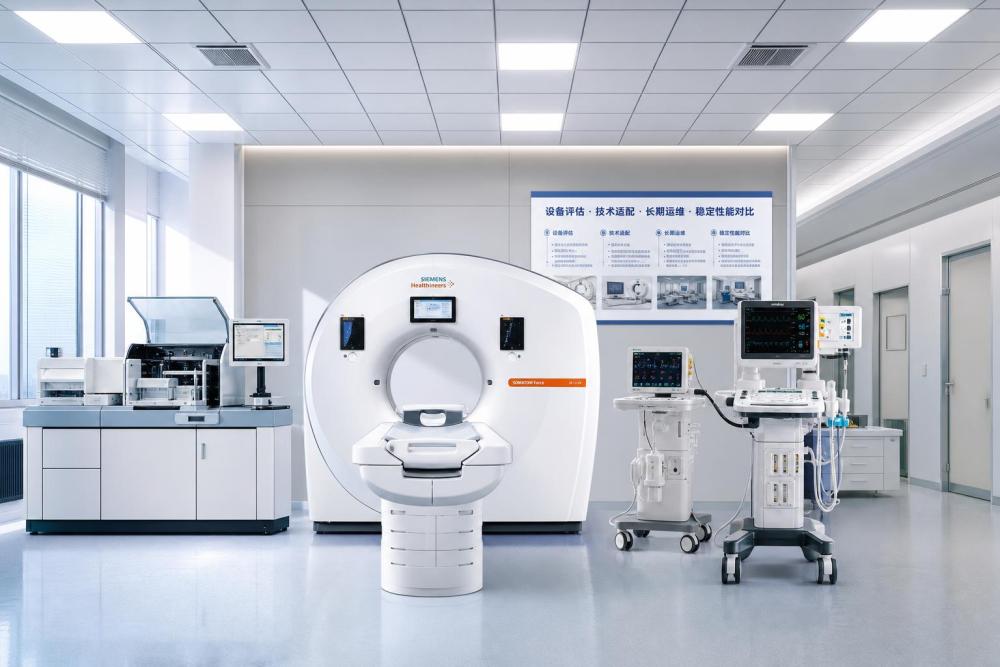
A CT scanner, sterilizer, patient monitor network, or immunoassay platform does not create value at delivery. Value appears later, through stable output, operator confidence, manageable maintenance, and predictable support. This is where many price-led comparisons fail.
The market also expects stronger transparency. Buyers increasingly review room planning, consumable dependency, software updates, cybersecurity, warranty exclusions, and service response terms before making a commitment. In this context, a capital medical equipment supplier must be assessed as a long-term partner, not a short-term bidder.
What a capital medical equipment supplier really provides
The term usually covers suppliers involved in higher-value medical systems with long service lives. These may include imaging systems, laboratory analyzers, anesthesia platforms, ICU devices, sterilization systems, digital infrastructure, and integrated hospital equipment packages.
In practice, the supplier relationship extends beyond equipment shipment. It may include site assessment, configuration advice, installation planning, calibration, user training, technical documentation, spare parts access, software service, and post-installation support.
This matters because the true comparison is not unit price versus unit price. It is one operating model versus another. One capital medical equipment supplier may offer a lower quotation, while another delivers faster commissioning, stronger compliance files, and lower disruption over the equipment lifecycle.
The first filter: clinical fit and technical relevance
Before reviewing commercial terms, it helps to confirm whether the supplier’s portfolio matches the intended clinical environment. A good offer on paper can still be the wrong fit if throughput, image quality, automation level, or alarm design do not match actual use.
For imaging systems, relevant questions include scan quality, dose management, workflow speed, room conditions, detector durability, and image handling. For laboratory systems, the focus may shift to assay menu, reagent dependence, calibration routines, sample throughput, and LIS connectivity.
Patient care equipment needs another lens. Ventilators, monitors, infusion systems, and anesthesia devices affect staff workload as much as device performance. Interface clarity, alarm behavior, training time, and maintenance intervals can shape real-world acceptance.
Questions that clarify technical fit
- What clinical workload was the system designed to handle each day?
- Which accessories, detectors, probes, or modules are included as standard?
- How does the platform integrate with existing software or hospital systems?
- Which consumables are locked to the supplier’s ecosystem?
- What maintenance tasks require supplier intervention rather than in-house support?
These questions often reveal more than a brochure does. They also make it easier to compare one capital medical equipment supplier against another using the same operational criteria.
Service capability is often where the real difference appears
Medical equipment is judged over time. Downtime, delayed parts, or weak field support can turn a reasonable purchase into an expensive problem. That is why after-sales structure deserves the same attention as the equipment specification.
A strong capital medical equipment supplier should be able to explain service coverage in practical terms. That includes engineer availability, remote diagnostics, preventive maintenance schedules, escalation paths, and spare parts stocking strategy.
Training is equally important. If advanced equipment requires repeated retraining or if user errors remain high after installation, the issue may be design, onboarding quality, or weak documentation. All three affect operating cost.
Compliance and documentation are not side issues
A supplier may have acceptable pricing and decent technical specifications, yet still create risk through incomplete documentation. In regulated healthcare markets, missing files can delay procurement approval, customs clearance, registration, installation, or reimbursement planning.
Useful review points include quality system evidence, product registration status, labeling consistency, risk management records, service manuals, installation requirements, and post-market support processes. Documentation quality is often a signal of operational maturity.
This is where structured industry intelligence becomes valuable. Platforms such as MTHH help organize technical and commercial information into practical comparison points, especially when equipment categories differ widely in complexity. That helps decision-making move beyond sales claims and into verifiable review.
Look at total operating cost, not just acquisition cost
The purchase price is only one layer of cost. A more accurate comparison includes service contracts, reagent or consumable dependency, calibration needs, energy use, software licensing, room preparation, accessories, and expected downtime.
For example, a laboratory analyzer with lower upfront pricing may require higher-cost reagents and more frequent service visits. An imaging platform may appear competitive until shielding, electrical upgrades, or ventilation changes are added to the project budget.
A capital medical equipment supplier should be able to explain cost drivers clearly. If lifecycle cost remains vague during early discussions, that is already useful information. It suggests the comparison process needs tighter commercial and technical questioning.
Lifecycle cost areas worth checking
- Consumables, reagents, or proprietary accessories
- Annual preventive maintenance and calibration
- Software licensing, upgrades, and interoperability work
- Facility preparation and installation dependencies
- Expected downtime cost during peak clinical periods
Comparison criteria should change by equipment category
Not every capital medical equipment supplier should be evaluated with the same emphasis. Category context matters. The priority set for a mammography system is not identical to the one used for sterilization equipment or nurse call infrastructure.
Imaging projects often emphasize room conditions, image quality, dose control, and uptime response. In vitro diagnostics may place more weight on throughput consistency, reagent stability, automation, and data integration. Critical care equipment usually demands stronger focus on interface design, alarm safety, and rapid service access.
Hospital infrastructure categories add another layer. Beds, gas systems, operating lights, cleanroom solutions, and sterilization systems affect facility planning, infection control, and maintenance workload. A supplier that performs well in one category may not offer the same depth in another.
A practical framework for stronger supplier decisions
A useful comparison model combines technical, commercial, service, and compliance factors in one review structure. This reduces the risk of overvaluing headline price or underestimating implementation challenges.
A weighted scorecard often works well. It forces each capital medical equipment supplier to be reviewed against the same business priorities, while leaving room for category-specific details.
- Technical fit: performance, workflow, compatibility, scalability
- Commercial terms: price structure, warranty scope, contract clarity
- Service readiness: response time, local support, parts access
- Compliance strength: documents, approvals, quality systems
- Lifecycle value: consumables, upgrades, maintenance, uptime
That kind of framework is especially useful when several internal teams need aligned judgment. It creates a common language for technical review, project planning, and financial approval.
Where to go from here
The best next step is rarely to ask for another discount. It is to sharpen the comparison standard. Clarify the intended clinical workload, list the required support conditions, identify documentation checkpoints, and map the full operating cost before final negotiation.
When the review is structured this way, the strongest capital medical equipment supplier becomes easier to identify. The decision is no longer driven by the cheapest offer, but by the supplier most likely to deliver stable performance, manageable risk, and credible long-term value.
For ongoing evaluation, it helps to keep using reliable industry references that explain equipment categories, procurement considerations, and service expectations in practical terms. Better information leads to better comparison, and better comparison usually leads to better outcomes after installation.
- laboratory diagnostics
- in vitro diagnostics
- ventilators
- sterilization equipment
- medical equipment
- hospital equipment
- hospital infrastructure
- patient care equipment
- critical care equipment
- dose management
- laboratory analyzers
- capital medical equipment
- medical equipment supplier
- capital medical equipment supplier