
How Hospital Infrastructure Planning Affects Imaging Department Uptime
Effective hospital infrastructure planning is a direct contributor to imaging department uptime. For project managers and engineering leaders, a CT, MRI, X-ray, or ultrasound purchase is only one part of the delivery challenge. The surrounding room, utilities, access routes, IT environment, and service arrangements determine whether that equipment can be installed on schedule, operated reliably, and maintained without repeatedly interrupting patient care.
Imaging downtime is often discussed as an equipment issue, but many disruptions begin outside the system itself. A scanner may be technically sound while its room overheats, its power quality is unstable, its replacement parts cannot be moved into the department, or its network connection prevents images from reaching PACS. These are not isolated facilities problems. They affect appointment capacity, emergency workflow, staff confidence, maintenance costs, and the credibility of the project plan.
The practical lesson is simple: hospital infrastructure should be planned around the imaging system’s full operating life, not only the installation day. This requires early coordination among the hospital’s project team, clinical engineering department, imaging leadership, architects, MEP contractors, IT specialists, radiation protection advisers where applicable, and the selected equipment supplier.
Uptime Begins Before the Equipment Reaches Site
A common project risk is treating the manufacturer’s site-planning documentation as a late construction reference. By the time it is reviewed, structural openings may be fixed, plant rooms may be undersized, and cable routes may be inaccessible. Rework then becomes expensive and can delay commissioning even when the scanner has already arrived.
The planning package for an imaging system typically contains requirements that must be reconciled with the building design: room dimensions, equipment footprint, floor loading, electrical supply, grounding, heat rejection, ventilation, cable pathways, shielding interfaces, access clearances, and environmental operating conditions. The exact requirements vary substantially by modality, model, configuration, and local regulation. They should therefore be confirmed against the final equipment documentation rather than copied from an earlier project or a generic room template.
This is especially important when procurement decisions remain open while construction progresses. Project leaders should identify the infrastructure assumptions that are difficult to change later: structural capacity, magnetic resonance zoning, electrical backbone capacity, HVAC plant provision, shielded-room interfaces, and logistics routes. If a final system has not been selected, these assumptions need an explicit review point before they are built into the project.
For MTHH, hospital infrastructure is not a background topic separated from device selection. A diagnostic system’s clinical value depends on the conditions in which it will operate. Structured review of site requirements, service obligations, workflow constraints, and long-term operating conditions helps project teams avoid evaluating a scanner only by image quality or purchase price.
Power, Cooling, and Environmental Stability Are Operational Requirements
Imaging equipment is sensitive to its utility environment. A department can appear complete at handover while still carrying reliability risks if electrical and mechanical systems have been designed only to meet nominal connected loads. The question is not merely whether power reaches the room. It is whether the supply arrangement supports the system’s start-up, operation, shutdown, protective functions, and recovery after an outage.
Project teams should clarify the equipment supplier’s requirements for incoming electrical characteristics, isolation or grounding arrangements, emergency power interfaces, and any recommended protection from disturbances. The hospital electrical engineer must then assess these requirements against the site distribution design and local electrical rules. A standby generator is not automatically a complete answer; transfer behavior, load prioritization, and the systems connected during restoration all need consideration.
Cooling is equally consequential. CT and MRI installations can create significant heat-management demands, while equipment rooms, technical spaces, control rooms, and IT cabinets may each require different temperature conditions. HVAC design should account for operational heat loads, maintenance access to air-handling components, seasonal performance, and the impact of an HVAC failure. If cooling equipment can only be serviced by shutting down the imaging suite, routine maintenance may turn into an avoidable loss of scanning time.
Environmental monitoring can provide a useful bridge between facilities management and clinical engineering. Temperature alarms, water-leak detection where relevant, power-event records, and trend review do not replace preventive maintenance, but they can help teams investigate recurring interruptions before they become a larger service event.
Room Design Must Support Both Clinical Flow and Technical Access
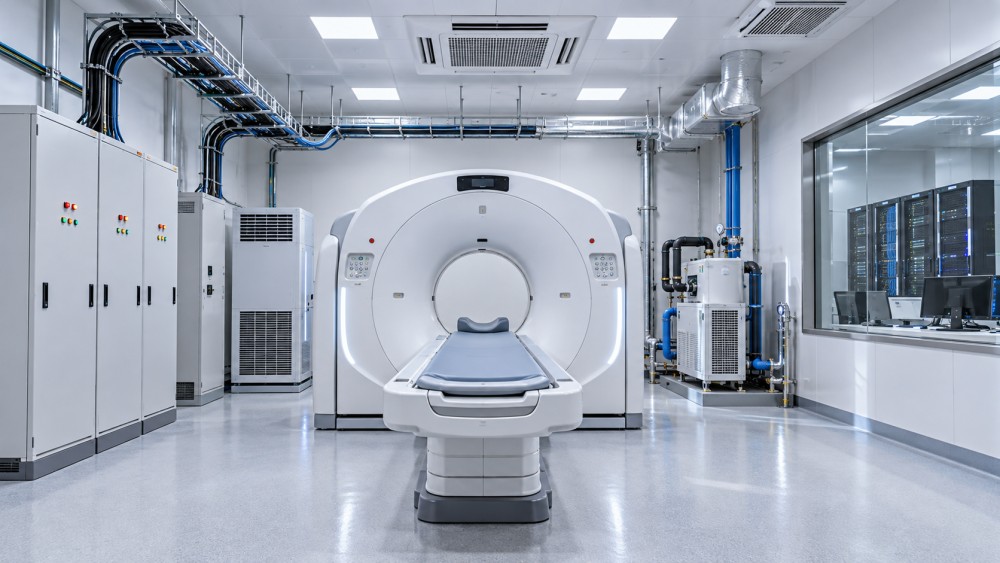
An imaging room is a clinical workspace, a technical installation, and a patient circulation point at the same time. When one of these functions is overlooked, uptime suffers in less obvious ways. A room might accommodate the gantry but leave insufficient turning space for a stretcher. A control room may offer poor observation of the patient. A door location may slow emergency access. A ceiling detail may restrict the route needed to replace a major component years later.
The best layout decisions are usually made by mapping real patient and staff movement rather than relying only on drawings. Consider scheduled outpatients, emergency arrivals, patients on beds, patients requiring mobility support, contrast workflows, cleaning, supply replenishment, and transfer to recovery or adjacent clinical areas. An imaging department serving an emergency unit has different circulation pressures from a planned outpatient center, even if both install similar equipment.
Service access deserves the same level of attention. Engineers need safe routes to cabinets, panels, chillers, ceiling services, and technical rooms. If access requires removal of finishes, interruption of an adjacent room, or movement through active patient areas, corrective work becomes slower and more disruptive. During design review, it is worth asking a direct question: how would the team replace the largest serviceable component after the department is live?
For MRI, planning has additional implications. Magnetic field safety zones, controlled access, ferromagnetic risk management, emergency procedures, and equipment movement routes must be developed with specialist input and aligned with the chosen system’s documentation. These matters should not be reduced to signage installed near project completion. They shape architecture, operations, and staff training from the beginning.
Shielding and Structural Decisions Cannot Be Treated as Late Finishes
In X-ray, CT, fluoroscopy, mammography, and other ionizing-radiation environments, shielding design is closely tied to equipment position, room use, occupancy of adjoining areas, and local requirements. A shielding approach that is based on an early equipment concept may need reassessment when the final system, workload assumptions, room layout, or neighboring occupancy changes. Project teams should ensure that the responsible qualified parties are involved at the right stage and that the final installation is verified in accordance with applicable requirements.
The operational consequence of poor coordination is not limited to compliance risk. Late shielding modifications can interrupt construction, delay acceptance activities, and force changes to finishes or penetrations that had already been completed. Door frames, observation windows, ducts, conduits, and cable openings all need coordinated detailing. A seemingly minor unplanned penetration can become a major issue once shielding integrity has to be restored and documented.
Structural planning also affects availability. Equipment weight, dynamic loads where relevant, vibration exposure, floor flatness, anchoring requirements, and the route used for delivery should be assessed early. It is not enough to confirm that a final room can hold the equipment. The route from unloading point to room matters as well: loading bays, corridors, lifts, temporary openings, thresholds, and turning radii can all constrain delivery. If the delivery route fails at the end of a project, the resulting delay can be disproportionate to the construction issue itself.
Digital Infrastructure Has Become Part of Imaging Availability
A modern imaging department depends on more than a functioning scanner. Images, worklists, reports, dose-related information where used, and service data may travel through interfaces involving RIS, PACS, electronic medical records, modality workstations, and vendor support tools. Network readiness therefore belongs in the project schedule, not in a final IT checklist.
The relevant questions are practical. Are the required network drops, segregated connections, server capacities, cybersecurity reviews, and user permissions ready before application training begins? Has ownership been agreed for DICOM configuration, worklist testing, image routing, backup arrangements, and downtime procedures? Are remote service capabilities permitted by hospital policy, and if so, what approval and access controls are required?
Not every site needs the same architecture, and hospital IT policies vary. What matters is avoiding the assumption that connectivity will “just work” after equipment installation. A scanner that cannot receive a patient list or send completed studies may be physically operational but clinically unavailable.
Commissioning Should Test the Whole Operating Environment
Factory acceptance, delivery, installation, and clinical handover are distinct milestones. A project can pass one while still being unprepared for the next. Commissioning should test the interaction between equipment, room systems, workflows, and users—not simply whether the device powers on.
Useful readiness reviews commonly include verification of utilities against approved documentation, environmental performance under expected operating conditions, safety features, network functions, patient movement routes, emergency response arrangements, and the availability of operating manuals and service contacts. Training also needs to reach the people who will manage everyday exceptions: radiographers, radiologists, nurses, porters, IT support, facilities teams, and biomedical engineers.
A clear handover record helps prevent the familiar problem of unresolved “small items” becoming operational failures later. It should distinguish construction defects, equipment issues, outstanding integrations, documentation gaps, and responsibilities during the warranty period. This protects the hospital as well as the supplier: neither side should have to diagnose an infrastructure defect as if it were a device failure.
Plan for Maintenance Windows Before the Department Opens
Long-term uptime is shaped by decisions that can feel secondary during construction. Does the department have a realistic maintenance window? Can facilities teams isolate a technical system without disrupting the scan room? Are replacement parts, consumables, and specialist service support addressed in the commercial arrangement? Has the hospital planned how it will redirect patients if a modality is unavailable for scheduled maintenance or unexpected repair?
These questions are particularly important when expanding an active hospital. Construction phasing, temporary routes, infection-control measures, noise restrictions, and access to live utilities can place pressure on the imaging schedule. A phased plan should make clear which services can be interrupted, who authorizes shutdowns, and how clinical teams will be notified. The safest technical sequence is not always the least disruptive clinical sequence, so both perspectives need to be represented in planning meetings.
Global MedTech & Healthcare Intelligence Hub supports this type of early evaluation by organizing information across imaging equipment, hospital infrastructure, clinical engineering, procurement, and healthcare project planning. For project leaders, the aim is not to replace specialist design or regulatory advice. It is to make the questions visible early enough that technical requirements, service expectations, and clinical workflows can be reviewed together.
A More Reliable Starting Point for Imaging Projects
The most durable imaging projects do not rely on a single final inspection to prove readiness. They establish a shared basis of design, confirm it against the selected system, and revisit it when clinical scope, equipment configuration, or construction conditions change. That process may take more coordination at the beginning, but it is usually easier than correcting access, cooling, shielding, or network problems after patients have been scheduled.
Before approving detailed design or releasing an imaging room for installation, project teams should be able to answer a small set of practical questions: Is the final vendor site plan approved? Are utilities and access routes demonstrably ready? Have clinical, facilities, IT, and engineering teams agreed on their handover responsibilities? Can planned maintenance and foreseeable failures be managed without unnecessary disruption?
If any answer remains uncertain, the right next step is usually not to accelerate installation. It is to identify the open dependency, confirm the relevant project documentation and local requirements, and resolve it while the change is still manageable.
- Last One:No more articles
- Next Article:What audit management software should medical device firms evaluate?Sep 28, 2026