
What audit management software should medical device firms evaluate?
The best audit management software for a medical device firm is not simply the platform with the longest feature list. It is the one that can turn audit findings into controlled, traceable action across the quality system without creating a parallel set of spreadsheets, email approvals, and disconnected records.
For an audit management medical device evaluation, start with the workflows that create the greatest compliance and operational risk: internal quality audits, supplier audits, corrective and preventive actions (CAPA), document changes, training evidence, and management review. A system that handles only audit scheduling and checklists may help a small team organize visits, but it will be inadequate when findings must be connected to root-cause analysis, controlled documents, product risk records, or supplier performance decisions.
The practical question is not, “Does the software support audits?” Most quality platforms do. The better question is, “Can our team demonstrate what was found, who assessed it, what evidence supports the conclusion, what actions were approved, and whether those actions were effective?” That trace from plan to closure should remain clear even when an audit involves multiple sites, contract manufacturers, distributors, or product families.
Evaluate the audit process before evaluating the interface
Medical device audits vary widely. An internal audit may examine whether a production process follows approved procedures. A supplier audit may assess a contract manufacturer’s controls, documentation, change notification practice, and ability to support an investigation. A distributor audit may focus on complaint handling, storage conditions, traceability, or field-service records. Treating all of these as the same checklist workflow usually produces weak records.
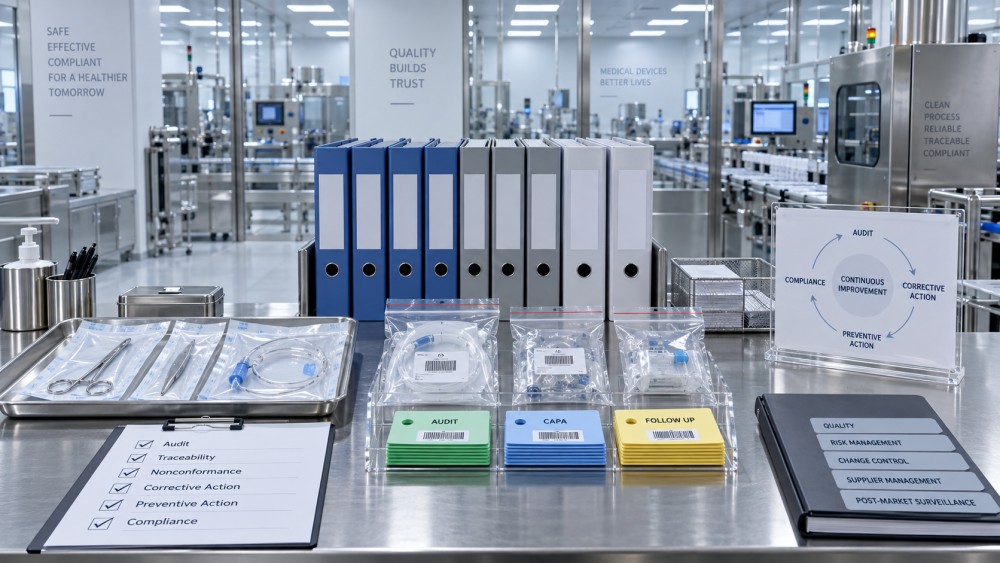
Map the actual audit lifecycle your organization needs to run. At minimum, examine whether a platform can support the following sequence without forcing users into workarounds:
- Risk-based annual or rolling audit planning, including audit scope, audit criteria, location, process owner, and auditor assignment.
- Reusable audit templates that can be adapted without losing control over approved questions and scoring logic.
- Field evidence capture, including observations, attachments, interview notes, photographs where appropriate, and references to controlled records.
- Clear categorization of findings, with defined ownership, due dates, escalation, and review requirements.
- Linkage from a finding to CAPA, nonconformance, supplier corrective action, complaint investigation, or document revision when the issue requires it.
- Verification of completion and effectiveness, rather than treating a completed task as automatic closure.
- Audit reports that preserve the record of what changed, who approved it, and why.
During demonstrations, ask vendors to show this end-to-end path using a realistic finding. A polished dashboard matters less than whether the system can follow a supplier audit observation through investigation, corrective action, evidence review, and closure without relying on manual reconciliation.
Audit findings must connect to the rest of the quality system
An audit tool becomes much more useful when it is part of a connected quality environment. A finding about an obsolete work instruction, for example, may require a document change, retraining, a production impact review, and an assessment of whether released devices are affected. If these activities remain in separate systems, the quality team must manually assemble the audit trail when management, a customer, or an inspector asks what happened.
Prioritize integration based on the systems your firm already uses. A mature manufacturer may need strong connections to document control, CAPA, complaint handling, change control, training, supplier quality, and risk management. A growing firm may initially need fewer modules, but should avoid choosing a point solution that cannot connect later without exporting records into spreadsheets.
Integration does not always mean buying one large suite. A focused audit application can be appropriate if it has dependable, governed connections to established quality systems. The concern is not whether every function resides in one product; it is whether records remain consistent, attributable, and accessible through the full investigation and decision process.
Do not confuse configurable with controlled
Medical device firms need flexibility because audit programs differ by site, product, supplier category, and market. Yet unrestricted configuration can weaken consistency. If any administrator can alter finding categories, approval paths, or scoring thresholds without review, comparable audits may become impossible to compare over time.
Look for controlled configuration: templates, workflows, roles, taxonomies, and reporting fields should be adjustable, but changes should be governed. The system should make it practical to standardize core processes while allowing justified variation. For example, supplier audits may need different evidence fields from internal manufacturing audits, but both should use consistent severity definitions and closure expectations where those distinctions matter.
This is especially relevant after acquisitions, rapid expansion, or implementation of a new quality model. A platform can appear flexible during a demonstration while creating dozens of slightly different forms in real use. That makes trend reporting unreliable and increases the burden on auditors, quality managers, and technical reviewers.
Inspection readiness is a retrieval problem, not a report-design problem
Teams often focus heavily on whether software can generate attractive audit reports. Reports are useful, but inspection readiness depends more on retrieval. The system should allow authorized users to find a specific audit, finding, action, approval, evidence item, or overdue commitment quickly and understand the relationship among them.
Evaluate search, filtering, and record navigation with realistic questions:
- Can a reviewer identify all open high-risk findings related to one manufacturing site or supplier?
- Can the team see recurring observations across multiple audits, even if the wording differs?
- Can a record show its full revision and approval history without reconstructing it from exports?
- Can users distinguish a delayed action from an action that has been completed but not effectiveness-checked?
- Can audit records be retained and accessed according to the firm’s quality and record-management approach?
Audit dashboards should support decisions, not just status meetings. A count of closed findings may look positive while repeat issues continue to appear in the same process. Useful reporting makes recurrence, aging, ownership, severity, and closure effectiveness visible. It should also allow technical evaluators to see whether the data model will support the organization’s future questions, not only its current metrics.
Security, validation, and supplier access need separate decisions
Audit management software contains sensitive operational records, supplier information, employee names, and potentially evidence related to product quality. Role-based access, approval controls, record history, and appropriately managed electronic signatures should be evaluated as operational requirements, not as a late-stage IT checklist.
The level of validation effort should match how the software is used and the impact of the records it manages. A system that stores controlled audit evidence and drives corrective-action approvals needs a more disciplined implementation approach than a simple scheduling tool. Ask the vendor how updates are handled, how configuration changes are documented, and how the customer can maintain confidence that intended workflows continue to operate as designed.
External participation deserves close attention. Supplier portals can reduce email traffic and simplify response collection, but access must be narrowly defined. Suppliers may need to respond to assigned findings and upload evidence without seeing unrelated audit records, internal comments, or information from other suppliers. Where external access is not well controlled, a portal may create more risk than efficiency.
Choose a deployment model that matches operational maturity
Smaller firms with a limited number of audits may benefit from a focused application that establishes a repeatable process quickly. In that setting, the priority is often controlled templates, findings, approvals, follow-up, and basic CAPA linkage. Buying a broad enterprise suite too early can lead to expensive configuration that users do not adopt.
Firms with multiple plants, extensive supplier networks, diverse device portfolios, or frequent quality events generally need stronger cross-process integration and reporting. They should assess how the platform handles shared versus site-specific workflows, delegated ownership, centralized oversight, and historical migration from legacy systems.
There is also a middle case: organizations that use a document management system and CAPA system successfully but still coordinate audits through spreadsheets. A standalone audit module may be a sensible step if it can use existing master data, link to controlled records, and avoid duplicate ownership. The right answer depends on the quality-system architecture already in place, not on whether an all-in-one platform appears more comprehensive.
Run a scenario-based evaluation, not a checkbox comparison
A requirements spreadsheet is necessary, but it should not be the final selection method. Vendors can often mark a feature as available when it requires custom work, a separate module, or an awkward manual process. Use a short set of scenarios drawn from your own audit program and require each shortlisted vendor to demonstrate them.
- Plan a supplier audit using a risk-based scope, assign roles, and issue the agenda or questionnaire.
- Record evidence and create a significant finding during the audit.
- Route the finding to the appropriate owner, link it to a corrective action, and document root-cause review.
- Show how a related procedure revision and required training would be tracked before closure.
- Demonstrate an overdue action, an escalation, an effectiveness review, and a repeat-finding trend report.
- Retrieve the final audit trail as a reviewer would, including evidence, approvals, changes, and linked records.
Score each scenario on more than functionality. Consider usability for auditors, administrative burden for quality staff, clarity for process owners, reporting quality, integration effort, and how much configuration is required to achieve the intended workflow. Include the people who will create records and resolve findings, not only the people who will administer the platform.
Common selection mistakes
The most frequent mistake is selecting a generic audit tool designed for operational inspections, financial controls, or workplace checklists and expecting it to manage a medical device quality process. These tools may support mobile forms and task assignment well, but often lack controlled links to CAPA, document revisions, risk records, and formal evidence review.
Another mistake is treating migration as a technical afterthought. Historical audit records may contain unresolved actions, inconsistent categories, expired suppliers, or incomplete attachments. Migrating every old file can preserve clutter; migrating too little can remove context needed for trends and open commitments. Define which records must remain active, searchable, or reportable before committing to a migration scope.
Finally, avoid selecting solely on speed of initial deployment. A quick launch has value, but only when roles, templates, severity rules, escalation paths, and ownership expectations have been agreed first. Software cannot resolve an unclear audit process. It will simply formalize the ambiguity.
Make the decision around evidence, ownership, and scale
A strong audit management platform gives a medical device firm a defensible record of how it identified quality-system weaknesses and how it controlled the response. The most suitable option should fit current audit volume while preserving room for supplier growth, broader quality integration, and more rigorous reporting.
Before signing, confirm three things: the platform can demonstrate a complete finding-to-closure trail; its configuration can be governed without constant vendor dependence; and the people who conduct audits, own actions, and review quality data can use it consistently. Resources such as Global MedTech & Healthcare Intelligence Hub can also help teams place audit software decisions within the wider medical-device quality environment, including supplier documentation, service support, procurement expectations, and long-term operational control.
Have questions about the global trade trends discussed here, or planning your expansion and supply chain strategy? Leave a message below and let the trade experts at MTHH guide you.
We respect your privacy. Your information is strictly confidential.
Related News
- Hong Kong Outlines Medical Device Legislation and Plans for Statutory RegulatorNov 14, 2026Hong Kong medical device legislation could reshape regulatory oversight. Explore the proposed regulator and what businesses should monitor.
- AAMI Issues TIR115 Guidance on Public Cloud Use in Medical DevicesNov 13, 2026AAMI TIR115:2026 guides public cloud use in medical devices. Explore its focus on risk management, supplier assessment and device boundaries.
- How are critical care devices regulated in the United States?Nov 12, 2026Critical care devices face FDA requirements based on intended use and risk. Explore classifications, marketing pathways, and practical compliance checks.
- Hong Kong Drafts Medical Device Bill to Establish Statutory OversightNov 12, 2026Hong Kong's Medical Devices Bill could introduce risk-based statutory oversight. Discover what the proposed framework may mean for suppliers.