
When a supplier says its respiratory consumables sterile products meet ISO standards, that statement should be treated as a starting point, not a conclusion. For quality and safety teams, real verification means checking which ISO standards actually apply, whether the product scope matches the claim, and whether the manufacturer can support that claim with current documents, validated sterilization records, traceability data, and packaging evidence. If those pieces do not line up, the product may still look acceptable on paper while carrying avoidable compliance risk in clinical use.
A short answer first: you verify sterile respiratory consumables by reviewing the product classification, the manufacturer’s quality management certification, sterilization validation, biocompatibility and material data, packaging integrity evidence, labeling, shelf-life support, and batch traceability. You also need to confirm that the ISO references are relevant to the exact product, not copied from another device family.
This matters more than many buyers expect. In respiratory care, a disposable breathing circuit, nebulizer kit, oxygen mask, filter, catheter mount, or sterile connector may all be grouped loosely as “consumables,” but they do not always follow the same technical path. Some are simple patient-contact items. Others are part of a higher-risk clinical system. A supplier that provides one certificate and one declaration for all of them is often oversimplifying.
Start by asking: which ISO standards are they claiming?
One common mistake is to ask whether a product is “ISO compliant” without asking with which ISO standard. ISO is not a single approval. It is a family of standards, and different standards cover different parts of compliance.
For sterile respiratory consumables, the first document many teams request is ISO 13485 certification. That is useful, but it only tells you the manufacturer operates a medical device quality management system. It does not prove that a specific sterile mask, tubing set, or filter has been properly sterilized, packaged, or tested for its intended use.
In practice, you usually need to look across several areas:
- Quality management system, often linked to ISO 13485
- Risk management processes, commonly aligned with ISO 14971
- Biocompatibility evaluation, often related to the ISO 10993 series where patient-contact materials are involved
- Sterilization validation standards, depending on the sterilization method used
- Packaging validation for sterile barrier systems, often associated with ISO 11607
- Any product-specific standards that apply to the respiratory device category
If the supplier cannot clearly state which standards apply to the exact SKU you are reviewing, that is usually the first warning sign.
What to review before accepting respiratory consumables sterile products
Many teams move too quickly to the certificate file. The smarter sequence is to start with product identity, then move into evidence. Ask for the technical file summary or product dossier that shows:
- Product name and model
- Intended use
- Sterile status and sterilization method
- Single-use or limited reuse status
- Patient contact type and duration
- Packaging configuration
- Manufacturing site
- Shelf life
This sounds basic, but it prevents a frequent problem: documents belonging to a similar product, not the one being purchased. A sterile suction catheter and a sterile oxygen mask may come from the same factory, yet their risk profile, material contact, and validation package can differ. Quality review should be SKU-level whenever possible.
Another point that gets missed: a valid document is not the same as a relevant document. A clean-looking certificate with no model traceability, no issuing scope clarity, or no connection to the product family should not close the review.
Sterilization validation is where weak submissions usually show up
For sterile products, the core question is simple: how do you know sterility was actually achieved and can be maintained until point of use?
The manufacturer should be able to state the sterilization method clearly, such as ethylene oxide, gamma irradiation, steam, or another validated process appropriate to the product. From there, your review should focus on whether the sterilization process has been validated for that product design and packaging format, and whether routine control is in place.
You do not always need the full validation report during early qualification, especially when dealing with confidential technical content. But you should expect at least a structured summary covering:
- Validation standard used
- Sterilization method
- Target sterility assurance approach
- Load configuration or worst-case rationale
- Routine monitoring controls
- Revalidation policy or trigger conditions
If a supplier only says “sterilized by EO” without validation references, that is not enough. If they say the product is sterile because the production area is clean, that is a more serious concern. Cleanroom manufacturing does not replace terminal sterilization validation when the product is marketed as sterile.
For safety managers, one practical check is consistency across documents. The sterilization method on the label, declaration, technical sheet, and validation summary should match exactly. Mismatches are often a sign of outdated document control.
Packaging integrity matters as much as sterilization
A product can leave the sterilizer correctly processed and still fail the real-world requirement if the sterile barrier cannot survive storage, transport, and handling. That is why packaging review deserves equal attention.
Look for evidence that the sterile barrier system and final pack were validated for their intended conditions. This usually includes seal integrity, package strength, microbial barrier performance where relevant, and transit or distribution simulation appropriate to the claimed supply chain. Shelf-life support also sits here, because sterility is not only about day-one release.
In practical review terms, check these points:
- Is the pouch, tray, or other sterile barrier identified in the documents?
- Are sealing parameters controlled and recorded?
- Does the packaging validation align with the stated shelf life?
- Are there instructions for inspection before use?
- Does the outer carton protect the sterile barrier during logistics?
A lot of teams focus on transport damage only after complaints appear. It is better to ask in advance whether the packaging was validated for export distribution, pallet stacking, humidity exposure, or extended storage. That is especially important for distributors handling cross-border supply or long warehouse cycles.
Do not skip materials and biocompatibility review
Respiratory consumables sit close to sensitive anatomy. Depending on the item, materials may contact mucosal surfaces, skin, gases delivered to the patient, or condensate pathways. Material review is not a paperwork exercise. It affects irritation risk, extractables concerns, odor, flexibility, and compatibility with intended clinical use.
The manufacturer should be able to identify the principal materials and support their safety assessment through a biocompatibility evaluation strategy appropriate to the device contact type. For some products, a declaration alone will not be enough. For others, especially lower-risk components with established materials and clear evaluation history, a summary may be acceptable during initial screening, with deeper review later if procurement moves forward.
What quality teams should watch for is vague wording like “medical grade PVC” or “biocompatible material” without any supporting evaluation logic. Material names are not proof of suitability. Additives, colorants, processing residues, and sterilization effects can all change the risk picture.
Labeling often reveals whether the compliance system is disciplined
Label review is underrated. In real audits and pre-purchase evaluations, labeling errors are often easier to spot than hidden technical gaps, and they tell you a lot about the manufacturer’s control level.
Check whether the label and instructions for use clearly state:
- Sterile status
- Sterilization method symbol or wording where required
- Single-use status
- Lot or batch number
- Manufacture date or expiry date where applicable
- Storage conditions
- Intended use and any key limitations
- Manufacturer identity and traceable contact information
If the packaging says sterile but the IFU does not, pause the review. If the expiry format is unclear, or symbols are used inconsistently, pause again. These may sound minor, yet they affect traceability, user interpretation, and complaint handling later.
For importers and distributors, local regulatory labeling rules may add another layer beyond ISO-related documentation. That has to be checked market by market.
The certificate is not the product
This is probably the most important mindset shift for new reviewers. A certificate supports confidence in a system; it does not replace product-level verification.
I often see three assumptions that cause trouble:
- If the factory has ISO 13485, every sterile product from that factory is acceptable
- If the test report exists, it must still be current and applicable
- If another hospital already bought it, the review is complete
None of those assumptions is reliable on its own. Manufacturing scope can be broad. Reports can be obsolete after design or packaging changes. A previous buyer may have accepted a lighter document set than your own risk policy requires.
A better approach is to build a verification checklist tied to your product category and use environment. Hospital procurement teams and distributors often need a slightly different depth of review, but both should be able to answer the same basic question: can we trace the compliance claim from the certificate down to the actual sterile product in the box?
How experienced reviewers usually separate strong suppliers from risky ones
Strong suppliers are rarely the ones with the most polished brochure. They are the ones that answer document questions precisely, keep versions aligned, explain the difference between product family evidence and SKU-specific evidence, and know when a standard applies and when it does not.
Risky suppliers tend to rely on generic phrases such as “international standard,” “hospital grade,” or “100% sterile guaranteed,” while avoiding technical specifics. They may send unrelated reports, omit manufacturing-site details, or provide certificates with unclear scope language. That does not automatically mean the product is bad, but it does mean your review should slow down.
Where structured industry information helps is in turning scattered documents into a usable decision process. Platforms such as Global MedTech & Healthcare Intelligence Hub can be useful at that stage because procurement and engineering teams often need more than raw files; they need context on how documentation, intended use, sterilization, infrastructure, and after-sales realities fit together before approval or market distribution.
When you should ask for deeper review
Not every evaluation needs a full technical audit. But some situations justify a much deeper look:
- New supplier with no prior performance history
- High-volume tender or strategic framework agreement
- Product used in ICU, anesthesia, neonatal, or infection-sensitive settings
- Recent packaging, material, or sterilization-process changes
- Long international shipping routes or difficult storage conditions
- Complaint history involving package failure, odor, breakage, or sterility concerns
In those cases, document review alone may not be enough. You may need sample inspection, supplier quality questionnaires, audit findings, or additional confirmation from the legal manufacturer.
What a practical approval decision looks like
By the time you sign off a product, you should be able to answer these points clearly:
- Which ISO standards are relevant to this respiratory consumables sterile product?
- Does the manufacturer’s documentation connect directly to the exact product or family being purchased?
- Is sterilization validated and routinely controlled?
- Has packaging been validated to maintain sterility through shelf life and distribution?
- Are materials and patient-contact considerations adequately addressed?
- Do labeling and traceability support field control if a complaint or recall occurs?
If even one of those answers is vague, approval should stay conditional.
That is the real test. Verifying respiratory consumables sterile compliance is not about collecting the largest number of PDFs. It is about checking whether the compliance story holds together from manufacturing system to packaged product to clinical use. When the documents are relevant, current, and internally consistent, the approval decision becomes much easier to defend.
FAQ
Is ISO 13485 enough to approve a sterile respiratory consumable?
No. It supports confidence in the manufacturer’s quality system, but it does not prove sterilization validation, packaging integrity, or product-specific suitability.
Can a CE mark or local registration replace ISO document review?
Not completely. Regulatory approval helps, but internal quality review still needs to confirm product scope, labeling, traceability, and current supporting evidence.
What is the fastest way to spot a weak supplier submission?
Check whether the certificate scope, product model, sterilization method, and label details all match. Inconsistencies usually appear there first.
Should every sterile consumable have the same review depth?
No. Review depth should follow risk, intended use, complaint history, and purchase impact. High-volume or high-sensitivity applications deserve closer scrutiny.
Image Placeholder Notes
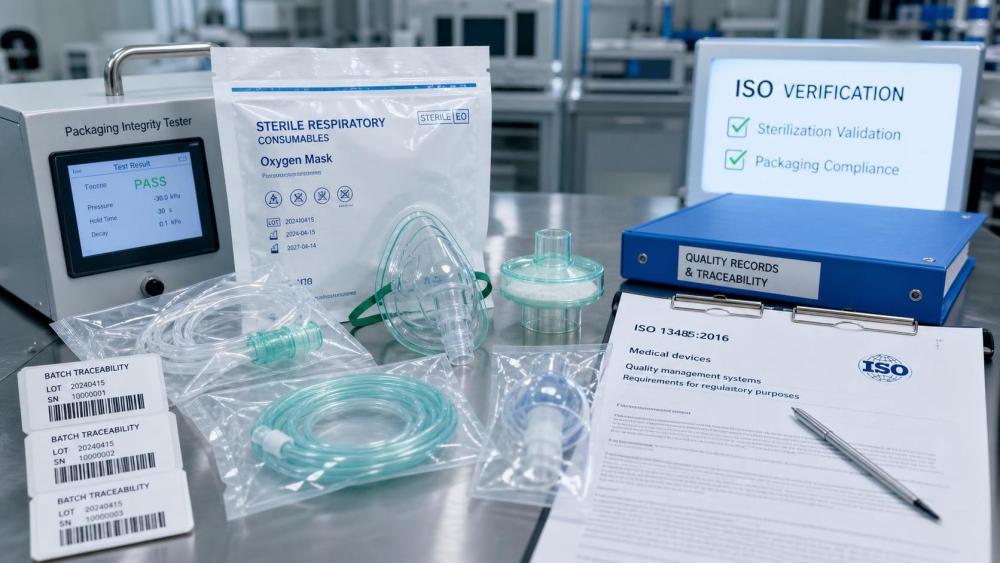
placement suggestion: after the section on document review and before sterilization validation.
Suggested image content: a visual checklist showing product identity, ISO document mapping, sterilization validation, packaging integrity, labeling, and traceability review flow.
Suggested alt text: Verification workflow for sterile respiratory consumables against ISO-related requirements.
Internal Linking Anchor Text Suggestions
- Sterile medical consumables documentation checklist: product compliance guide page
- How to evaluate medical device packaging integrity: packaging validation article
- ISO 13485 for hospital procurement teams: quality management explainer
- Medical device traceability requirements in distribution: compliance workflow page
- How to review sterilization equipment and process records: infection control content page
External Authority Source Suggestions
- Official ISO standards catalog and guidance pages
- Government medical device regulator pages for labeling and sterile device documentation requirements
- Recognized standards guidance from medical device industry associations or notified body technical resources