
Start with the clinical use case, not the supplier's brochure
A surgical gown supplier should be evaluated against the procedures, exposure conditions, and regulatory markets the gowns are intended to serve. A supplier that can provide acceptable gowns for low-fluid procedures may be unsuitable for lengthy operations with high fluid exposure, orthopedic cases, trauma surgery, or procedures involving pressurized irrigation.
The first step is to define an internal specification before comparing suppliers. Quality and safety teams should identify whether the organization needs reusable or single-use gowns, the expected protection level, preferred cuff and closure design, size range, sterility status, packaging configuration, and the markets in which the product will be used. This specification becomes the basis for document review, sample inspection, and ongoing supplier control.
Without a defined use profile, purchasing teams can be drawn toward broad claims such as “high protection,” “premium fabric,” or “hospital grade.” Those claims do not establish whether the gown provides the required barrier performance at critical zones, whether the sizing supports safe movement, or whether production quality remains stable across batches.
Confirm which standard applies to the product and market
Standards should be reviewed as a product-specific requirement, not as a generic quality signal. The relevant standard depends on the destination market, whether the gown is sterile, and whether it is disposable or reusable. A supplier should be able to explain which standards apply, provide the applicable test reports, and show that the documents correspond to the exact gown model under consideration.
For the United States, surgical gowns are commonly assessed using the AAMI PB70 classification system, which categorizes barrier performance from Level 1 through Level 4. Level 1 is intended for minimal fluid exposure, while Level 4 addresses the highest barrier category and includes more demanding testing conditions. The intended procedure should determine the required level. Selecting a Level 4 gown for every procedure may create unnecessary cost and comfort burdens, while using a lower-level gown in a high-exposure setting can leave staff insufficiently protected.
For European markets, EN 13795 is a central reference for surgical gowns and drapes. It distinguishes between standard-performance and high-performance requirements and addresses characteristics such as resistance to microbial penetration, resistance to liquid penetration, cleanliness, particle release, and tensile strength. A declaration that a gown is “EN 13795 compliant” should lead to further questions: which performance classification applies, which areas of the gown were tested, and whether the supplied version matches the tested construction.
International quality-system certification also matters, particularly ISO 13485 for manufacturers of medical devices and related products. However, an ISO 13485 certificate does not independently prove that every gown model meets the needed barrier classification or local registration requirement. It indicates that the manufacturer operates a quality management system within the certified scope. Product evidence still needs separate review.
- Ask for the standard or regulatory pathway claimed for the precise gown reference and configuration.
- Check that test reports identify the product model, material construction, performance class, and test method.
- Confirm that the legal manufacturer named in the documentation is the entity responsible for the product.
- Review whether certificates and reports are current, complete, and issued by credible bodies or laboratories.
- Verify that labeling, instructions for use, and packaging claims align with the submitted evidence.
A common weak point is document mismatch. A supplier may present a quality certificate for one manufacturing site, a barrier test for another fabric construction, and a catalog page describing a broader range of gowns. Each document can appear legitimate in isolation while failing to demonstrate compliance for the item being purchased.
Review barrier protection as a construction, not a single claim
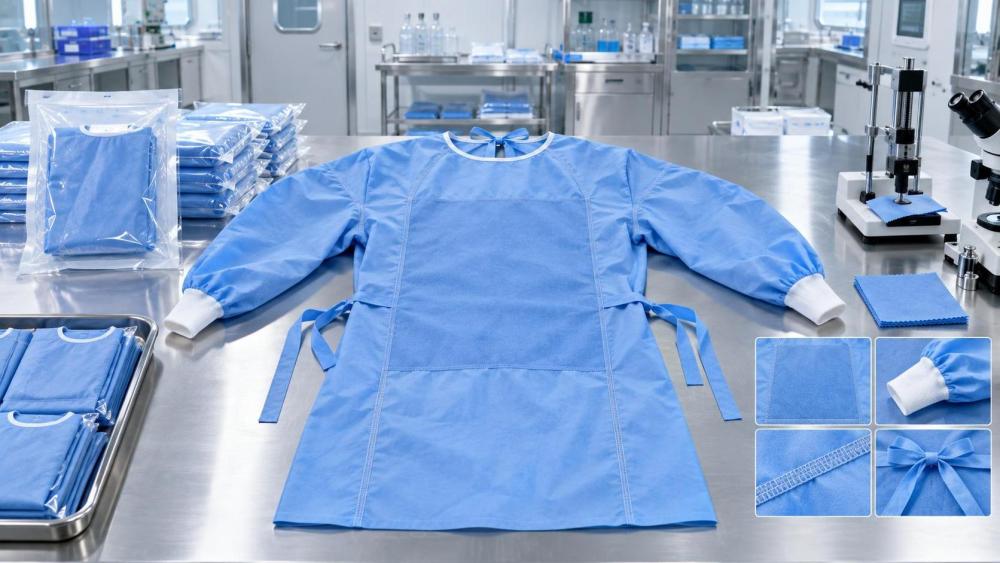
Barrier performance depends on more than the base material. The critical areas of a surgical gown generally include the front torso, sleeves, and cuffs, although the required protection zone and performance level vary by standard and product design. Reinforced panels, seam construction, sleeve attachment, cuff integrity, and closure arrangement can all affect protection during use.
Quality teams should request a technical specification that describes the material layers, basis weight or relevant material characteristics, reinforcement areas, seam method, cuff material, and closure system. For reusable gowns, the verification should also cover the maximum validated reprocessing cycles and the conditions needed to preserve performance. Repeated laundering, sterilization, mechanical stress, and repair practices can change barrier and strength characteristics over time.
Disposable gowns require equivalent scrutiny. A multilayer nonwoven material may provide good protection, but only when its design and manufacturing controls are consistent. Material substitution, changes in reinforcement panel dimensions, altered seam settings, or a switch in elastic cuff components can affect fit, durability, and barrier reliability.
Sample evaluation should include more than visual inspection. Teams should examine whether the gown allows adequate arm movement, whether the sleeves remain positioned during use, whether cuffs create a secure interface with gloves, and whether ties or closures hold under normal clinical movement. A gown can meet a laboratory barrier classification while creating practical risks if it is difficult to don, tears at stress points, or exposes the wrist area during glove application.
Traceability and sterility controls deserve separate verification
If sterile surgical gowns are being sourced, sterility assurance must be reviewed as its own control area. A sterile label is only meaningful when the supplier can maintain traceability from raw material through assembly, sterilization, release, and distribution. The organization should know which party performs sterilization, how sterile batches are identified, and how packaging integrity is protected during transport and storage.
Documents commonly requested during supplier qualification include sterilization validation summaries, packaging validation information, lot-release procedures, shelf-life support, and procedures for handling deviations. The level of detail shared will vary according to commercial arrangements and regulatory obligations, yet a supplier should be able to provide enough evidence for the buyer to establish that its sterile-product controls are credible.
Packaging inspection is especially important for gown kits and individually packed sterile gowns. Check that the sterile barrier is intact, seals are consistent, product labels are legible, and the package can be opened without compromising aseptic presentation. Lot number, expiration date where applicable, size, product reference, and sterility information should be clear enough for receiving and operating-room staff to identify the item quickly.
For non-sterile gowns, traceability still matters. Quality teams should be able to trace a shipment to a production lot, identify the manufacturing site, connect the lot to relevant inspection records, and receive timely notification if a quality issue or recall affects supplied goods.
Audit the supplier's ability to control variation
One approved sample does not establish a capable supplier. Surgical gowns are high-volume consumables, and the central quality question is whether the supplier can repeatedly manufacture the same approved configuration. This is where production controls, incoming material inspection, in-process checks, final release criteria, and change management become more important than polished sales materials.
A desk audit can begin with the supplier's quality manual, certification scope, organization chart, complaint procedures, corrective and preventive action process, and control of nonconforming product. For higher-risk supply arrangements, a remote or on-site audit may be justified. The depth of review should reflect the gown's risk category, annual volume, clinical criticality, and availability of alternative sources.
During an audit, quality and safety personnel should look for evidence that the supplier can answer practical questions clearly:
- How are raw materials approved, sampled, and released for production?
- What controls prevent incorrect material, gown size, cuff, reinforcement panel, or packaging from being used?
- Which production parameters are monitored for sealing, stitching, ultrasonic bonding, or other assembly steps?
- How are defects such as tears, incomplete seams, contamination, incorrect labels, and weak closures identified and segregated?
- What triggers a product change, and how are customers informed before the change takes effect?
- How are complaints investigated, trended, and translated into corrective action?
Change notification is often underestimated during initial qualification. A supplier may change a fabric source, manufacturing site, sterilization provider, packaging material, or product design for operational reasons. Each change can affect the evidence on which the original approval was based. The supply agreement should state which changes require prior notification, supporting documentation, sample approval, or formal requalification.
Compare documents to physical samples and delivered lots
Document review and physical verification should reinforce each other. When samples arrive, compare the product code, material description, labeling, dimensions, packaging, and stated performance level against the technical file. Differences that seem minor can signal uncontrolled variation or an unclear product configuration.
Receiving inspection should be risk-based rather than purely administrative. Teams may check carton condition, labeling accuracy, quantity, lot consistency, package integrity, and visible workmanship. For a newly approved supplier or a product with a history of quality concerns, inspection can be expanded to include dimensional checks, gown opening assessment, closure testing, cuff evaluation, and retained-sample review.
Acceptance criteria should be defined before the shipment arrives. Otherwise, staff may identify concerns without a clear basis for rejecting, quarantining, or escalating the lot. A simple receiving process is sufficient for stable suppliers with strong performance, but it should still preserve batch identification and enable rapid response if issues emerge later.
Do not treat price, lead time, and certifications as substitutes for supplier qualification
A low quoted price can be valid only after the buyer has established that the product meets the intended clinical and regulatory requirements. Comparing price across gowns with different barrier levels, sterile status, reinforcement designs, packaging formats, or validated reuse cycles produces a misleading result.
Delivery capability also needs evidence. A supplier should be able to explain production capacity, lead-time assumptions, minimum order quantities, contingency arrangements, and how it manages allocation during supply disruption. These commercial controls are relevant to quality because emergency substitutions often bypass normal product evaluation and introduce unfamiliar materials or performance levels into clinical use.
The most reliable approval process brings infection control, operating-room users, quality assurance, procurement, and supplier management into the same decision. Clinical users can assess usability and procedural fit. Quality teams can verify documentation, traceability, and manufacturing controls. Procurement can establish supply terms that preserve the approved configuration over time.
A surgical gowns supplier has met the required standard only when the evidence supports the exact product, the product suits the intended procedures, and the supplier can maintain that result from batch to batch. That standard of verification takes more effort than comparing certificates, but it gives safety teams a defensible basis for approval and a clearer path for managing future changes.