
How to verify CE marking on rehabilitation consumables in Germany
For procurement teams sourcing rehabilitation consumables in Germany, a CE mark is an essential starting point—not proof that every compliance requirement has been met.
Before placing an order, buyers need to establish whether the product qualifies as a medical device, check its labeling and EU Declaration of Conformity, and verify any required notified body certificate.
This guide explains how to review CE marking documentation, identify common warning signs, and ask suppliers the right questions when purchasing for hospitals, clinics, or rehabilitation centers in Germany.
Start with the product’s intended purpose and risk class
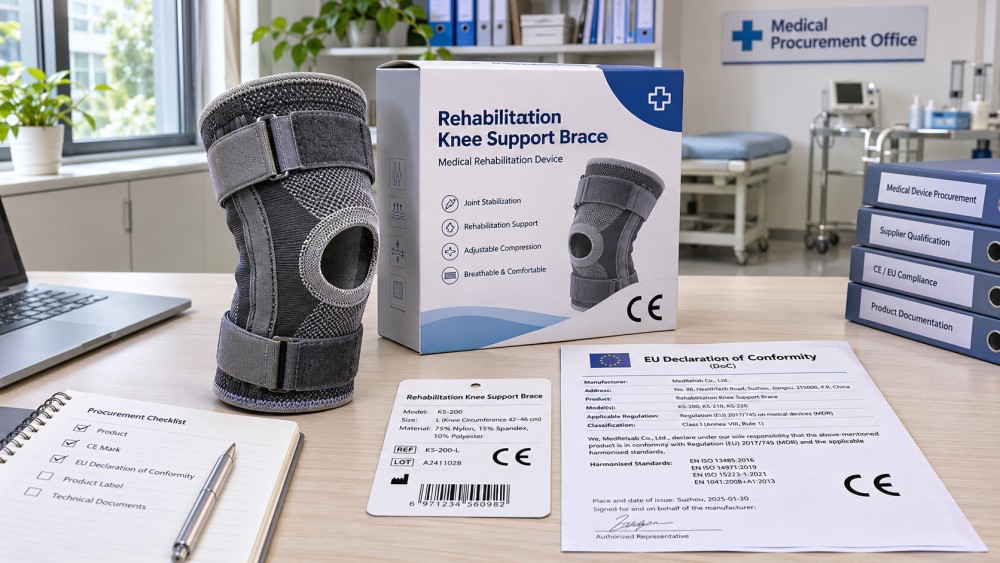
A reliable review starts with the exact product, its intended medical purpose, and its regulatory status. A supplier’s general claim that its range is CE marked is insufficient.
Ask for the product name, model, variants, intended purpose, and the manufacturer’s classification rationale under the EU Medical Device Regulation, or MDR: Regulation (EU) 2017/745.
Some rehabilitation consumables qualify as medical devices because their manufacturer intends them for a medical purpose, such as supporting treatment or compensating for an injury or disability.
Examples can include certain orthopedic supports, rehabilitation electrodes, and wound care products. Classification depends on the specific product and claims, not simply its commercial category.
Other products sold to rehabilitation facilities may be general consumer goods or subject to different legislation. Ask the supplier to identify every applicable legal framework.
For medical devices, the risk class determines the conformity assessment route. Many low-risk devices are Class I, but buyers should never assume that all consumables belong there.
Record the proposed class and the applicable classification rule. If the supplier cannot explain either, request clarification before evaluating certificates or comparing prices.
What documents should procurement request before ordering?
Request documentation for the exact product and configuration being purchased. The manufacturer’s name, product identifiers, intended purpose, and regulatory route should tell a consistent story.
For a medical device, a practical initial document request includes the following items. Request additional evidence when the product’s characteristics or procurement policy make it necessary.
- The current EU Declaration of Conformity, signed by or on behalf of the manufacturer.
- Product labeling, packaging artwork, and instructions for use where required, including the German-language materials applicable to the product.
- The manufacturer’s legal name and address, plus the EU authorized representative’s details when the manufacturer is established outside the EU.
- The applicable notified body certificate, including its scope and validity, when notified body involvement is required.
- The device identifier, including the UDI where applicable, and a product list linking commercial models to the declaration and certificate.
- A copy of the distributor or importer details and a documented explanation of any remaining compliance questions.
A manufacturer is responsible for drawing up the declaration. A certificate issued by a notified body serves a different purpose and does not replace that declaration.
Full technical documentation is generally not supplied to every buyer. For unresolved concerns, request relevant evidence or ask the manufacturer to explain how it meets the requirement.
Set a deadline for document submission before issuing a purchase order. This avoids discovering missing evidence after a clinic has committed to a product or delivery schedule.
How to check the EU Declaration of Conformity
Read the declaration alongside the product label and quotation. Check whether the manufacturer, device name, identifiers, and variants match the items the facility intends to buy.
The declaration should identify the applicable legislation, including the MDR when relevant, and contain the information required by its Annex IV. Check its date, signature, and issuing entity.
Look for the Basic UDI-DI or other required product identification and confirm how the listed device family relates to the offered model and packaging configuration.
If the declaration covers several products, request a mapping from each ordered SKU to the relevant entry. A broad family description alone may leave important variants unclear.
Check whether the declaration refers to other applicable EU legislation. A device with electrical components, for example, may have additional requirements beyond its medical device obligations.
Ask about conflicting manufacturer names, obsolete model numbers, or references that do not match the product’s regulatory status. Record the supplier’s explanation with the procurement file.
An ISO 13485 certificate can support an assessment of the manufacturer’s quality management system, but it does not establish that a particular product conforms to MDR requirements.
When is a notified body certificate required?
Not every medical device requires a notified body certificate. Many ordinary Class I devices follow a manufacturer-led conformity assessment without notified body involvement.
Class I devices supplied sterile, with a measuring function, or classified as reusable surgical instruments require notified body involvement limited to the relevant aspects of conformity assessment.
Class IIa, IIb, and III devices generally require notified body involvement. The precise assessment route and certificates depend on the device and applicable MDR provisions.
Check the four-digit number beside the CE mark when a notified body is involved. It should identify the body responsible for the applicable assessment activity.
Use the European Commission’s NANDO database to check the body’s designation and relevant scope under the applicable legislation.
NANDO can help establish whether the organization is designated; it does not by itself prove that a particular certificate is genuine or covers your product.
Compare the certificate holder, certificate number, product scope, issue date, and validity with the declaration and quotation. Check any annexes, since product details may appear there.
Contact the issuing notified body through contact details obtained independently, and request confirmation of status and scope. Follow up on suspensions, withdrawals, or unclear product coverage.
Do not accept a four-digit number alone as proof. Likewise, do not reject an ordinary Class I device merely because its CE mark has no notified body number.
How to assess older certificates and transitional products
Some devices may remain on the market under MDR transitional provisions linked to earlier EU directives. An old directive certificate is neither automatically invalid nor automatically acceptable.
Transitional eligibility depends on the device, its history, applicable deadlines, and conditions such as required quality system and notified body application arrangements. Extensions are conditional, not blanket renewals.
Ask the manufacturer for its written justification, the original certificate, relevant notified body evidence, and confirmation that the specific device remains eligible under current rules.
Pay particular attention to significant changes in design or intended purpose and to the manufacturer’s compliance with applicable MDR requirements during the transition.
Because transition arrangements can change and depend on facts, check current European Commission guidance and obtain specialist advice when the documentation is incomplete or the purchase is material.
Where a supplier presents only an expired certificate and a generic statement that all certificates were extended, place the order on hold until product-specific eligibility is substantiated.
What should buyers check on labels and German instructions?
Compare the physical product, or approved final artwork before delivery, against the documents. The CE mark should be visible, legible, and appropriately placed under applicable rules.
Check the manufacturer’s name and address, product identification, batch or serial number where applicable, and any expiry date or special storage conditions.
For a manufacturer established outside the EU, verify that the authorized representative is identified as required. Imported devices also carry applicable importer identification.
Confirm that information supplied with the device meets German requirements, including German-language labeling and instructions where applicable. Do not assume an English-only leaflet is sufficient.
Check whether instructions for use are required for the particular device. Some Class I and Class IIa devices may be used safely without them under specified conditions.
For consumables supplied sterile, examine sterile-barrier labeling, expiry dates, and handling instructions. A valid declaration does not make damaged or expired stock suitable for use.
For single-use items, check the symbol or wording and ensure that proposed clinical workflows respect it. Confirm any compatibility restrictions with rehabilitation equipment already in use.
Can EUDAMED verify a CE mark?
The European Commission’s EUDAMED database can provide useful information about economic operators, devices, and certificates where relevant data is available.
Search using reliable identifiers, such as the manufacturer’s details, UDI-DI, or certificate information. Compare any result with the supplier’s documents and the product being purchased.
Database availability, mandatory use, and completeness vary by module and implementation stage. An absent record alone does not establish noncompliance; investigate the applicable requirements and circumstances.
A matching record also does not replace review of the declaration, product labeling, certificate scope, and any relevant transitional evidence. Use it as one source of corroboration.
If online information conflicts with supplier documents, preserve the record and ask for an explanation. Escalate unresolved discrepancies to the manufacturer or relevant authority.
Who is responsible for checks in the German supply chain?
Manufacturers, authorized representatives, importers, and distributors have distinct obligations under the MDR. Identify which organization performs each role for the product and transaction.
Distributors must verify specified matters before making a device available, including CE marking, the declaration, required information, and importer identification where applicable. Some checks may use sampling.
Importers have additional obligations, including checking the manufacturer’s conformity assessment and the appointment of an authorized representative where required. Contractual assurances do not replace statutory responsibilities.
A hospital purchasing for its own use should establish its role rather than assume it is a distributor. Buying directly from outside the EU can change the analysis.
In Germany, the Federal Institute for Drugs and Medical Devices provides medical device information, while competent state authorities undertake important market surveillance responsibilities.
For suspected nonconformity, quarantine affected stock where appropriate, document the concern, and contact the supplier. Seek guidance from the relevant authority when necessary.
Ensure the contract identifies who handles complaints, field safety corrective actions, recalls, and communication with affected facilities. Keep batch records so products can be traced quickly.
Warning signs that should pause a purchase
A missing document does not always mean a product is unlawful, but unresolved inconsistencies can prevent a buyer from establishing whether the offered goods are compliant.
- The declaration names a different manufacturer or product, and the supplier cannot explain the connection.
- A certificate is presented for a Class I device without a clear explanation of why notified body involvement applies.
- A notified body number is printed beside the CE mark, but the named body or certificate scope cannot be confirmed.
- The supplier provides only an ISO certificate, a laboratory report, or a document described as a “CE certificate” without an applicable declaration.
- The product label makes medical claims that differ materially from the intended purpose in the declaration or instructions.
- German-language information, importer details, product identifiers, or sterile packaging documentation are missing when required.
- The supplier relies on a generic transition statement without evidence that the specific device meets the applicable conditions.
Document each issue, request corrective evidence, and set an escalation date. If the discrepancy remains material, do not approve the product until a qualified reviewer resolves it.
Turn verification into a practical purchasing decision
Once regulatory evidence is satisfactory, compare clinical suitability, compatibility, shelf life, packaging, supply continuity, and total cost. These factors determine whether the product works in practice.
Ask clinical users to assess fit and usability, and involve biomedical engineers when consumables connect to powered rehabilitation systems. Confirm approved accessories and equipment models.
Include minimum remaining shelf life, required documentation, traceability, replacement arrangements, and notification of regulatory changes in the purchase agreement or supplier qualification process.
Keep a review record linking each SKU to its declaration, certificate where required, label version, supplier, and approval date. Recheck documents when products or certificates change.
Final takeaway
For rehabilitation consumables in Germany, a defensible CE review connects the product’s intended purpose and risk class to matching documentation, labeling, and any required notified body evidence.
Use EUDAMED and NANDO to corroborate available information, investigate transitional claims carefully, and resolve discrepancies before ordering. Then assess the product against clinical and supply requirements.
Have questions about the global trade trends discussed here, or planning your expansion and supply chain strategy? Leave a message below and let the trade experts at MTHH guide you.
We respect your privacy. Your information is strictly confidential.
Related News
- How to verify CE marking on rehabilitation consumables in GermanyNov 13, 2026Buying rehabilitation consumables in Germany? Learn how to verify CE marking, check MDR documents and spot supplier red flags before ordering.
- How to assess a medical consumables management supplier's ability to prevent stockoutsNov 11, 2026Evaluate a medical consumables management supplier with practical checks for forecasting, inventory visibility and contingency plans to reduce stockout risk.
- FDA Alert: Arrow Removes Guidewire Products Over Coating Shedding RiskNov 11, 2026FDA alert: Arrow guidewire products face voluntary removal over potential coating shedding. Explore the risks and key checks for buyers and healthcare providers.
- How does order volume affect disposable medical supplies cost?Nov 07, 2026Discover how order volume affects disposable medical supplies cost and learn to balance bulk discounts, storage, expiry risk, and reliable supply.