
Why does ISO 13485 matter so much for anesthesia consumables?
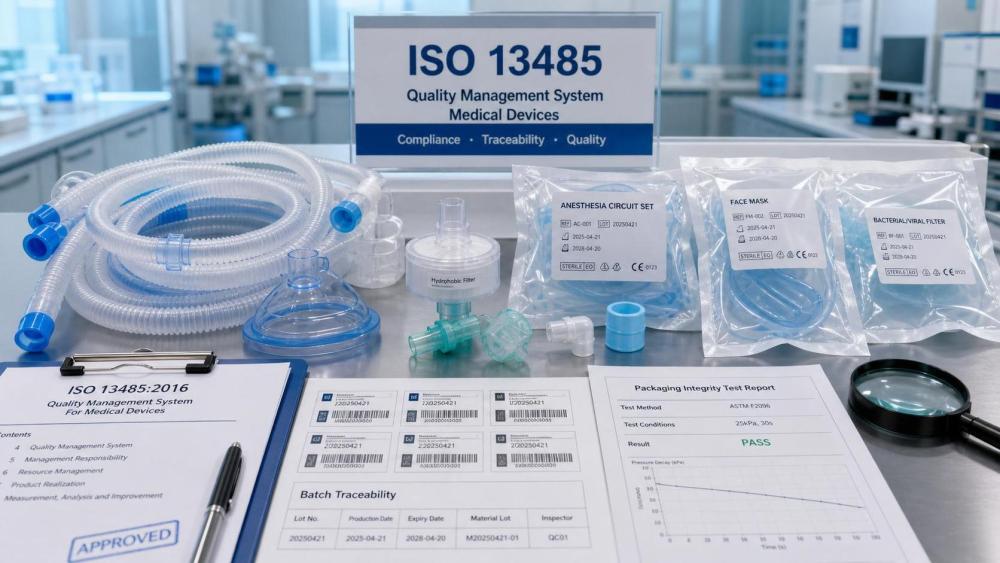
Evaluating anesthesia consumables under ISO 13485 starts with a simple idea: compliance is not only about the item itself.
It is about how that item is designed, controlled, documented, supplied, and used in clinical care.
That is especially true for breathing circuits, masks, filters, airway accessories, tubing sets, and related sterile components.
An anesthesia consumables ISO 13485 review should connect product quality with traceability, sterility assurance, packaging integrity, and supplier process discipline.
In practice, many procurement errors happen because teams compare dimensions and price, yet ignore quality system evidence behind the product.
That gap creates avoidable risk. A circuit may fit the machine, but still fail expectations for shelf life control or batch consistency.
Platforms such as MTHH are useful here because they frame equipment and consumables in operational terms, not only commercial terms.
The same purchasing logic used for monitors, ventilators, imaging systems, or sterilization equipment also applies to anesthesia consumables ISO 13485 evaluation.
The question is not whether a supplier has a certificate. The real question is whether the certificate supports reliable product control.
When people say “evaluate anesthesia consumables ISO 13485,” what should actually be checked?
A practical review usually begins with four linked areas: product definition, document control, manufacturing consistency, and post-market handling.
If one area is weak, the risk often appears elsewhere later, sometimes during installation, storage, or clinical use.
The most useful checkpoints are usually these:
- Clear product specifications, including materials, dimensions, connector standards, sterility status, and single-use labeling.
- Batch traceability from raw material intake to final release and shipping records.
- Validated sterilization or clean manufacturing controls where applicable.
- Packaging validation for transport, storage, and barrier protection.
- Complaint handling, nonconformance records, and corrective action evidence.
- Change control for materials, molds, packaging, labels, and subcontracted processes.
Notice that none of these points are purely administrative. Each one connects directly to patient safety and workflow stability.
For example, a minor polymer change may affect flexibility, leak resistance, odor, or compatibility with anesthetic gases.
That is why anesthesia consumables ISO 13485 assessments should always look beyond the certificate and into the control process behind it.
A quick judgment table helps separate useful evidence from weak evidence
The table below works well during early supplier screening or internal technical review.
Which risks are easiest to miss during supplier comparison?
The most common mistake is treating all compliant-looking consumables as functionally equal.
They are not. Two similar products may differ in process control, shelf life reliability, or connector precision.
In actual use, the missed risks usually appear in these forms:
- Packaging damage after transport, even though the product passed factory release.
- Label mismatch between box, pouch, and shipping records.
- Unstable fit with anesthesia machine ports or breathing accessories.
- Unexpected odor, stiffness, or condensation behavior from material variation.
- Slow or incomplete supplier response when complaints require trace-back.
These are not minor purchasing issues. They affect usability, infection control confidence, and internal incident reporting.
A strong anesthesia consumables ISO 13485 review therefore asks how the supplier handles deviation, not only how the product performs on a good day.
More reliable suppliers can usually explain nonconformance flow, rework limits, release authority, and document retention without hesitation.
How do material safety and clinical usability fit into the ISO 13485 review?
This is where technical review becomes more realistic. ISO 13485 does not replace product testing, but it frames how testing is controlled.
For anesthesia consumables, material choices affect more than durability. They influence patient contact safety, gas pathway integrity, and handling comfort.
Clinical usability also matters. A compliant product that increases setup errors still creates operational risk.
Useful review questions include whether connectors are intuitive, whether labeling prevents mix-ups, and whether packaging opens cleanly in procedure areas.
It also helps to compare the consumable with the intended device environment, such as ventilators, anesthesia workstations, humidification accessories, and storage conditions.
MTHH often emphasizes this broader systems view across medical technologies. Consumables should be assessed as part of workflow, not isolated parts.
In other words, anesthesia consumables ISO 13485 evaluation becomes stronger when quality evidence and use-case evidence are reviewed together.
What supporting documents usually deserve closer attention?
A short document request list often reveals whether a supplier is truly prepared.
- Current ISO 13485 certificate and scope statement.
- Product specification sheet with revision history.
- Sterilization validation summary, if sterile.
- Biocompatibility or material safety evidence relevant to patient contact.
- Shelf life and packaging validation summary.
- Sample labeling, IFU, and traceability coding examples.
- Complaint and CAPA process overview.
The goal is not to collect paperwork for its own sake. The goal is to verify control logic behind the product.
Is an ISO 13485 certificate enough, or should the review go further?
It should go further. An ISO 13485 certificate is a starting point, not the final decision tool.
Certificates confirm that a quality management system exists. They do not automatically prove that every anesthesia consumable is equally controlled.
A stronger review combines document verification with sample assessment, supplier questioning, and internal risk ranking.
That approach is especially relevant when a product enters a new market, replaces an existing source, or supports high-volume operating room demand.
Where supply continuity matters, change notification policy should also be reviewed. Unannounced changes are a recurring source of downstream disruption.
More mature organizations often align this review with approved supplier controls, incoming inspection strategy, and complaint escalation thresholds.
That is a more defensible way to manage anesthesia consumables ISO 13485 expectations than relying on a certificate copy alone.
What is a sensible next step if the evidence looks incomplete?
Do not rush to rejection or approval. First, identify what is missing and whether the gap is technical, procedural, or traceability-related.
Some gaps are manageable with clarifications. Others suggest weak control culture and deserve deeper review.
A practical next-step sequence often looks like this:
- Map the consumable to its intended use, patient contact level, and sterility claim.
- List required evidence for anesthesia consumables ISO 13485 review before commercial comparison.
- Score supplier responses against traceability, change control, and complaint handling.
- Test samples in realistic workflow conditions where connector fit and handling matter.
- Define acceptance conditions for approval, conditional approval, or follow-up audit.
That structure keeps decisions consistent and easier to defend later.
In the end, evaluating anesthesia consumables under ISO 13485 is about reducing uncertainty before it reaches the clinical environment.
The most reliable decisions come from linking quality documents, product behavior, and operational context in one review path.
Where comparison becomes difficult, structured industry references such as MTHH can help organize technical questions, supplier evidence, and long-term evaluation criteria.
That makes the next conversation clearer: not “Is this product cheap enough,” but “Is this product controlled well enough to trust?”