
Yes, latex surgical gloves can still meet current hospital safety standards when they are appropriately specified, tested, stored, and used within a controlled latex-allergy policy. Their barrier performance, tactile sensitivity, elasticity, and secure fit remain suitable for many surgical procedures. The limiting issue is not that latex has become inherently unsafe; it is that a glove with strong mechanical performance may still create an unacceptable risk where natural rubber latex sensitivity is present or poorly managed.
A hospital safety standard is rarely satisfied by material choice alone. Surgical gloves must provide an intact barrier throughout the procedure, support precise hand movement, resist tearing during normal clinical use, fit reliably across available sizes, and align with infection-prevention procedures. The product documentation, packaging condition, sterilization status, labeling, and traceability also matter. Latex gloves remain acceptable only where these requirements are met together and where exposure to latex proteins is addressed deliberately.
Barrier protection remains the starting point
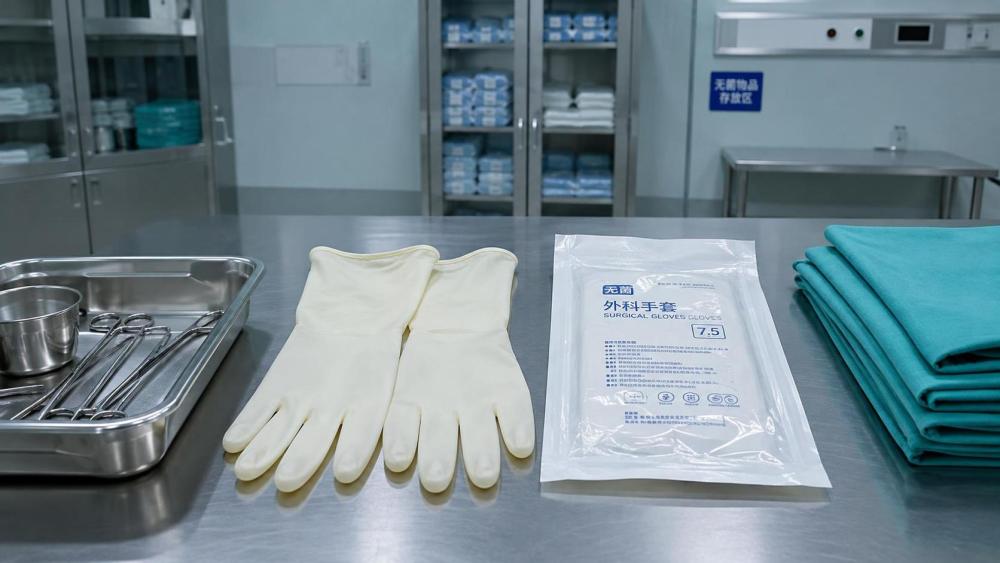
The fundamental purpose of a surgical glove is to reduce transfer of microorganisms and body fluids between the surgical field and the hands of clinical staff. A glove should arrive sterile, remain intact during use, and be removed without contaminating the wearer or nearby surfaces. Latex has physical characteristics that can support this role well: it is elastic, conforms closely to the hand, and often provides high tactile feedback for suturing, fine dissection, and instrument handling.
However, a low defect rate in a product specification does not guarantee protection in the operating room. Small punctures can occur while handling needles, bone fragments, sharp instruments, wires, clamps, or implant components. Glove integrity is affected by fit, hand fatigue, the duration of the procedure, contact with disinfectants or lubricants, and repeated friction against instruments. A glove that is too tight can experience concentrated stress at the fingertips, thumb web, or cuff. A loose glove may bunch at the palm, reduce dexterity, and increase the chance of catching on an instrument.
For that reason, the relevant question is not simply whether latex forms a barrier. The more useful question is whether the supplied glove system provides consistent barrier protection under the intended surgical conditions. That includes the available size range, cuff retention under gown sleeves, finger thickness, puncture indication features, and controls for lot-to-lot quality.
Latex allergy changes the safety assessment
Natural rubber latex contains proteins capable of causing sensitization and allergic reactions in some individuals. The severity of a reaction can range from localized skin symptoms to serious systemic responses. This distinguishes latex from many other glove materials: a latex surgical glove may meet sterility and physical-performance requirements while still being unsuitable for a clinical environment that requires latex-free practice.
There are also different reactions that are often grouped together incorrectly. Irritant contact dermatitis is commonly related to wet work, frequent handwashing, harsh cleansers, prolonged occlusion, or glove powder. It does not necessarily indicate latex allergy. Allergic contact dermatitis can be associated with chemical additives used in glove manufacturing, such as accelerators, and may occur with latex, nitrile, or other rubber-based materials. Immediate latex allergy is related to natural rubber latex proteins and has a separate exposure-control concern.
This distinction matters because changing from powdered latex to powder-free latex can reduce airborne powder-associated protein transfer, but it does not make the glove latex-free. Likewise, selecting a synthetic glove does not automatically solve every skin reaction if the reaction is linked to accelerators or hand-care products rather than latex proteins. A credible safety policy identifies the type of reaction involved before treating all glove complaints as the same problem.
Latex exposure can also affect patients, not only staff. Surgical history, known sensitivity, and the possibility of repeated healthcare exposure may influence the glove material selected for a procedure. A latex-free operating environment requires more than changing one pair of gloves. Items that contact the patient or the sterile field, including elastic components and selected medical accessories, need to be reviewed under the same protocol.
Powder-free does not mean risk-free
Powdered natural rubber latex gloves are particularly problematic because powder can carry latex proteins into the air and onto surrounding surfaces. Powder-free surgical gloves reduce this transfer pathway and are widely preferred in controlled clinical settings. Yet the term powder-free should be read as a manufacturing and surface-treatment characteristic, not as a declaration that all sensitization risks have been eliminated.
Manufacturers use different approaches to make a glove easier to don without powder. Surface chlorination, polymer coatings, and internal lubricating treatments can alter donning feel, grip, and interaction with skin. These treatments may also affect residual chemical content, surface slipperiness, or the tendency of gloves to stick together after storage. The evaluation should therefore include actual handling, rather than relying only on a statement that a glove is powder-free.
Residual protein information is relevant when latex is being considered, but a single reported value should not be treated as a universal pass-or-fail signal. Test method, production consistency, packaging, handling conditions, and the organization’s allergy-control requirements affect how the information should be interpreted. A glove with lower residual protein content can reduce exposure, but it cannot be described as free of latex allergen merely because the reported level is low.
Standards compliance requires evidence, not a generic claim
A package statement that a glove is “medical grade,” “surgical,” or “compliant” is insufficient on its own. The supplied documentation should identify the product as a sterile surgical glove, state the material composition, show the intended use, identify the manufacturing lot, and provide storage and shelf-life information. Applicable market authorization, quality-system documentation, and conformity records must match the destination market and the specific product configuration being supplied.
It is useful to separate four claims that can otherwise be confused:
- Sterile concerns the validated condition of the product before the package is opened. It does not prove that the glove will resist puncture during a difficult procedure.
- Latex identifies natural rubber as a material component. It says nothing by itself about powder status or the level of residual proteins.
- Powder-free indicates that donning powder is not intentionally present as the glove’s surface aid. It is not equivalent to latex-free.
- Low-allergen or low-protein wording may describe a measured characteristic, but it must be tied to a stated test basis and should not override a latex-avoidance policy.
Physical testing evidence also deserves close reading. Tensile strength and elongation show how the material behaves under controlled stretching, while freedom-from-holes testing examines barrier integrity in a sampled production lot. Neither measurement fully predicts performance against a sharp surgical needle. A very thin glove may offer excellent sensitivity but provide less material reserve at high-stress points. A thicker glove may improve durability but reduce feedback and increase fatigue if its fit is poor. The desired balance depends on the procedure and the facility’s glove-use protocol.
Double gloving is a system, not just two layers
Double gloving is commonly used in procedures with elevated exposure risk, prolonged duration, orthopedic instruments, or frequent sharp contact. Two gloves can provide an additional barrier after an outer-glove puncture, but the protection is improved most when the layers work together. An indicator underglove in a contrasting color can make a breach in the outer glove easier to notice when fluid enters the space between layers.
Two identical latex gloves do not always create an effective double-gloving arrangement. Excessive tightness can reduce movement and make donning difficult; an oversized outer glove can twist or bunch. The cuff length and glove shape should permit stable placement over the underglove and beneath the gown cuff. Some procedures require planned glove changes at defined points, especially after handling sharp bone, cement, contaminated instruments, or after an observed tear. A glove-change rule that exists only on paper offers little protection if replacement sizes are not immediately available in the sterile area.
Packaging, storage, and supply handling can undermine a compliant glove
Glove quality can degrade before it reaches the operating room. Heat, direct sunlight, excessive humidity, compression, and poor stock rotation may affect packaging and material condition. Sterile glove packs should be protected from crushing, moisture exposure, and conditions outside the manufacturer’s stated storage range. A damaged outer carton may not always mean that every inner pack is compromised, but it should trigger a controlled inspection rather than routine release to stock.
At the point of use, the package should be checked for its integrity, correct size, correct material, sterility marking, and expiration status. A surgical glove package with a torn seal, wet paper, unusual discoloration, brittle feel, or damaged inner wrapper should not be treated as normal stock. Such observations can indicate a storage or distribution issue even when the carton label appears valid.
Traceability is especially important when a concern arises after a procedure. Lot identifiers, delivery records, complaint handling, and segregation of suspect stock allow a facility to determine whether the issue is isolated or potentially broader. Without this information, a reported tear, odor, powder residue, or skin reaction becomes difficult to investigate meaningfully.
Material substitution needs procedural validation
Nitrile and neoprene surgical gloves are common alternatives where latex exposure must be avoided. Their performance characteristics differ from latex in elasticity, tactile feel, stress distribution, and chemical formulation. Replacing latex with a synthetic material should be evaluated as a controlled change in the glove system, especially where staff routinely double glove, use delicate instruments, or work with specific antiseptics and surgical materials.
A common mistake is to compare only thickness. Thickness does influence feel and material reserve, but gloves of similar thickness can perform differently because of formulation, curing process, surface treatment, and design. Finger shape, cuff geometry, tensile behavior, and friction can matter more to real handling than a single thickness figure on a specification sheet.
Glove acceptance should also account for the hand hygiene products used before donning. Incomplete drying after alcohol-based hand rub, excessive lotion, or incompatible hand-care products can affect comfort and make gloves harder to don. Repeated handwashing and occlusion may damage skin, which can then be mistaken for a material allergy. Clear compatibility information and consistent hand-care practices reduce this source of confusion.
When latex remains an acceptable choice
Latex surgical gloves remain capable of meeting current safety expectations where sterile barrier performance is verified, powder is absent, allergy controls are active, and the product is suitable for the intended procedure. They are not a universal default material. Their acceptability narrows when a patient or staff member has known or suspected latex sensitivity, when a facility maintains a latex-free clinical policy, or when the available product documentation cannot establish material composition and sterile supply integrity.
The soundest evaluation joins material evidence with the real workflow: intact packaging, correct fit, procedure-specific durability, double-gloving compatibility where required, controlled storage, and a reliable route for identifying and responding to latex-related reactions. Under those conditions, latex is still a clinically viable glove material; without them, its familiar feel is not enough to satisfy modern hospital safety expectations.