
Do ECG Electrodes Require Calibration in Hospital Use?
Hospitals depend on reliable ECG monitoring to support timely clinical decisions, but electrode maintenance is often misunderstood. How often should ECG electrodes be calibrated in hospital use? The short answer is that most ECG electrodes themselves are not calibrated. They are passive, patient-contact consumables or reusable accessories, not measuring instruments with adjustable accuracy settings. The ECG monitor, diagnostic electrocardiograph, acquisition module, lead set, and signal-processing pathway are the parts of the system that may require scheduled performance verification or calibration.
That distinction matters in practice. A ward may have a documented calibration program for bedside monitors while staff are still seeing baseline wander, intermittent traces, false alarms, or poor waveform quality. In many of those situations, the problem is not a missed calibration interval. It is old electrodes, dried gel, poor skin preparation, damaged lead wires, incorrect placement, incompatible accessories, or a connector that has been cleaned too aggressively.
For procurement teams and clinical engineering departments, the useful question is not simply whether an ECG electrode “needs calibration.” It is which part of the ECG chain needs calibration, which part needs inspection, and which part should be replaced before performance becomes unreliable.
An electrode is not the same as the ECG measuring system
An ECG electrode provides the interface between the patient’s skin and the monitoring system. It detects the small electrical activity available at the skin surface and transfers that signal through the lead wire or cable to the acquisition electronics. Disposable adhesive electrodes typically contain conductive gel and a metal or conductive sensing element. Reusable electrodes may use a clamp, suction cup, plate, or other contact design, depending on the clinical application.
Neither type normally has a calibration control. Their condition affects signal transmission, impedance, patient comfort, and attachment stability, but there is no routine adjustment that restores a deteriorated disposable electrode to its original performance. Once gel dries, packaging is compromised, the adhesive loses grip, or the conductive surface becomes contaminated or corroded, replacement is usually the appropriate response.
The monitor or ECG machine is different. It contains amplifiers, filters, analog-to-digital conversion, software, alarm logic, display functions, and often diagnostic interpretation features. Those functions may be subject to preventive maintenance, electrical safety testing, functional checks, and calibration or verification procedures specified by the manufacturer. The exact approach should be based on the equipment’s instructions for use, the hospital’s maintenance policy, local regulatory expectations, and the risk level of the clinical setting.
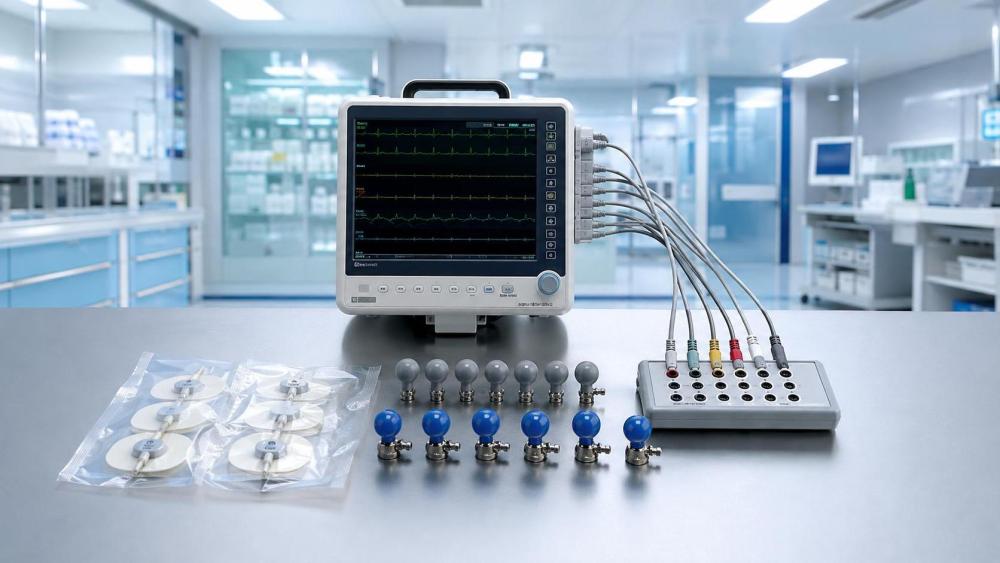
How often should ECG electrodes be calibrated in hospital use?
For disposable ECG electrodes, the practical answer is: they should not be calibrated, and they should not be reused unless the manufacturer explicitly identifies them as reusable. Their performance is managed through correct storage, expiry-date control, inspection of package integrity, appropriate skin preparation, and replacement at the clinical interval defined by the product instructions and hospital protocol.
For reusable electrodes, the answer remains broadly the same: routine calibration is generally not the issue. They need cleaning, disinfection where applicable, visual inspection, functional assessment, and replacement when contact quality or physical integrity is no longer acceptable. A reusable electrode with damaged insulation, loose snaps, oxidation, cracked housing, worn conductive surfaces, or persistent signal instability should not be kept in circulation simply because it can still be connected to a cable.
For the ECG device and accessories as a system, calibration frequency is not universal. Some organizations use an annual preventive-maintenance cycle; others set different intervals according to device type, manufacturer instructions, usage intensity, service history, and local quality procedures. A high-use emergency department monitor fleet may warrant closer operational attention than a seldom-used diagnostic ECG unit in an outpatient area. Clinical engineering should avoid treating a generic calendar interval as a substitute for the manufacturer’s documented service requirements.
This is why asking “how often should ECG electrodes be calibrated in hospital use” can lead to the wrong maintenance action. If the concern is waveform accuracy, verify the acquisition system. If the concern is poor adhesion or noisy traces at the bedside, inspect the electrode and the patient-contact process first.
What should be checked instead of calibrating the electrode?
A sensible ECG quality-control process separates consumable checks from equipment checks. This avoids both unnecessary service calls and the more serious mistake of overlooking a degraded monitoring system.
A simulator or approved test device may be used by qualified personnel to evaluate the ECG monitor’s response to known input signals. That is a system verification activity, not electrode calibration. The test setup should follow the device manufacturer’s service documentation and the hospital’s biomedical engineering procedures. Improvised testing can be misleading, particularly when a device has proprietary lead identification, filtering behavior, or alarm configuration.
Signal problems often start at the skin-electrode interface
In real clinical use, electrode performance is affected by more variables than many purchasing specifications reveal. Diaphoresis, body hair, fragile skin, edema, motion, topical creams, poor placement, and long monitoring duration can all compromise contact. The same electrode may perform well during a short resting ECG but be less suitable for a mobile patient undergoing extended telemetry monitoring.
Skin preparation should follow hospital protocol and the electrode manufacturer’s instructions. The objective is stable contact, not aggressive skin abrasion. Over-preparation can create discomfort or skin injury, especially for neonates, older patients, and individuals requiring prolonged monitoring. Under-preparation, on the other hand, can increase artifact and repeated electrode changes. This is a workflow issue as much as a consumable issue: when nursing staff are repeatedly troubleshooting leads, the apparent savings from low-cost electrodes can disappear quickly.
A common mistake is to blame the monitor when one lead shows intermittent noise. Before escalating the issue, staff can check whether the artifact moves when the electrode is replaced, whether it follows a particular lead wire, and whether it persists with a known-good cable. These observations help clinical engineering distinguish a patient-contact issue from an accessory fault or device fault without making assumptions.
Storage and procurement choices influence ECG quality
Electrode storage is sometimes treated as a minor supply-chain detail, yet it has direct consequences for bedside performance. Disposable electrodes should be stored within the environmental conditions stated by the manufacturer. Excessive heat, humidity, freezing exposure, prolonged warehouse storage, or opened pouches can affect adhesive and gel characteristics. Hospitals should also maintain usable stock rotation rather than allowing older cartons to remain in scattered ward cupboards until a shortage occurs.
Procurement should not evaluate ECG electrodes by unit price alone. Compatibility with existing lead systems, patient population, monitoring duration, packaging format, skin sensitivity requirements, shelf-life management, and local availability all deserve review. A product that appears interchangeable may have a different snap design, backing material, gel behavior, or intended dwell time. If it does not perform consistently in the hospital’s actual environment, it can increase rework and create avoidable uncertainty around clinical signals.
For distributors, documentation matters too. Clear instructions for use, storage guidance, compatibility statements, cleaning instructions for reusable accessories, and traceable product identification make it easier for hospitals to build defensible processes. Where a supplier cannot clarify whether an electrode is single-use, reusable, or compatible with a specific cable family, that ambiguity should be resolved before purchase rather than at the bedside.
Build maintenance responsibilities around the whole ECG pathway
A workable hospital policy usually assigns responsibilities across departments. Clinical users need a clear process for applying electrodes, responding to artifact, and removing damaged accessories from use. Supply teams need to manage stock conditions and avoid uncontrolled substitution. Clinical engineering needs access to device service manuals, approved test equipment, maintenance history, and escalation pathways when recurring signal issues appear.
It is also worth separating routine user checks from formal maintenance. Nurses and technicians may identify loose leads, expired consumables, broken clips, or unusual traces during normal care. Formal performance verification of ECG equipment should be performed by appropriately trained personnel under the organization’s maintenance program. Blurring those roles can leave simple consumable faults unresolved while also encouraging unqualified adjustment of equipment settings.
Global MedTech & Healthcare Intelligence Hub approaches this kind of question as an equipment-lifecycle issue rather than a narrow product question. ECG monitoring quality depends on consumables, accessories, device performance, user training, service support, documentation, and purchasing discipline working together. That perspective is especially useful when hospitals compare suppliers or prepare preventive-maintenance plans for larger patient-monitoring fleets.
The practical takeaway
ECG electrodes generally do not require calibration in hospital use. Disposable electrodes should be used, stored, and replaced according to their instructions for use. Reusable electrodes require cleaning and condition checks, not routine calibration. The ECG monitor, diagnostic recorder, acquisition module, and related cables are the components that may require scheduled verification or calibration under manufacturer guidance and hospital policy.
When ECG quality deteriorates, start with the simplest credible causes: electrode condition, placement, skin contact, cable integrity, and connector damage. If those are satisfactory, move to a documented system-level check. That sequence is faster, safer, and more useful than trying to “calibrate” an item that was never designed to be calibrated.