
Choosing the right throughput is critical when evaluating biochemistry analyzers for diagnostic labs. Technical assessment teams must look beyond tests per hour and examine demand patterns, workflow, downtime, and reporting requirements.
For most diagnostic laboratories, analyzer throughput should be evaluated as usable, sustained capacity rather than the manufacturer’s highest published tests-per-hour figure.
A system rated at 800 tests per hour may deliver substantially less productive capacity when calibration, quality control, sample repeats, maintenance, and reagent preparation are included.
Technical evaluators should begin with the laboratory’s actual workload, especially peak-hour sample arrivals, test menu composition, urgent requests, and required report turnaround times.
Small laboratories may operate effectively with 200 to 400 photometric tests per hour, while busy hospital laboratories often require 800 to 2,000 tests per hour.
High-volume reference laboratories may need multiple analyzers, track automation, integrated immunoassay modules, and redundant capacity to maintain service during unexpected demand spikes.
The right choice depends less on selecting the fastest instrument and more on matching available capacity to clinical demand with enough operational headroom.
For technical assessment teams, a practical target is usually capacity that exceeds forecast peak demand by 20 to 40 percent after planned downtime is considered.
Start With Real Daily Volume and Peak-Hour Demand
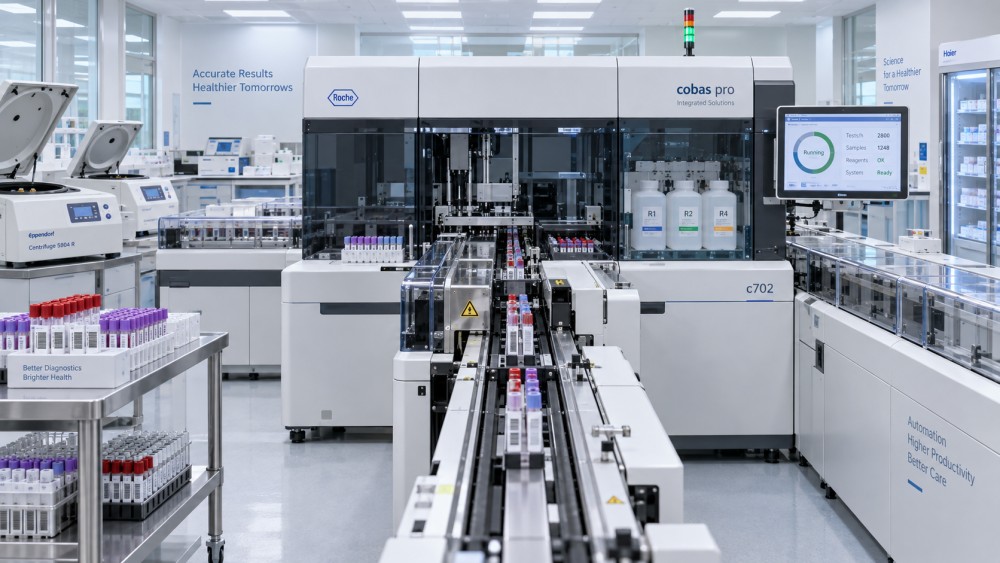
Daily sample volume is useful, but it does not reveal whether biochemistry analyzers for diagnostic labs can manage the laboratory’s busiest operating periods.
A laboratory processing 1,000 samples daily may receive half of them during a two-hour morning collection peak, creating much higher short-term demand.
Assessment teams should request hourly accession data for at least several representative weeks, including normal demand, seasonal peaks, and unusually busy clinical periods.
Separate routine inpatient work, outpatient collections, emergency samples, preoperative testing, health screening programs, and referral samples because their service expectations differ.
Urgent testing affects usable throughput because STAT samples may interrupt routine sequences, require priority loading, or demand faster verification and result release.
Calculate both samples per hour and tests per hour. A single sample may require glucose, liver function, renal function, lipid testing, electrolytes, and enzymes.
Test concentration also matters. If most samples require only two assays, sample handling and loading may become bottlenecks before analytical throughput is reached.
Conversely, a complex test profile can consume many reagent positions, cuvette cycles, dilution steps, and repeat runs even when sample volume appears moderate.
A useful planning formula is peak tests per hour multiplied by expected growth, then divided by realistic analyzer availability rather than nominal uptime.
For example, a peak workload of 500 reportable tests per hour may justify a system rated above 700 tests per hour after operational losses are included.
Understand What Published Throughput Actually Measures
Manufacturer throughput specifications commonly represent idealized continuous operation under defined assay conditions, not the complete laboratory workflow experienced during routine service.
Specifications may exclude sample loading, barcode exceptions, reagent replacement, calibration, quality control, result review, reruns, dilution, maintenance, and laboratory information system delays.
Technical teams should ask suppliers whether the stated rate reflects photometric tests, electrolyte tests, calculated results, or combined analytical modules operating simultaneously.
ISE modules can process electrolytes rapidly, but their performance should not be added blindly to photometric throughput without understanding the supplier’s measurement methodology.
Some platforms quote maximum test throughput with a limited assay menu, optimized reagent placement, and no interruptions from routine quality assurance procedures.
Request throughput data for the laboratory’s expected test mix, including common profiles, high-volume chemistry assays, low-volume specialty assays, and reflex testing rules.
Ask for a demonstration scenario that includes calibration, two levels of quality control, urgent samples, sample reruns, and reagent replacement during active operation.
Measured workflow performance during a realistic evaluation is more valuable than a peak technical specification presented without operational context.
Suppliers should also clarify whether throughput is based on first-result output, final-result output, or raw analytical processing before validation and reporting.
For clinical operations, final verified results are the relevant measure because clinicians cannot act on tests still awaiting review, repeat analysis, or middleware rules.
Use Throughput Ranges That Match Laboratory Scale
Low-volume clinics, small hospitals, and satellite laboratories commonly require compact systems with roughly 200 to 400 photometric tests per hour.
These analyzers may be appropriate where daily demand remains below approximately 300 to 700 samples and service continuity can be supported through contingency arrangements.
Mid-volume hospital laboratories often need 400 to 800 tests per hour, especially when they support inpatient wards, outpatient departments, and emergency services.
This range can suit laboratories processing approximately 700 to 1,500 samples daily, depending on the average number of chemistry tests ordered per sample.
Large acute-care hospitals often evaluate systems rated from 800 to 1,600 tests per hour, frequently combined with automated sample handling and integrated ISE capability.
Such configurations are relevant where morning peaks are intense, turnaround-time commitments are strict, and multiple clinical departments depend on continuous chemistry reporting.
Central laboratories and reference facilities may require 1,600 to 2,000 or more tests per hour, often using connected analyzer lines rather than one instrument.
At this scale, throughput evaluation must include track speed, centrifugation capacity, aliquoting, decapping, sample storage, repeat management, and laboratory information system performance.
Published ranges are planning references, not procurement rules. A lower-rated analyzer may outperform a faster model when it better matches workflow and test distribution.
Measure Sustained Throughput, Not Only Peak Speed
Sustained throughput describes the output a laboratory can maintain across a normal shift while completing required quality procedures and handling expected operational interruptions.
It is usually lower than maximum throughput because laboratories do not run a perfectly balanced, uninterrupted stream of identical tests throughout the day.
Calibration frequency can materially reduce usable capacity, particularly for laboratories with broad test menus, multiple reagent lots, changing assay batches, or strict local protocols.
Quality control requirements also consume analyzer time, reagents, consumables, and staff attention. Their operational impact should be calculated rather than treated as negligible.
Repeat testing may result from flags, hemolysis, lipemia, insufficient volume, dilution requirements, failed quality control, delta checks, or clinically implausible results.
Ask for expected repeat rates under comparable operating conditions and determine whether the analyzer can prioritize reruns without delaying urgent samples.
Maintenance requirements matter equally. Daily cleaning, weekly procedures, probe checks, wash-station maintenance, and periodic replacement tasks reduce available testing time.
Assessors should request a complete maintenance schedule showing operator time, engineer time, system downtime, mandatory consumables, and tasks required before restart.
A platform requiring fifteen minutes of daily maintenance may be manageable in a low-volume laboratory but disruptive during a tightly scheduled hospital morning peak.
Check Whether Sample Handling Limits Analyzer Performance
Analytical speed delivers little value when samples accumulate before reaching the analyzer or wait afterward for manual sorting, verification, or transport.
Manual laboratories should assess barcode reading, rack capacity, continuous sample loading, primary tube compatibility, tube dimensions, sample volume requirements, and clot detection features.
Sample loading capacity becomes important when staff availability is limited. Frequent rack changes may interrupt workflow even when analytical modules remain capable of testing.
Consider how the analyzer manages priority specimens. A useful system can introduce urgent samples quickly without forcing staff to reorganize routine sample queues.
Track-connected systems should be assessed as complete workflows, including conveyor speed, routing logic, sample identification, buffer capacity, and recovery from transport faults.
Pre-analytical delays may be greater than analytical delays in high-volume settings, particularly when centrifugation, decapping, aliquoting, and sorting remain manual.
Post-analytical processes also matter. Automated storage, retrieval, repeat testing, and sample archiving can reduce staff workload while protecting turnaround-time performance.
Technical evaluators should map the full sample journey from accession to result release rather than reviewing the analyzer as an isolated instrument.
Where automation is planned later, confirm that the selected analyzer has compatible interfaces, physical access points, and vendor-supported connectivity options.
Evaluate Reagent Capacity and Assay Menu Constraints
Reagent handling directly affects usable throughput because testing stops or slows whenever high-volume reagents, water, wash solution, cuvettes, or waste containers require attention.
A broad onboard reagent capacity can reduce interventions, but capacity alone is insufficient if reagent cooling, stability, mixing, or loading procedures are inefficient.
Review the laboratory’s highest-volume assays and confirm that enough reagent volume can remain onboard to cover a full peak period without replacement.
Assess whether reagent replacement can occur continuously during testing. Batch replacement procedures may create avoidable delays during heavy routine workload.
Closed reagent systems can simplify workflow and traceability, but they may increase dependency on a single supplier and affect long-term operating costs.
Open systems may offer procurement flexibility, although laboratories must carefully validate assay performance, reagent compatibility, calibration requirements, and quality control procedures.
Test menu breadth is another throughput consideration. Laboratories requiring enzymes, proteins, drugs, special chemistries, or calculated indices need suitable reagent positions and workflow support.
A narrow menu may force samples onto another platform, adding handling time and creating fragmented reporting even when the core analyzer is fast.
During supplier evaluation, request projected reagent consumption, replacement frequency, cold-storage requirements, waste generation, and contingency arrangements for supply disruptions.
Include LIS, Middleware, and Result Verification Time
Biochemistry analyzers for diagnostic labs are most valuable when their results move reliably into laboratory information systems, middleware, electronic records, and clinical reporting workflows.
An analyzer can complete tests rapidly while overall turnaround time remains poor because of interface delays, rejected messages, manual validation, or incomplete patient data.
Technical assessment teams should test bidirectional communication, barcode matching, order download, result transmission, error handling, and recovery following temporary network interruption.
Middleware rules can improve throughput by auto-validating appropriate results, applying delta checks, managing reflex tests, and directing exceptions to qualified staff.
However, poorly configured rules can create queues of held results. Review how the proposed workflow manages flags, critical values, repeat requests, and approval responsibilities.
Ask suppliers to demonstrate reporting during peak testing, including simultaneous result transmission from chemistry, electrolyte, and any connected immunoassay modules.
Integration planning should identify ownership clearly. The laboratory, hospital IT team, middleware provider, analyzer vendor, and LIS supplier may each control different components.
Acceptance testing should include measurable criteria for message accuracy, data completeness, result delivery time, audit trails, and restoration after interface failure.
Plan Capacity for Downtime, Growth, and Service Resilience
Throughput planning should include equipment availability because an analyzer that meets demand only under ideal conditions creates significant operational and clinical risk.
Review historical reliability data where available, including unscheduled downtime, common failure modes, mean repair time, remote support capability, and local engineer coverage.
Service response commitments should be compared with clinical demand. A next-business-day response may be inadequate for laboratories supporting emergency departments and critical care units.
Redundancy does not always require two identical analyzers, but laboratories need a documented contingency route for essential chemistry tests during outages.
Possible options include backup analyzers, connected modules, validated manual methods, referral arrangements, reagent sharing, or service-level agreements with nearby facilities.
Growth forecasts should include new clinical services, hospital bed expansion, outpatient programs, public health campaigns, population changes, and potential referral contracts.
Buying only for current volume may create replacement pressure within several years, particularly when automation infrastructure has been designed around a limited analyzer capacity.
Nevertheless, excessive capacity can increase capital cost, reagent wastage, service expenses, floor-space needs, and operational complexity without improving patient service.
The best procurement decision balances forecast demand, resilience needs, staff capability, total cost of ownership, and realistic workflow performance over the equipment lifecycle.
Questions Technical Teams Should Ask Before Selection
Before final selection, ask suppliers to state expected sustained throughput using the laboratory’s own test mix, quality control plan, sample arrival profile, and urgent testing requirements.
Request a complete workflow timing model covering sample loading, first-result time, routine result completion, reruns, calibration, maintenance, reagent changes, and verification.
Confirm whether the proposed configuration includes required modules, automation interfaces, backup arrangements, water treatment equipment, uninterrupted power protection, and installation support.
Compare total operating costs alongside throughput, including reagents, calibrators, controls, consumables, service contracts, spare parts, connectivity, training, and waste handling.
Reference-site visits can provide useful evidence when the visited laboratory has comparable daily volume, staffing patterns, test menus, automation level, and clinical urgency.
Acceptance criteria should be written before purchase. They should define test accuracy, precision, uptime, throughput, turnaround time, interface performance, and staff competency requirements.
Clear criteria protect both the laboratory and supplier by ensuring that performance is assessed using agreed operational conditions rather than vague expectations after installation.
Conclusion: Choose Capacity That Supports the Entire Workflow
Diagnostic laboratories should expect throughput from biochemistry analyzers to vary widely, from roughly 200 tests per hour in compact settings to over 2,000 in centralized facilities.
Yet the published number is only a starting point. Useful capacity depends on test mix, peak arrivals, sample handling, quality procedures, reagent management, downtime, and reporting integration.
For technical assessment teams, the strongest decision is based on sustained performance during realistic operations, with enough reserve capacity for growth, disruptions, and urgent clinical demand.
When evaluating biochemistry analyzers for diagnostic labs, prioritize demonstrated workflow output and service resilience over headline speed alone. That approach supports reliable reporting, controlled operating costs, and scalable laboratory performance.