
How to verify that ECG electrodes are genuinely CE certified
A CE mark on a pouch of ECG electrodes is not, by itself, evidence that the product is legally placed on the EU market. The meaningful question is whether the exact electrode—under the stated manufacturer name, catalogue number, intended purpose, and packaging configuration—is covered by a valid EU Declaration of Conformity and the conformity-assessment route required by Regulation (EU) 2017/745, the Medical Device Regulation (MDR).
This distinction matters because ECG electrodes are frequently sourced as relatively low-cost consumables, while their failure modes are clinical rather than merely commercial. Poor adhesion, unstable impedance, skin irritation, dried gel, incorrect connector compatibility, or misleading claims about use duration can affect signal quality and patient safety. A document labeled “CE certificate” may be irrelevant, expired, issued for another legal entity, or unnecessary for the device classification claimed. Verification must therefore link the physical product to the legal and technical evidence behind its CE marking.
Start with the device identity, not the CE logo
Before reviewing certificates or declarations, establish exactly what is being offered. “ECG electrode” is not a sufficiently precise product identity for compliance review. The verification file should identify the product in terms that can be matched across packaging, labeling, the Declaration of Conformity (DoC), invoices, and supplier records.
At minimum, record the manufacturer’s legal name and address, trade name, catalogue or reference number, electrode type, intended use, patient-contact duration, whether the electrode is disposable or reusable, connector type, gel type, package size, lot number format, and any claimed special feature. Relevant claims may include paediatric use, long-term monitoring, radiolucency, MRI-related statements, defibrillation recovery, foam or textile backing, or use in stress testing and ambulatory monitoring.
A common control failure occurs when a supplier provides a valid-looking declaration for “disposable ECG electrodes” but ships a different model, a modified gel formulation, a different packaging material, or a private-label product manufactured by another entity. The legal manufacturer named on the DoC must be the entity that takes responsibility for the device, even if production is subcontracted.
The product’s intended purpose is especially important. An electrode designed for short diagnostic ECG recording may not support the same claims as an electrode marketed for continuous monitoring, neonatal use, or prolonged skin contact. The conformity assessment, risk analysis, biological evaluation, performance substantiation, and instructions for use should be consistent with the intended purpose actually stated in sales material and labeling.
Understand what “CE certified” can and cannot mean
Under the MDR, the legally significant outcome is CE marking supported by a manufacturer’s EU Declaration of Conformity. The phrase “CE certified” is often used loosely in commercial communication, but it can create the mistaken impression that every medical device has received a certificate from a Notified Body.
That is not how the system works. Some medical devices may be self-declared by their manufacturer, while others require assessment by an EU-designated Notified Body. Whether Notified Body involvement is required depends on the device classification and applicable MDR rules, not on a buyer’s preference for a third-party certificate.
For an ECG electrode, classification cannot be inferred solely from its appearance or from the fact that it contacts intact skin. Its role as an accessory, the active medical device with which it is intended to be used, the duration and nature of contact, and the manufacturer’s intended purpose all affect the regulatory assessment. A supplier that simply states “Class I” without a clear classification rationale should not be treated as providing a complete compliance answer.
If the product is legitimately within a route that does not require Notified Body intervention, the absence of a Notified Body certificate is not evidence of non-compliance. Conversely, if the claimed product route requires Notified Body involvement, a generic ISO certificate or an unverified “CE certificate” is not an acceptable substitute.
The practical control point is simple: ask the manufacturer to state the MDR classification, the classification rule relied upon, and whether a Notified Body was involved in conformity assessment. The response should be consistent with the DoC and the device’s actual claims.
The EU Declaration of Conformity is the primary document to examine
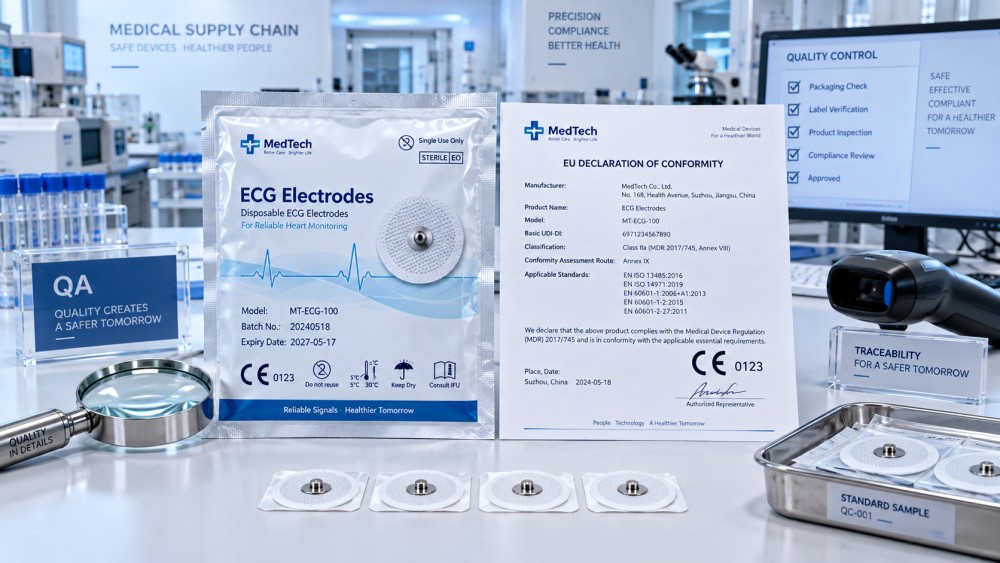
A genuine DoC is not a marketing certificate. It is a formal statement by the manufacturer that the device meets applicable EU requirements. Under MDR Annex IV, it should contain information that enables a purchaser or distributor to identify the responsible manufacturer, the device covered, the applicable legislation, the conformity-assessment route, and the person authorized to sign on the manufacturer’s behalf.
For ECG electrodes CE marked under the MDR, a review should look for the following points:
- The manufacturer’s legal name and registered address match the product label and commercial documentation.
- The document identifies the electrode model or family clearly enough to establish coverage of the supplied SKU.
- The declaration refers to Regulation (EU) 2017/745, rather than relying only on the former Medical Devices Directive, 93/42/EEC.
- The stated intended purpose is compatible with the use being promoted and purchased.
- The declaration identifies any applicable Notified Body, certificate number, and certificate details where a Notified Body is required.
- The document is dated, signed, and signed by a person authorized to represent the manufacturer.
- The referenced standards, where listed, are relevant to the product rather than copied from an unrelated device dossier.
A DoC can cover a product family, but a family declaration must still make the relationship between the listed products and the delivered electrodes intelligible. Broad wording such as “medical consumables” or “patient monitoring accessories” is weak evidence when no model numbers, product codes, or traceable family identifiers are provided.
Older documentation requires particular care. MDR transitional provisions can allow certain legacy devices to remain on the market under defined conditions, but transitional eligibility is not established by presenting an old directive-era certificate alone. The supplier should be able to explain the regulatory basis for continued placement on the market, confirm that applicable MDR conditions are met, and show that the exact product remains within the scope of the relevant legacy documentation.
Match the declaration against the label and packaging
Document review becomes reliable only when it is tied back to the goods. Inspect a sample from the actual shipment or pre-shipment production batch, not only a supplier’s artwork file.
The label should identify the legal manufacturer. Where the manufacturer is outside the European Union, the EU authorized representative should also be identified as required. Importer details must be provided in accordance with MDR obligations, generally on the device, packaging, or accompanying documentation. The CE mark should be visible, legible, and indelible where applicable. If a Notified Body has participated in the conformity assessment that requires its identification next to the CE marking, the four-digit Notified Body number should appear with the CE mark.
Absence of a four-digit number is not automatically a defect for a device that has been self-declared under an appropriate route. However, a mismatch creates a clear escalation point: a DoC naming a Notified Body while packaging shows no associated number, or packaging showing a Notified Body number that is absent from the DoC, requires explanation before release.
Other labeling information is equally useful for detecting inconsistencies. Check the catalogue number, lot or batch identifier, expiry date where relevant, single-use symbol, storage conditions, warnings, and instructions. If the packaging calls the product “single use” but a catalogue or website promotes repeated application, the inconsistency is not merely editorial. It may indicate that the manufacturer’s intended use, validation evidence, and risk controls have not been aligned.
Language requirements also matter. Instructions, warnings, and labeling must be provided in the language or languages required by the Member State where the device is made available. English-only packaging may not be sufficient for every EU destination market.
How to verify a Notified Body claim
Where a supplier claims Notified Body certification, verify both the organization and the scope. A four-digit number is not proof by itself. Notified Bodies are designated for specific EU legislation and scopes, and their designation can be checked through the European Commission’s NANDO information system.
The review should confirm that the named organization is a Notified Body under the MDR, not merely an inspection company, laboratory, or certification body operating under another scheme. It should also confirm that the number belongs to the organization named in the documentation.
Then examine the certificate more closely. The legal manufacturer on the certificate must match the manufacturer on the DoC and label. The certificate scope must reasonably cover the relevant electrode or device family. The certificate should not be expired, withdrawn, superseded, or limited to a quality management system with no demonstrated link to the specific product. A certificate for ISO 13485, for example, can support confidence that a quality management system has been assessed, but ISO 13485 certification is not an MDR CE certificate and does not independently authorize CE marking.
Where doubt remains, the most dependable approach is confirmation with the issuing Notified Body using its official contact channel. The inquiry should identify the certificate number, manufacturer legal entity, and product family. A purchaser should not rely on email addresses or web links supplied only in a PDF certificate, because fraudulent documents can direct verification requests to false contacts.
Do not confuse test reports with regulatory conformity
ECG electrode suppliers often provide laboratory reports, material declarations, biocompatibility summaries, or test statements. These documents can be useful, but they answer narrower questions than the DoC.
For skin-contacting electrodes, biological safety evaluation is central. EN ISO 10993-1 provides a framework for evaluating biological safety based on the nature and duration of body contact, supported where necessary by appropriate endpoint testing or justified material evidence. A report on one adhesive, foam, hydrogel, or conductive gel does not automatically cover a modified formulation, a new pigment, a revised release liner, or a different patient-contact duration.
Performance evidence should also reflect the intended use. Electrical performance, impedance stability, adhesion, motion tolerance, connector integrity, packaging integrity, storage life, and compatibility with the intended ECG system can all be relevant. The applicable standards and test methods depend on the product’s claims and the system context. A list of standards without reports, revision details, device identification, or applicability rationale has limited value.
Technical documentation is generally not public, and a manufacturer is not expected to hand over its complete MDR file to every commercial counterparty. That does not prevent meaningful review. A controlled supplier questionnaire, redacted test summaries, a classification rationale, a declaration of material and process change control, and documented confirmation of model coverage can provide stronger assurance than a folder of unrelated certificates.
Traceability is what turns document review into a quality control process
A one-time CE document check is insufficient if later shipments can change without notice. ECG electrodes are sensitive to raw-material consistency, gel chemistry, pouch sealing, humidity exposure, and storage conditions. The compliance file should therefore be linked to the supplier approval process and incoming inspection controls.
Maintain a record of the approved manufacturer, authorized representative, product references, DoC revision, certificate details where applicable, labeling artwork version, and documents reviewed. Incoming checks should confirm that the delivered product identity and labeling remain consistent with the approved file. Any change in manufacturer name, production site, electrode material, adhesive, gel, packaging, intended use, shelf life, product reference, or CE documentation should trigger reassessment.
Batch traceability deserves particular attention. Lots should be identifiable through the purchase order, delivery record, and the packaging actually received. Where products are imported or distributed, preserve evidence of supplier verification and traceability in a form that can support investigation, complaint handling, field safety corrective action, or authority inquiry.
Warning signs that merit escalation
Several patterns justify holding the product pending clarification: a CE logo with no identifiable legal manufacturer; a DoC that names a trading company while packaging names another entity; a certificate issued under a different regulatory framework but presented as MDR proof; a Notified Body number that cannot be matched through official sources; broad product descriptions with no SKU linkage; altered PDFs with inconsistent fonts, dates, or logos; and claims such as “100% CE approved” without a declaration or classification basis.
Another warning sign is an excessive focus on certificates while basic product controls are absent. A supplier unable to state lot identification, expiry conditions, storage limits, or whether an electrode is intended for diagnostic versus monitoring use has not provided evidence that the product is adequately controlled for clinical distribution.
Genuine verification of ECG electrodes is therefore less about locating a single document than establishing an evidence chain: the supplied item matches the label; the label matches the manufacturer and intended purpose; the Declaration of Conformity covers that exact device; and any Notified Body involvement is real, relevant, and current. When that chain cannot be demonstrated, the CE claim should be treated as unsubstantiated rather than assumed to be valid.
Have questions about the global trade trends discussed here, or planning your expansion and supply chain strategy? Leave a message below and let the trade experts at MTHH guide you.
We respect your privacy. Your information is strictly confidential.
Related News
- Hong Kong Outlines Medical Device Legislation and Plans for Statutory RegulatorNov 14, 2026Hong Kong medical device legislation could reshape regulatory oversight. Explore the proposed regulator and what businesses should monitor.
- AAMI Issues TIR115 Guidance on Public Cloud Use in Medical DevicesNov 13, 2026AAMI TIR115:2026 guides public cloud use in medical devices. Explore its focus on risk management, supplier assessment and device boundaries.
- How are critical care devices regulated in the United States?Nov 12, 2026Critical care devices face FDA requirements based on intended use and risk. Explore classifications, marketing pathways, and practical compliance checks.
- Hong Kong Drafts Medical Device Bill to Establish Statutory OversightNov 12, 2026Hong Kong's Medical Devices Bill could introduce risk-based statutory oversight. Discover what the proposed framework may mean for suppliers.