
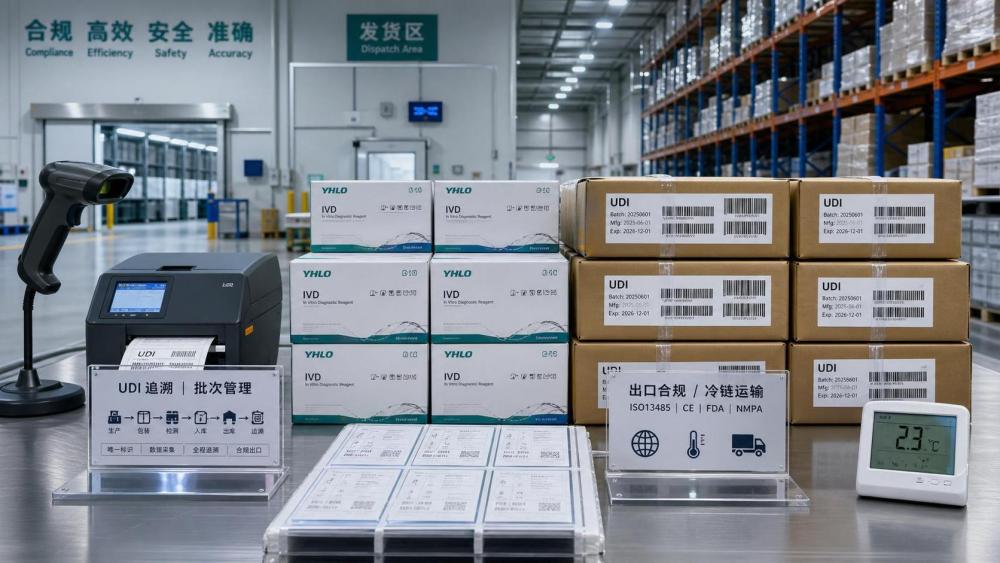
On July 8, 2026, the FDA updated its IVD Export Traceability Guidance and set an immediate requirement for Chinese manufacturers exporting IVD reagents to the United States: batch-level UDI data must be connected and real-time traceability information must be submitted through the FDA Gateway. For exporters, distributors, procurement teams, and supply chain operators, this is not a routine documentation update. It directly affects export compliance, customs timing, distributor access, and the continuity of product delivery into the U.S. market.
A rule change with immediate export implications
The confirmed facts are limited but clear. The FDA updated the IVD Export Traceability Guidance on July 8, 2026. Under the updated guidance, all Chinese manufacturers exporting IVD reagents to the United States are required, effective immediately, to complete batch-level UDI data integration. They must also submit real-time batch traceability information through the FDA Gateway. According to the provided event summary, this requirement directly affects export compliance, customs clearance efficiency, and distributor qualification, and companies that do not meet the requirement may face import suspension risk.
Where the pressure will appear first in the trade chain
Export operations will be judged on data readiness, not only product shipment
From an industry perspective, exporters are likely to feel the impact first because shipment eligibility is now tied more closely to traceability connectivity at the batch level. The operational pressure is not limited to physical goods leaving the factory. It extends to whether batch data can be connected in time and whether submission through the FDA Gateway supports the shipment process without interruption. What deserves closer attention is that compliance here appears to move closer to an execution requirement rather than a background recordkeeping exercise.
Distributors may face tighter entry screening
For channel and distribution businesses, the stated impact on distributor qualification means access to product supply may depend more heavily on whether upstream manufacturers can maintain compliant traceability submissions. Analysis shows that distributor onboarding, product continuation, and commercial access may all become more sensitive to the quality and timeliness of batch-level traceability records, even where the distributor is not the party building the UDI system connection itself.
Procurement and delivery schedules may become more exposed to compliance delays
Procurement teams and downstream buyers should pay attention to the risk that customs timing and delivery predictability may be affected when required batch traceability information is incomplete or not transmitted as required. Observably, this shifts part of the delivery risk from logistics execution to compliance data execution. In practical terms, supplier qualification reviews, delivery planning, and order timing may need to account for traceability readiness as part of normal supply assurance.
Supply chain service providers may need closer document and status coordination
For supply chain service providers supporting export movement, the update raises the importance of coordination around traceability status, submission timing, and shipment documentation consistency. The event summary does not provide detailed process steps, so it would be premature to assume a fixed operational model. Even so, the stated link to customs efficiency suggests that service providers will need tighter visibility into whether the manufacturer's batch data connection and FDA Gateway submission status are aligned with shipment release plans.
What companies should review now
Check whether batch-level UDI connectivity is operational in practice
Analysis shows that the immediate issue is not whether a company recognizes the UDI requirement in principle, but whether batch-level data access has actually been completed and can support real-time submission. Companies exporting IVD reagents to the United States should closely review whether internal traceability records, batch identifiers, and submission workflows are aligned with the updated requirement described in the event summary.
Review trade documents and compliance handoffs around shipment release
What deserves closer attention is the handoff between compliance functions and export operations. Because the update is described as affecting customs timing and import continuity, businesses should review whether shipment-facing teams have a clear process for confirming that required traceability information has been prepared and submitted before export milestones are reached. The available facts do not define a full document checklist, so this remains a monitoring point rather than a confirmed procedural conclusion.
Reassess distributor and customer communications
Observably, the stated effect on distributor qualification means companies may need to communicate more clearly with channel partners and customers about compliance status, submission readiness, and any potential delivery disruption. This is especially relevant where market access depends not only on product availability but also on confidence that the manufacturer's traceability obligations are being met in real time.
Track follow-up language and execution signals
The event summary establishes the rule change, but it does not provide detailed implementation language beyond the immediate requirement. It is more appropriate to understand this as a point that requires active follow-up: companies should continue watching for official clarifications, practical enforcement signals, evolving compliance interpretation, and any related changes in procurement requirements or downstream commercial documentation.
Why this reads as an execution signal
Analysis shows that this update is better understood as more than a general policy reminder. The combination of immediate effect, batch-level UDI integration, real-time FDA Gateway submission, and stated import suspension risk gives it the character of an execution-facing compliance signal. At the same time, the input does not provide detailed enforcement scenarios, technical specifications, or transition arrangements. For that reason, the market should avoid over-interpreting operational details that have not been confirmed, while still treating the requirement itself as active and material.
How the market may need to interpret this update
From an industry perspective, the most reasonable reading is that traceability has moved closer to a practical gate for IVD export continuity into the U.S. market for affected Chinese manufacturers. The immediate significance lies in compliance readiness, shipment timing, and channel access rather than in broad market forecasting. It is more appropriate to understand this development as a rule already in force at the requirement level, while the finer points of execution and market response still need continued observation.
Basis of this article and what still needs verification
This article is based on the user-provided news title, event date, and event summary. For developments of this kind, relevant source categories typically include official regulatory notices, releases from supervisory authorities, customs or trade administration updates, industry association communications, standard-setting documents, and reporting by authoritative trade media. No specific official source link was provided in the input, so the precise official publication path still needs ongoing verification. Further observation is also needed on detailed implementation language, compliance interpretation, procurement document changes, distributor-side execution, industry feedback, and how affected companies complete operational rollout.